Glass Frog
Glass frogs communicate primarily through vocalizations. To initiate the mating process, males sit on leaves—either on the top or the underside, depending on…
How do glass frogs communicate with each other?
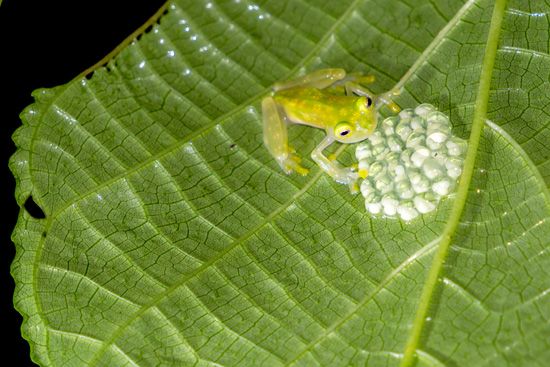
Glass frogs communicate primarily through vocalizations. To initiate the mating process, males sit on leaves—either on the top or the underside, depending on the specific species—positioned over streams or lake edges to call to females.1
Once a female arrives, the pair engages in a physical mating position known as amplexus, where the male clasps the female’s back with his arms wrapped around her waist. After the female deposits her eggs on the leaf and departs, the male often remains at the site. In addition to protecting the eggs from predators, he continues to call to attract additional females, which can result in him guarding multiple egg clutches in various stages of development.1
Where are glass frogs typically found in the wild, and what is their preferred habitat?
Glass frogs (family Centrolenidae) are native to the New World tropics. Their habitat is primarily arboreal, as they possess expanded digit tips that allow them to live in trees and shrubs.1
These frogs are typically found in environments ranging from tropical lowland forests to mid-elevation mountain forests. A defining feature of their preferred habitat is the presence of water sources, as they specifically inhabit vegetation located along forest streams or lake edges. This proximity to water is essential for their reproductive cycle, as it allows the tadpoles to drop into the water once they hatch from eggs deposited on overhanging leaves.1
What are the main predators of glass frogs, and how do they defend themselves?
Glass frogs face various threats in their natural environment, particularly during their vulnerable egg stage. A primary predator of these egg masses is the “frog fly,” which deposits its own eggs directly onto the frog’s clutch. Once these fly eggs hatch, the resulting maggots consume the developing frog embryos.1
To defend against these and other threats, glass frogs employ several strategies:
- Parental Care: After mating, the male often remains at the site to guard the eggs from predators, allowing him to protect multiple clutches simultaneously.1
- Edge Diffusion: The frogs utilize a form of camouflage known as edge diffusion. By having translucent skin, the edges of the frog soften, allowing them to blend seamlessly into the brightness or darkness of their surroundings.1
- Visual Mimicry: Some species feature white or yellow spots on their skin that mimic the appearance of glass frog egg masses, which may help them avoid detection or confuse potential threats.1
Are glass frogs considered endangered, and what conservation efforts are in place to protect them?
Sorry, the Britannica knowledge base does not contain information regarding the current conservation status of glass frogs or specific efforts in place to protect them. The provided search results focus on the biology, habitat, and reproductive behaviors of the family Centrolenidae, as well as the threats facing the unrelated goliath frog.31
Sources
- glass frog — Encyclopædia Britannica
- tree frog — Encyclopædia Britannica
- goliath frog: Top Questions — Encyclopædia Britannica
Published on · 2 min read