Hellbender
The hellbender (Cryptobranchus alleganiensis) is a nocturnal predator that emerges from beneath stones at night to feed primarily on crayfish, small fishes…
What do hellbender salamanders eat, and how do they hunt for their prey?
The hellbender (Cryptobranchus alleganiensis) is a nocturnal predator that emerges from beneath stones at night to feed primarily on crayfish, small fishes, and worms.1
As an aquatic salamander, the hellbender utilizes a specific hunting technique common to many species in its environment. Rather than actively foraging or using a projectile tongue, these salamanders employ a lunge-and-suction method. They lunge at their prey with an open mouth, rapidly expanding their buccal (oral) cavity to create suction that draws the victim inside.2
While many amphibians rely heavily on sight to locate food, the hellbender’s nocturnal habits and aquatic environment suggest a specialized approach to detecting prey in the dark, swift-flowing streams they inhabit.12
What are the unique physical characteristics of hellbender salamanders?
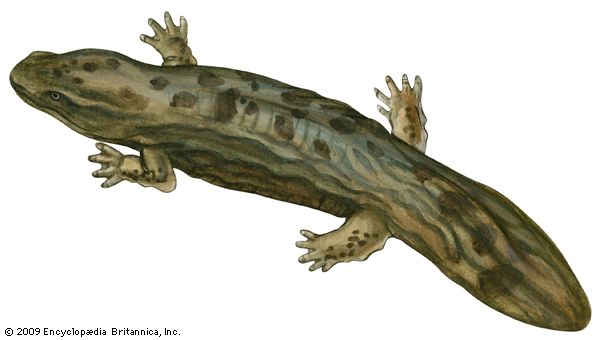
The hellbender (Cryptobranchus alleganiensis) is a distinctively adapted salamander characterized by several unique physical traits that support its life in swift-flowing streams.1
Physical Characteristics
- Size and Shape: Adults are stout-bodied and flat-headed, typically reaching lengths of 30–74 cm (12–29 inches).1
- Skin and Respiration: A defining feature is the presence of conspicuous, wrinkled fleshy folds along the body and legs. These folds significantly increase the surface area of the skin, which serves as the animal’s primary organ for oxygen intake.1
- Coloration: They are generally brownish-gray in color, often marked with black spots.1
- Anatomy: They possess a broad tail fin, which aids in their aquatic movement. While adults have functional lungs, they also retain a gill slit on each side behind the head, a vestige from their larval stage.1
The Ozark hellbender subspecies is noted for being slightly smaller than the standard hellbender, with its spots appearing as larger, distinct blotches.1
How large can hellbender salamanders grow, and how does this compare to other salamander species?
The hellbender (Cryptobranchus alleganiensis) is a large salamander that typically grows to lengths of 30–74 cm (12–29 inches).1
When compared to other members of the order Caudata, the hellbender is considered a very large species, though it is significantly smaller than its closest relatives in the family Cryptobranchidae. For instance, the Chinese giant salamander (Andrias sligoi) can reach lengths of up to 2 metres (6.6 feet), and the Japanese giant salamander can grow up to 1.7 metres (5.6 feet).4
In contrast, most other salamander species are much smaller. The average salamander is generally 10 to 15 cm (4 to 6 inches) long, with many families—such as the mole salamanders or lungless salamanders—rarely exceeding 30–35 cm in length. While some other aquatic groups like sirens and congo eels can reach lengths of 100 cm or more, the hellbender remains one of the most substantial amphibians in its native North American range.34
Where are hellbender salamanders typically found in the wild?
Hellbender salamanders (Cryptobranchus alleganiensis) are primarily found in the larger, swift-flowing streams of the eastern and central United States. Key habitats include the Ohio River system and the Susquehanna River.1
A specific subspecies, the Ozark hellbender (C. alleganiensis bishopi), is found in the Black River system, which spans parts of Arkansas and Missouri. Within these aquatic environments, they typically spend their daylight hours hiding beneath stones on the stream bottom.1
Sources
- hellbender — Encyclopædia Britannica
- amphibian - Food and feeding — Encyclopædia Britannica
- salamander — Encyclopædia Britannica
- Caudata - Annotated classification — Encyclopædia Britannica
Published on · 2 min read