Gloriosa
Gloriosa is a genus of tuberous-rooted plants in the family Colchicaceae, native to tropical regions of Africa and Asia. Commonly known as climbing lilies or…
What is Gloriosa?
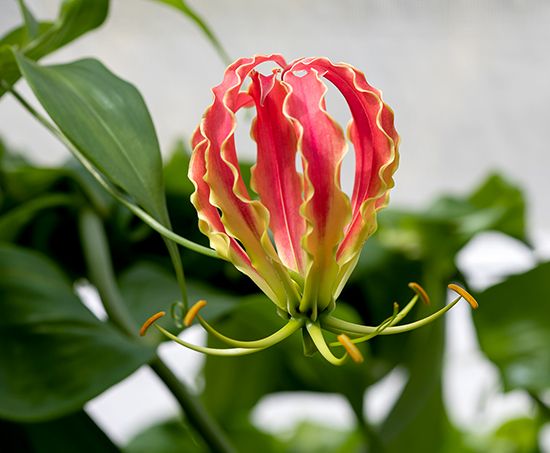
Gloriosa is a genus of tuberous-rooted plants in the family Colchicaceae, native to tropical regions of Africa and Asia. Commonly known as climbing lilies or glory-lilies, these plants feature slender, vinelike stems, lance-shaped leaves, and vibrant flowers in shades of red, yellow, or purple.12
It is important to note that while they are often grouped with other plants called “lilies,” they are distinct from true lilies (Lilium species) and daylilies (Hemerocallis species), which are known to cause acute kidney failure in cats. However, the flame lily (Gloriosa superba) is still dangerous, as it contains colchicine. This toxin disrupts cell division and can lead to severe multi-organ failure if ingested.3
Additionally, the term is sometimes associated with the “gloriosa daisy,” which is a tetraploid cultivar of the black-eyed Susan (Rudbeckia hirta) known for its large, colorful flowers.4
What is colchicine and how does it affect the body?
Colchicine is a poisonous alkaloid derived from the autumn crocus (Colchicum autumnale). It is primarily utilized as a drug to treat gout, a condition marked by painful inflammation caused by uric acid deposits in the joints and tissues.56
Regarding its physiological effects, colchicine functions by inhibiting mitosis—the process of cell division—which is also why it is used in botanical research to induce polyploidy in plants. While its exact mechanism for relieving gout pain remains unknown, its use is associated with significant side effects, including diarrhea and other gastrointestinal disturbances. Because it is a potent toxin, it must be handled and administered with extreme caution to avoid systemic toxicity.65
How do climbing plants like the flame lily use tendrils to grow?
Climbing plants, such as the flame lily (Gloriosa superba), utilize specialized organs called tendrils to anchor themselves and climb toward light and support. These structures are highly sensitive to contact, a response known as thigmotropism.78
In the case of the flame lily, the leaf tip of the blade elongates into a threadlike tendril. When this tendril brushes against a solid object, it curves toward the contact point and wraps around it, clinging firmly as long as the stimulation persists. While tendrils often begin as slender, flexible strands, they eventually develop strong mechanical tissue called sclerenchyma, which provides the necessary strength to support the weight of the growing plant.79
Depending on the species, these climbing aids can be modified leaves, leaflets, leaf tips, or even modified stem branches. Some tendrils may also feature terminal enlargements that secrete an adhesive to cement the plant to a substrate, ensuring a secure hold as the plant continues its upward growth.79
What are some other common garden plants that are toxic to pets?
Many common garden plants can pose significant risks to pets if ingested. While true lilies (Lilium species) and daylilies are notoriously dangerous to cats due to their potential to cause acute kidney failure, other popular plants also contain harmful toxins.3
Here are some examples of garden plants that are toxic to pets:
- Lily of the valley: This plant contains cardiac toxins that can lead to irregular heartbeats in animals.3
- Flame lily: It contains colchicine, a substance that disrupts cell division and can result in multi-organ failure.3
- Peace lily: These plants contain calcium oxalate crystals, which form needle-shaped raphides. Ingestion can cause a burning sensation in the mouth and tongue, difficulty swallowing, and nausea in both humans and pets.12
Because the severity of these reactions can range from mild irritation to fatal organ failure, it is essential to research the toxicity of any plant before introducing it to a home or garden where pets are present.312
Sources
- Gloriosa — Encyclopædia Britannica
- gloriosa — Merriam-Webster
- Why Are Lilies Toxic to Cats? — Encyclopædia Britannica
- gloriosa daisy — Merriam-Webster
- colchicine — Encyclopædia Britannica
- colchicine — Merriam-Webster
- tendril — Encyclopædia Britannica
- angiosperm - Leaf modifications — Encyclopædia Britannica
- angiosperm - Shoot system modifications — Encyclopædia Britannica
- Did you know? — Merriam-Webster
- Locomotion - Climbing — Encyclopædia Britannica
- peace lily — Encyclopædia Britannica
Published on · 3 min read