Hechtia
Hechtia is a genus of approximately 35 species of semidesert plants belonging to the pineapple family (Bromeliaceae). These plants are primarily native to…
What is Hechtia?
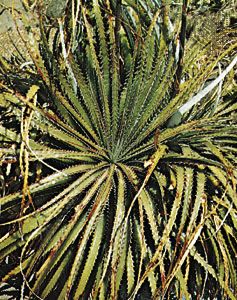
Hechtia is a genus of approximately 35 species of semidesert plants belonging to the pineapple family (Bromeliaceae). These plants are primarily native to the New World, particularly Mexico, and are characterized by their growth in dense rosettes of spiny-edged leaves that appear purplish on the top and silvery underneath.12
While they produce inconspicuous white flowers in small, stalked clusters, some species are valued as indoor ornamentals for their unique foliage and floral bracts. The genus was named in honor of the 19th-century Prussian counselor J.G.H. Hecht.12
What are the main characteristics of the Bromeliaceae family?
The Bromeliaceae family, commonly known as the pineapple family, comprises approximately 3,000 species across 56 genera of herbaceous evergreen perennials. These flowering plants are primarily native to the tropical New World and the West Indies.34
Key characteristics include:
- Growth Habit: Many species are epiphytes that grow on trees or cacti for support, though others are terrestrial. Some, known as tank bromeliads, form water-collecting rosettes that serve as vital habitats for various animals.45
- Foliage: They feature simple, spirally arranged leaves.4
- Flowers: The flowers typically have three parts with contrasting sepals and petals, often appearing in spikes surrounded by distinctive, brightly colored bracts.4
- Reproduction: Most produce fleshy fruit, while others develop dry capsules.4
- Specialization: A few species, such as Brocchinia reducta, have evolved to be carnivorous evolved to be carnivorous.4
Economically, the family is best known for the pineapple and Spanish moss, as well as various ornamental species.4
How do desert plants adapt to survive in arid environments?
Plants adapted to arid environments, known as xerophytes, have evolved various structural and physiological mechanisms to prevent water loss and store moisture.
Water Storage and Physical Adaptations
Many desert plants are succulents, possessing thick, fleshy tissues designed to store water. Depending on the species, this water is held in either the stems (as seen in cacti) or the leaves (as seen in agaves). To further minimize water loss, these plants may feature:
- Waxy leaf coatings.
- Dense, hairy leaf coverings.
- The ability to fold or reposition leaves to reduce sunlight absorption.
- The capacity to drop leaves entirely during extreme dry periods.67
Physiological Adaptations
A critical adaptation for many desert plants is crassulacean acid metabolism (CAM). Unlike most plants, CAM species keep their stomata closed during the hot, dry day to prevent transpiration. Instead, they open their stomata at night to take in carbon dioxide, which is then stored as organic acid for use in photosynthesis during the following day.789
What are some other types of bromeliads grown as houseplants?
Beyond the well-known pineapple, many members of the Bromeliaceae family are popular houseplants, prized for their striking foliage and long-lasting, colorful flower spikes.131415
Commonly cultivated genera include:
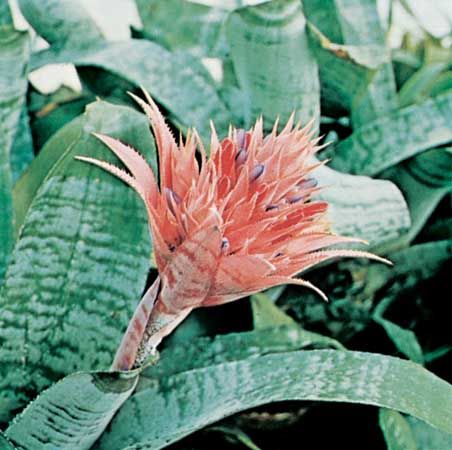
- Aechmea: Known for their spiny-edged leaves and showy spikes of red and yellow flowers.134
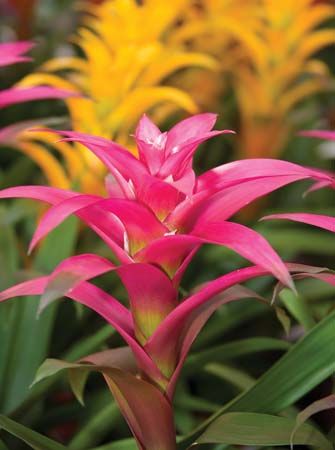
- Guzmania: These feature stiff, rosette-forming leaves and clusters of yellow or white flowers surrounded by vibrant bracts.1316
- Neoregelia: Often grown for their mottled or banded leaves; their flowers are typically tucked deep within a central cup that may turn brilliant crimson during the flowering period.1317
- Vriesea: Distinguished by their stiff, sword-shaped leaves and flattened, spear-like flower spikes.1318
- Billbergia: These have a distinct tubular shape, often producing pendant flower stalks with blue blossoms.13
- Cryptanthus: Known as “earth stars,” these terrestrial bromeliads grow in flattened rosettes with intricate, tiger-banded or striped leaf patterns.13
- Tillandsia: Often sold as “air plants,” these are frequently kept as novelties due to their ability to thrive without traditional soil.14
Sources
- Hechtia — Encyclopædia Britannica
- Hechtia — Merriam-Webster
- list of plants in the family Bromeliaceae — Encyclopædia Britannica
- Bromeliaceae — Encyclopædia Britannica
- epiphyte — Encyclopædia Britannica
- xerophyte — Encyclopædia Britannica
- succulent — Encyclopædia Britannica
- Desert - Flora — Encyclopædia Britannica
- photosynthesis - Carbon fixation via crassulacean acid metabolism (CAM) — Encyclopædia Britannica
- angiosperm - Root systems — Encyclopædia Britannica
- plant - Specific variations in photosynthesis — Encyclopædia Britannica
- tree - Tree roots — Encyclopædia Britannica
- houseplant - Foliage plants — Encyclopædia Britannica
- Neoregelia — Encyclopædia Britannica
- Vriesea — Encyclopædia Britannica
- Guzmania — Encyclopædia Britannica
- houseplant — Encyclopædia Britannica
- Aechmea — Encyclopædia Britannica
Published on · 3 min read