Curly Mesquite
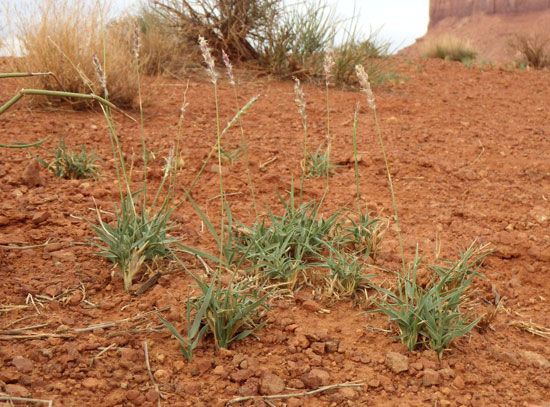
Curly mesquite refers to a valuable creeping pasture grass (Hilaria belangeri) native to the southwestern United States and other warm, dry regions of North…
What is curly mesquite?
Curly mesquite refers to a valuable creeping pasture grass (Hilaria belangeri) native to the southwestern United States and other warm, dry regions of North America. It belongs to the Poaceae family, which includes approximately 10 species within the genus Hilaria.12
These grasses are significant as range plants, particularly because they are highly palatable to livestock when they are fresh and green1. Depending on the specific species, curly mesquites can be annuals or perennials and often grow in tufts. Many species feature rhizomes or stolons, which allow them to act as effective soil binders. Their branched inflorescences produce reduced flower spikelets and grains that may or may not have hairy awns.1
What are rhizomes and stolons?
Rhizomes and stolons are specialized plant structures that facilitate vegetative reproduction, allowing plants to propagate asexually and survive unfavorable conditions.345
Rhizomes
A rhizome is a horizontal, usually subterranean stem that grows within or upon the soil. Unlike roots, rhizomes possess nodes with reduced scale leaves and internodes. Their primary functions include:354
- Food Storage: They store starches and proteins, helping the plant survive periods of drought or extended winters.34
- Propagation: As they branch and spread, they send up new shoots from their nodes, allowing the plant to colonize an area.45
- Examples: Many grasses, bamboos, ginger, and turmeric rely on rhizomes for growth and reproduction.34
Stolons
A stolon, also known as a runner, is a slender, horizontal stem that typically grows above the soil surface. Key characteristics include:645
- Growth: Stolons grow horizontally and develop roots and new vertical shoots at specialized points called nodes.64
- Propagation: When these nodes make contact with moist soil, they can develop into new, independent plantlets.45
- Examples: The strawberry is a well-known example of a plant that uses stolons to spread and reproduce.45
How do grasses help prevent soil erosion?
Grasses play a critical role in preventing soil erosion by acting as a protective barrier against the forces of wind and water. Their effectiveness is primarily due to their extensive root systems, which help to anchor the soil in place, making it significantly more resistant to being dislodged or transported.8
The mechanisms by which grasses mitigate erosion include:
- Anchoring Soil: The dense, fibrous root systems of grasses stabilize the ground, preventing the soil from being easily stripped away by surface runoff or lifted by strong winds.8
- Reducing Wind Impact: By providing vegetative cover, grasses break the wind’s force at the surface, reducing its ability to lift and transport loose soil particles—a process that is particularly vital in arid regions to prevent the formation of bare soil or desert pavements.8
- Mitigating Water Erosion: Grasses help minimize the impact of rainfall by breaking the force of raindrops before they strike the soil, which prevents the breakdown of soil aggregates. Furthermore, by slowing the flow of surface runoff, they reduce the likelihood of rill and gully erosion.8
- Structural Integrity: Many grasses utilize rhizomes and stolons to spread and form dense colonies, which further binds the soil and maintains its structure.9
Conversely, human activities that remove this vegetation, such as deforestation or intensive tilling, eliminate these stabilizing root systems and leave the soil highly susceptible to degradation.8
What are some other common types of range grasses?
Range grasses are essential components of grassland ecosystems and serve as a primary food source for grazing animals. These grasses vary significantly by region and climate, with many species adapted to specific environmental conditions.131415
Common types of range grasses include:
- Grama Grasses (Bouteloua): Native primarily to North America, these include important species such as blue grama, sideoats grama, black grama, and hairy grama.16
- Bluestem Grasses: Found in tallgrass prairies, big bluestem and little bluestem are iconic species of the North American landscape.15
- Wheatgrass (Agropyron): A dominant grass in the mixed-grass prairies of North America and the Eurasian steppe.15
- Buffalo Grass (Buchloe dactyloides): A key species in the shortgrass plains of North America.1415
- Needlegrass (Stipa): Also known as porcupine grass, this genus is widespread across North American prairies, the Eurasian steppe, and the South American Pampas.1415
- Other Notable Species:
- Fescue (Festuca): Common in northern prairies and the Eurasian steppe.15
- Mitchell Grass (Astrebla): Prevalent in the seasonally arid regions of Australia.15
- Tropical Grasses: Species such as Pennisetum, Hyparrhenia, and Themeda are significant in African grasslands.15
- Spinifex Grasses (Triodia): Characteristic of arid Australian grasslands.15
Sources
- curly mesquite — Encyclopædia Britannica
- curly mesquite — Merriam-Webster
- stolon — Encyclopædia Britannica
- horticulture - Vegetative propagation — Encyclopædia Britannica
- rhizome — Encyclopædia Britannica
- angiosperm - Shoot system modifications — Encyclopædia Britannica
- vegetative reproduction — Encyclopædia Britannica
- soil - Resistance to erosion — Encyclopædia Britannica
- What causes soil erosion? — Encyclopædia Britannica
- angiosperm - Uptake of water and mineral nutrients from the soil — Encyclopædia Britannica
- Agricultural technology - Tilling — Encyclopædia Britannica
- Grassland - Biological productivity — Encyclopædia Britannica
- grama grass — Encyclopædia Britannica
- Prairie — Encyclopædia Britannica
- Grassland - Biota — Encyclopædia Britannica
- Grassland - Environment — Encyclopædia Britannica
- Feed - Pasture — Encyclopædia Britannica
Published on · 3 min read