Goblin Shark
The goblin shark (Mitsukurina owstoni) is a rare species of shark belonging to the family Mitsukurinidae. While it is sometimes associated with the genus…
What is goblin shark?
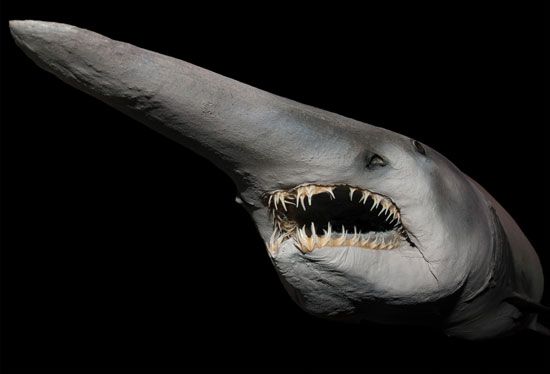
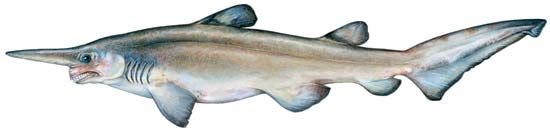
The goblin shark (Mitsukurina owstoni) is a rare species of shark belonging to the family Mitsukurinidae. While it is sometimes associated with the genus Scapanorhynchus in older or alternative classifications, it is the only extant member of its family.12
These sharks are primarily found in deep marine waters, with most recorded specimens captured near Japan. They are physically distinct, characterized by a long, protruding forehead spike, an extended tail, and highly protrusible jaws that allow them to snap at prey. They are closely related to sand sharks and share some physical traits with thresher sharks1. Though they are rarely encountered, they have been known to reach lengths of approximately 3.4 meters (11 feet).12
How do goblin sharks use their protrusible jaws to catch prey?
The provided search results confirm that the goblin shark (Mitsukurina owstoni) possesses protrusible jaws, a feature that allows the shark to extend its mouth rapidly to capture prey.12
While the specific mechanics of the goblin shark’s strike are not detailed in the provided text, the general feeding behavior of sharks with this adaptation involves the protrusion of the jaws as the shark positions itself to attack. This action serves to erect and lock the teeth into position, facilitating a powerful bite. This mechanism is part of a broader suite of sensory and physical adaptations—including a keen sense of smell, the lateral line system for detecting vibrations, and the ability to sense weak electrical signals—that allow sharks to locate and secure food in their environment.3
What are some other unique deep-sea shark species?
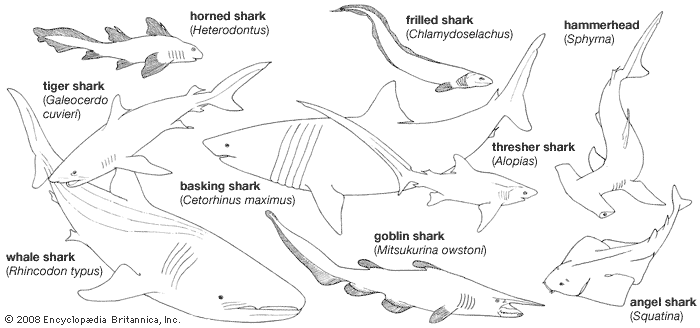
Beyond the goblin shark, the deep sea is home to several other unique shark species with remarkable adaptations:
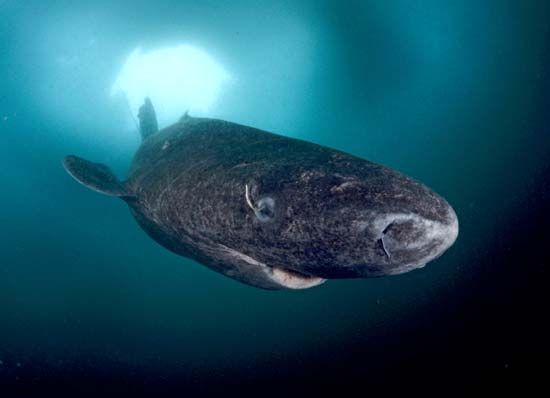
- Greenland shark (Somniosus microcephalus): Known as the world’s longest-lived vertebrate, this slow-moving, bulky shark can live for several centuries, with some individuals estimated to be over 500 years old. It inhabits cold, deep Arctic and North Atlantic waters and is a scavenger and predator that feeds on fish, seals, and even carrion.456
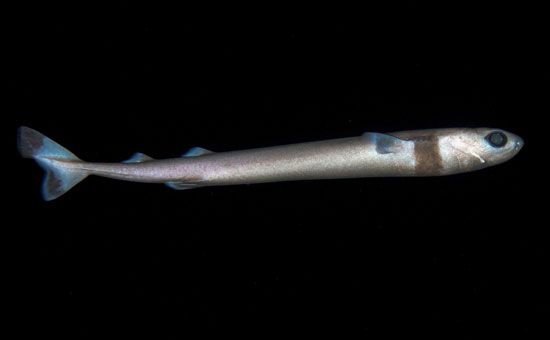
- Cookiecutter shark (Isistius): These small, cigar-shaped sharks are named for their unique feeding habit of using suction and large, bladelike teeth to excise cookie-shaped plugs of flesh from much larger animals, such as whales and tuna. They possess photophores on their undersides that produce a greenish glow, which scientists believe is used to attract prey.7
- Frilled shark (Chlamydoselachus anguineus): This deep-water species is distinct for its eel-like body shape and a terminal mouth. It is characterized by six pairs of gill slits that feature broad, frilled margins.8
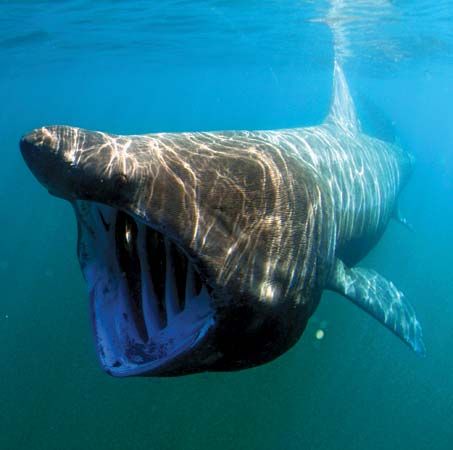
- Megamouth shark (Megachasma pelagios): Similar to the whale shark and basking shark, this rare species is a filter feeder that uses modified gill rakers to strain plankton from the water.9
Why do goblin sharks have such a long, spike-like snout?
The goblin shark (Mitsukurina owstoni) is well-known for its distinct, elongated, spike-like snout. While the specific evolutionary purpose of this snout is not explicitly detailed in the provided literature, it is important to note that sharks rely on a sophisticated network of sensory organs to navigate and hunt in deep, dark environments.11123
Specifically, sharks possess the ampullae of Lorenzini, a specialized system of electroreceptors located primarily on the head. These organs allow sharks to detect the weak electric fields produced by other organisms, which is essential for locating prey in murky or deep waters where vision is limited. Given that the goblin shark’s snout is a prominent feature of its head, it likely houses a significant portion of this sensory network, aiding the shark in detecting prey in its deep-sea habitat.2311
Sources
- goblin shark — Encyclopædia Britannica
- goblin shark — Merriam-Webster
- chondrichthyan - Sharks — Encyclopædia Britannica
- Greenland shark — Encyclopædia Britannica
- What animal has the longest life span? — Encyclopædia Britannica
- cookiecutter shark — Encyclopædia Britannica
- frilled shark — Merriam-Webster
- Bioluminescence - The range and variety of bioluminescent organisms — Encyclopædia Britannica
- shark - Description and habits — Encyclopædia Britannica
- shark — Encyclopædia Britannica
- ampulla of Lorenzini — Encyclopædia Britannica
Published on · 3 min read