Dragonfish
The term "dragonfish" typically refers to two distinct groups of marine fish, rather than a single species:
What is dragonfish?
The term “dragonfish” typically refers to two distinct groups of marine fish, rather than a single species:
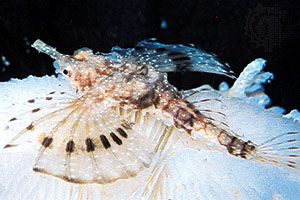
- Pegasidae family: These are small, Indo-Pacific fish (up to 16 cm) characterized by an elongated body encased in bony armor. They feature large, winglike pectoral fins and a small, toothless mouth located beneath a bony snout.1
- Scaleless dragonfish: These belong to the subfamily Melanostomiinae. Unlike the armored variety, these fish are entirely scaleless and possess a fierce appearance due to numerous fanglike teeth. They often inhabit deep waters and are equipped with long barbels on the lower jaw and luminescent organs along their sides.2
It is important not to confuse these with dragonets, which are a separate family (Callionymidae) of bottom-dwelling fish often found in shallow, sandy areas. While some deep-sea fish utilize bioluminescence through luciferin and luciferase reactions to produce light, the term “dragonfish” specifically identifies the physical characteristics described above.3245
How do deep-sea fish use bioluminescence to survive?
Deep-sea fish utilize bioluminescence—a chemical reaction involving luciferin and the enzyme luciferase—as a versatile tool for survival in the ocean’s depths. This light, typically blue-green, is highly visible in the dark environment and serves several critical functions:678
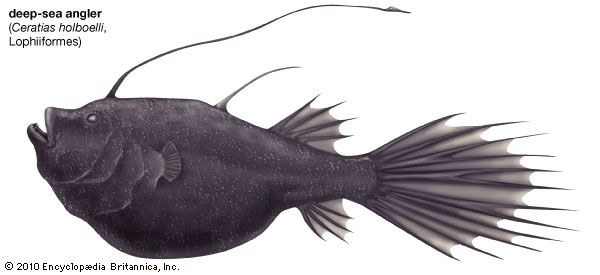
- Predation: Many species, such as the anglerfish, use luminous lures dangling from modified dorsal spines to attract unsuspecting prey directly toward their jaws.678
- Camouflage: Through a process called counter-illumination, fish like lanternfishes and hatchetfishes use photophores on their ventral surfaces to match the intensity of sunlight filtering from above. This conceals their silhouette from predators lurking below.68
- Communication and Mating: Distinct patterns of light organs allow individuals to recognize members of their own species and sex, which is essential for maintaining schools and finding mates.678
- Defense: Some fish use flashes of light to startle or confuse predators, providing an opportunity to escape.68
We could dive deeper into the specific anatomy of photophores or explore how other marine organisms use light for survival.
What are some other strange creatures that live in the deep ocean?
The deep ocean is home to a variety of highly specialized creatures that have evolved unique adaptations to survive in extreme darkness, cold, and pressure. Beyond the well-known deep-sea fish, the abyss hosts fascinating invertebrates and unusual predators:
Deep-Sea Fish
- Anglerfishes: These mid-water predators use a bioluminescent lure on a modified dorsal fin spine to attract prey in the darkness.910
- Viperfishes: Known for their fearsome appearance, these fish possess numerous fanglike teeth that make them formidable predators.9
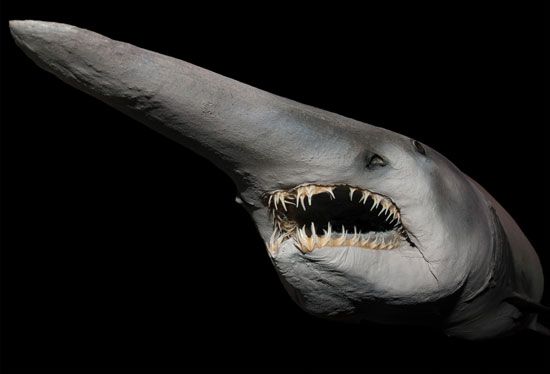
- Goblin Shark: A rare, deep-sea shark characterized by a long, protruding snout and highly protrusible jaws used to snatch prey.1112
- Bristlemouths: Often cited as the most abundant fish on Earth, these small, bioluminescent creatures are a staple of the deep-sea ecosystem.9
Unusual Invertebrates
- Giant Isopod: These massive crustaceans are deep-sea scavengers that feed on detritus, such as whale carcasses, drifting down from the surface.13
- Japanese Spider Crab: The largest living arthropod, this crab can reach a leg span of up to 13 feet while plodding across the seafloor.13
- Giant and Colossal Squids: These elusive, massive cephalopods are legendary for their size and their deep-sea battles with sperm whales.14
- Bobbitt Worm: A predatory marine worm that can grow up to 10 feet long, burying itself in sediment to ambush prey with sharp mandibles.13
Why do some fish have armor instead of scales?
Some fish possess armor rather than typical overlapping scales because these bony plates provide enhanced physical protection and structural support, which are critical for their specific lifestyles and environments.1516
This armor is composed of dermal bone—the same material that forms the base of many fish scales—but it is organized into rigid, interlocking plates rather than thin, flexible layers. For instance, armored catfishes (family Loricariidae) utilize these plates as a defensive barrier against predators. Historically, the extinct placoderms were defined by heavy dermal armor that formed protective head and trunk shields, which likely served as a primary defense for these early jawed fishes.17151618
While modern teleost fish generally rely on thin, overlapping cycloid or ctenoid scales for a balance of protection and flexibility, the evolution of armor represents a specialized adaptation where the dermal skeleton is prioritized for durability over mobility.171519
Sources
- dragonfish — Encyclopædia Britannica
- scaleless dragonfish — Encyclopædia Britannica
- dragonet — Encyclopædia Britannica
- luciferase — Encyclopædia Britannica
- Bioluminescence - Biochemical events of light emission — Encyclopædia Britannica
- Bioluminescence - The role of bioluminescence in behavior — Encyclopædia Britannica
- Marine bioluminescence — Encyclopædia Britannica
- Everything’s Illuminated: 6 Bioluminescent Organisms — Encyclopædia Britannica
- deep-sea fish — Encyclopædia Britannica
- Big Bugs and Colossal Crabs: 7 Invertebrates of Unusual Size — Encyclopædia Britannica
- goblin shark — Encyclopædia Britannica
- goblin shark — Merriam-Webster
- How Big Is the Giant Squid? — Encyclopædia Britannica
- paracanthopterygian - Ecology and behavior — Encyclopædia Britannica
- scale — Encyclopædia Britannica
- Integument - Dermal derivatives — Encyclopædia Britannica
- Integument - Fishes — Encyclopædia Britannica
- armored catfish — Merriam-Webster
- placoderm — Encyclopædia Britannica
Published on · 3 min read