Golden Gate
The Golden Gate strait did not play a direct role in the extraction of gold during the California Gold Rush; rather, it served as the vital maritime gateway…
What role did the Golden Gate strait play in the California Gold Rush?
The Golden Gate strait did not play a direct role in the extraction of gold during the California Gold Rush; rather, it served as the vital maritime gateway through which the massive influx of fortune seekers arrived in San Francisco.
As the primary entrance to the San Francisco Bay, the strait facilitated the arrival of approximately 40,000 people by boat in 1849 alone. This surge of humanity transformed San Francisco from a small settlement into a prominent city, fueling the rapid demographic and economic changes that defined the era.12
While the strait itself was a geographic conduit for the Gold Rush, its long-term significance in the region’s history is tied to the city’s subsequent growth. The rapid expansion following the Gold Rush eventually created a need for a permanent land connection across the strait, leading to the construction of the Golden Gate Bridge to replace the ferry systems that had become a bottleneck for regional development.34
How has the Golden Gate strait influenced the development of San Francisco and the surrounding area?
The Golden Gate strait has been a defining feature in the development of San Francisco and the surrounding region, serving as both a vital maritime gateway and a significant geographic barrier.
Maritime Gateway
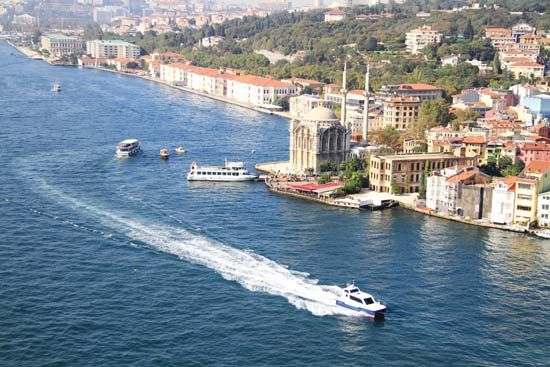
As the primary connection between the Pacific Ocean and San Francisco Bay, the strait functions as the ocean entrance to the region’s major port cities and the Sacramento–San Joaquin river system. Captain John C. Frémont named the strait in 1846, envisioning it as a gateway for valuable trade flowing from Asia, similar to the Golden Horn of the Bosporus.32
Economic and Physical Growth
Following the California Gold Rush, San Francisco experienced rapid population growth. Because the strait separated the city from Marin County to the north, the lack of a direct land connection forced a heavy reliance on ferries. By 1920, this dependence on ferry transportation became a bottleneck that limited the city’s economic and physical expansion.17
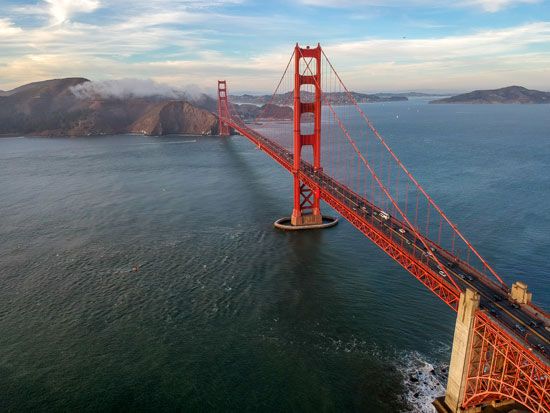
The construction of the Golden Gate Bridge, completed in 1937, finally provided the necessary infrastructure to link these areas, supporting continued regional development and serving as a symbol of progress.172
How has the Golden Gate strait been used for maritime transportation throughout history?
The Golden Gate strait has served as a vital maritime gateway for centuries, connecting the Pacific Ocean to the San Francisco Bay and the Sacramento–San Joaquin river system.13
Historically, the strait functioned as a critical passage for maritime trade and exploration. While likely sighted by Sir Francis Drake in 1579, the first European ship to navigate the strait was the San Carlos in 1775, commanded by Juan Manuel de Ayala. By 1846, Captain John C. Frémont named the passage the “Golden Gate,” envisioning it as a gateway for valuable trade flowing from the Orient.13
Following the California Gold Rush, the strait became a central hub for passenger and freight movement. Because no land connection existed between San Francisco and Marin County, the region relied heavily on ferries to transport people and goods across the water. This dependence persisted until the 1937 completion of the Golden Gate Bridge, which replaced the ferry bottleneck with a permanent land link, fundamentally altering regional transportation.937
What is the Golden Gate strait and where is it located in California?
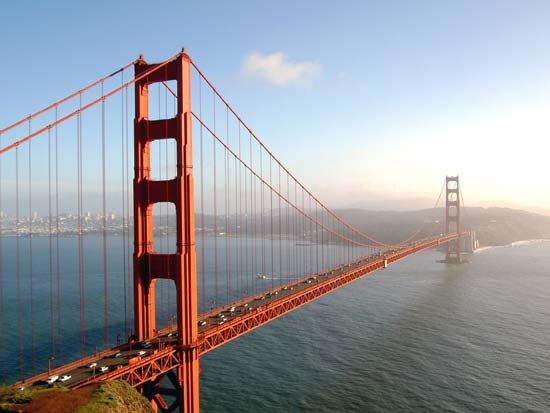
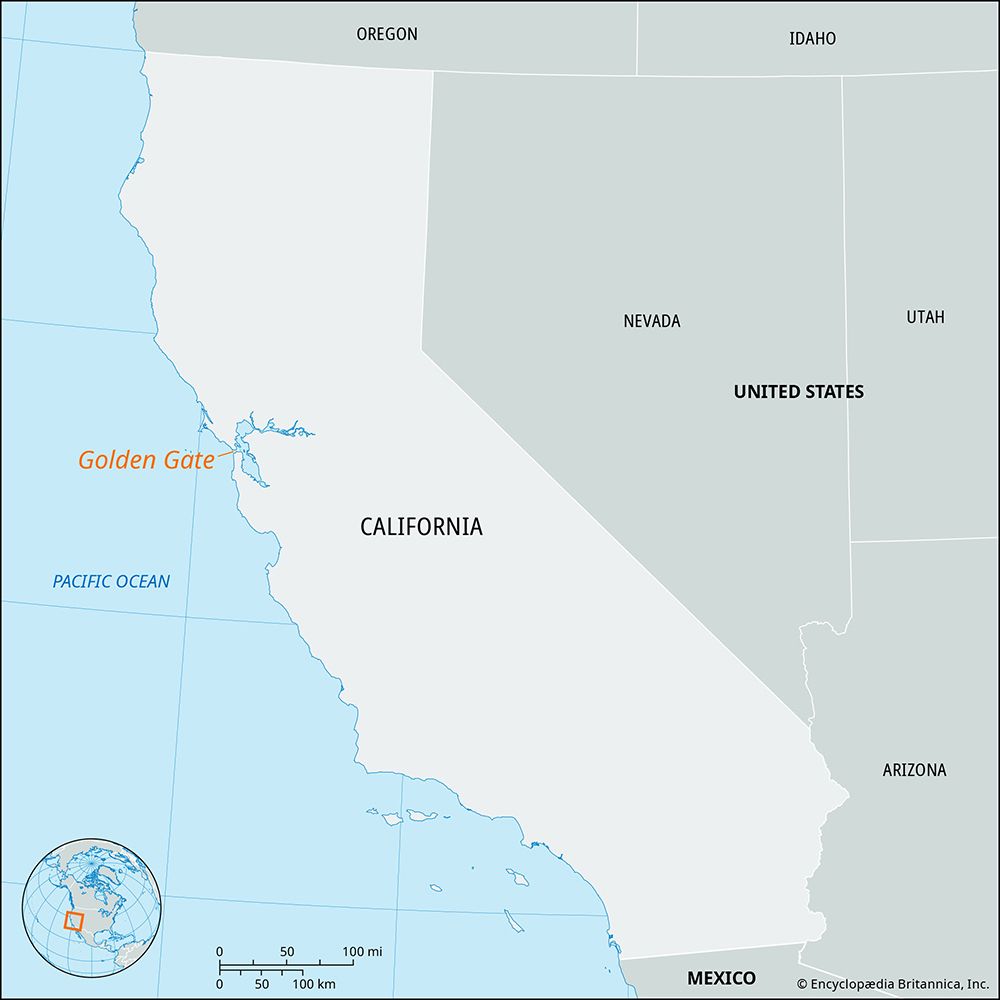
The Golden Gate is a strait located in western California that serves as the primary connection between the Pacific Ocean and San Francisco Bay. It acts as a geographic separator between the city of San Francisco and Marin County.1
Geologically, the strait is an ancient river mouth measuring approximately 3 miles (5 km) in length, with a width ranging from 1 to 3 miles and a depth of 300 feet (90 meters). It functions as a vital maritime gateway for port cities within the bay and the Sacramento–San Joaquin river system. The strait is famously spanned by the Golden Gate Bridge, a landmark that connects the two sides of the passage.1
Sources
- Golden Gate — Encyclopædia Britannica
- Golden Gate Bridge — Encyclopædia Britannica
- Golden Gate Bridge: Top Questions — Encyclopædia Britannica
- California Gold Rush — Encyclopædia Britannica
- California - The Gold Rush — Encyclopædia Britannica
- San Francisco - Exploration and early settlement — Encyclopædia Britannica
- Where does the Golden Gate Bridge get its name? — Encyclopædia Britannica
- San Francisco Bay — Encyclopædia Britannica
- ferry — Encyclopædia Britannica
Published on · 3 min read