Rush
Rushes are monocotyledonous flowering plants typically found in temperate regions, particularly in moist or shady environments. They are characterized by…
What are the main characteristics and varieties of rush plants?
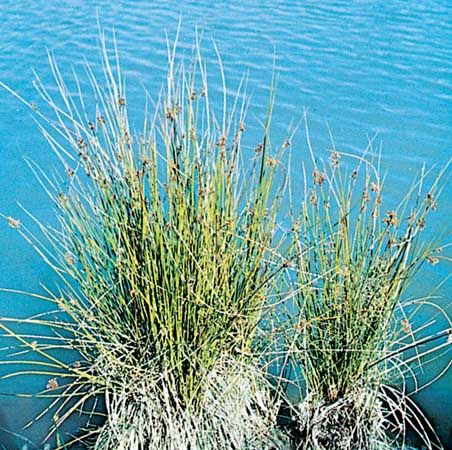
Rushes are monocotyledonous flowering plants typically found in temperate regions, particularly in moist or shady environments. They are characterized by cylindrical, often hollow, stemlike stalks or leaves.12
Main Varieties
The true rush family, Juncaceae, primarily consists of two major genera:
- Juncus: Known as the common rushes, this genus includes about 300 species. The soft rush (J. effusus) is a well-known variety used for making traditional Japanese tatami mats.31
- Luzula: Commonly referred to as woodrushes, this genus contains approximately 115 species.3
Other plants are often colloquially called “rushes” due to their similar appearance, though they belong to different families:
- Flowering rush (Butomus umbellatus): A perennial freshwater plant in the family Butomaceae, known for its rose-colored flowers.14
- Bulrush (Typha angustifolia): Also known as cattail, this member of the Typhaceae family is used for weaving and as a source of emergency food.13
- Scouring rush (Equisetum): Also called horsetail, these plants are used for scouring surfaces due to their silica-laden stalks.1
- Sweet rush (Acorus calamus): Also known as sweet flag, belonging to the Acoraceae family.1
What are the traditional and modern uses of rush plants?
Rush plants have served a variety of practical purposes throughout history, ranging from household utility to specialized industrial applications.
Traditional Uses
For centuries, the durable, cylindrical stalks of Juncus species have been harvested for weaving. Their flexibility and strength make them ideal for crafting chair bottoms, baskets, and floor mats. Historically, the pith of these plants was extracted to serve as wicks for oil lamps and to create “rushlights,” which were simple tallow candles. Similarly, the cattail (Typha angustifolia) has been utilized in regions like North India to produce ropes, mats, and various woven containers.1
Modern and Specialized Uses
- Interior Design: The soft rush (J. effusus) remains essential in modern Japanese culture for the production of traditional tatami mats.1
- Cleaning: The horsetail (Equisetum), often called scouring rush, contains high levels of silica. This abrasive quality allows the stalks to be used effectively for scouring metal and other hard surfaces.1
How do rush plants differ from other wetland plants like sedges and grasses?
While rushes, sedges, and grasses are all grasslike plants often found in wetlands, they belong to distinct botanical families and possess unique structural characteristics.
Key Differences
- Family Classification:
- Stem Structure:
- Leaf Arrangement:
- Reproductive Features:
- Sedges: Individual flowers are subtended by a single scale.2
- Grasses: Individual flowers are usually subtended by two scales.2
- Evolutionary Relationship: Evidence suggests that sedges are more closely related to rushes than to grasses, as they share specialized chromosomal structures and pollen development patterns.2
What are some common species of rush plants found around the world?
Rush plants are found in temperate regions worldwide, particularly in moist or shady environments. While the term “rush” is often used colloquially for various grasslike wetland plants, true rushes belong to the family Juncaceae, which includes the following notable groups:
- Juncus: This is the primary genus of common rushes, consisting of perennial, tufted herbs with cylindrical or channeled leaves. A prominent species is the soft rush (J. effusus), also known as hard rush, which is widely used in the production of Japanese tatami mats.1910
- Luzula: Commonly known as woodrushes, these are also members of the Juncaceae family and are typically found in woodland habitats.1
Other plants often referred to as “rushes” due to their appearance or habitat include:
- Bulrush: Also called cattail (Typha angustifolia), this plant belongs to the family Typhaceae and is utilized for making ropes and baskets.1
- Scouring Rush: The horsetail genus (Equisetum), sometimes called Dutch rush, is valued for its silica-laden stalks.1
- Flowering Rush: Butomus umbellatus, which belongs to the family Butomaceae.1
- Sweet Rush: Also known as sweet flag (Acorus calamus), a member of the Acoraceae family.1
Sources
- rush — Encyclopædia Britannica
- Cyperaceae - Characteristic morphological features — Encyclopædia Britannica
- Poales — Encyclopædia Britannica
- rush — Merriam-Webster
- flowering rush — Encyclopædia Britannica
- grass — Encyclopædia Britannica
- Bulrush — Encyclopædia Britannica
- Cyperaceae - Economic and ecological importance — Encyclopædia Britannica
- hard rush — Merriam-Webster
- Juncaceae — Merriam-Webster
- juncus — Merriam-Webster
- Juncaginaceae — Merriam-Webster
Published on · 3 min read