Golden Hamster
The golden hamster (Mesocricetus auratus), also known as the Syrian hamster, became a popular pet following the transport of a small group from Syria to…
How did golden hamsters become popular as pets?
The golden hamster (Mesocricetus auratus), also known as the Syrian hamster, became a popular pet following the transport of a small group from Syria to Palestine in 1930. Descendants of this group were subsequently distributed worldwide, facilitating their rise in popularity. A second group was later captured in Syria and brought to the United States in 1971.1
While these rodents have not been fully domesticated, they are considered tractable, which has contributed to their status as common household pets. Beyond their role in homes, their ease of handling has also made them frequent subjects for biological research and zoo exhibits. Breeders have since developed more than 120 varieties, resulting in a wide range of fur colors, patterns, and textures that further appeal to enthusiasts.1

How do golden hamsters reproduce and what is their gestation period?
In captivity, golden hamsters reach breeding age at approximately four months old. The gestation period for the species is notably short, lasting between 16 and 19 days.1
Females are capable of producing up to five litters per year. While a litter can contain as many as 16 young, the typical size ranges from 6 to 8 offspring. At birth, the young are blind and hairless, weighing between 2 and 3 grams. They are generally weaned at about three weeks of age. Notably, if a mother senses danger during the first few days following birth, she may protect her young by sheltering them within her cheek pouches.1
What are the physical characteristics of the golden hamster?
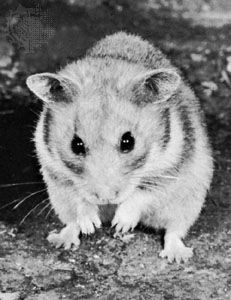
The golden hamster (Mesocricetus auratus) is a small rodent characterized by a stout body, short and stocky legs, and wide feet equipped with small, sharp claws.1
Key physical features include:
- Size and Weight: They typically reach a body length of up to 18 cm (7.1 inches) and generally weigh more than 100 grams (about 3.5 ounces). Females are typically larger than males.1
- Head and Face: They possess small, furry ears and expansive internal cheek pouches. These pouches open inside the lips and extend back to the shoulders, allowing the animal to transport food.1
- Tail: The tail is stubby and appears either white or pink.1
- Fur: In their natural state, they have dense, soft fur that is golden brown on the upperparts and white or cream on the underparts. Through selective breeding, there are now more than 120 varieties featuring a wide range of colors, patterns, and textures.1
How do golden hamsters differ from other hamster species?
The golden hamster (Mesocricetus auratus) is one of 18 species within the subfamily Cricetinae, but it possesses several distinct characteristics that set it apart from other hamsters:
- Geographic Range: While hamsters as a group are found across a vast range from central Europe to Korea, the golden hamster has a highly restricted natural distribution, found only in a small region near Aleppo in northwestern Syria.13
- Classification: It belongs to the genus Mesocricetus, which includes only four living species. Other hamsters are categorized into six different genera, such as Phodopus (dwarf desert hamsters) or Cricetus (the common hamster).13
- Size: Golden hamsters are medium-sized, reaching up to 18 cm in length. They are significantly larger than the dwarf desert hamsters (genus Phodopus), which measure only 5 to 10 cm, but much smaller than the common hamster (Cricetus cricetus), which can grow up to 34 cm long.13
- Appearance: Unlike species such as the Dzhungarian or striped dwarf hamsters, which feature a dark stripe down their backs, the golden hamster typically displays a solid golden-brown coat.13
Sources
- golden hamster — Encyclopædia Britannica
- golden hamster — Merriam-Webster
- hamster — Encyclopædia Britannica
Published on · 3 min read