Proboscis Monkey
Sorry, the Britannica knowledge base does not contain information regarding the typical lifespan or the specific predators of the proboscis monkey.
How long do proboscis monkeys typically live, and what are their main predators?
Sorry, the Britannica knowledge base does not contain information regarding the typical lifespan or the specific predators of the proboscis monkey.
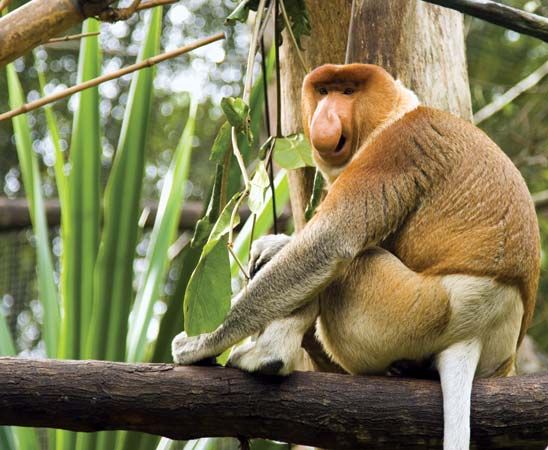
What is the scientific name of the proboscis monkey and why was it given this name?
The scientific name of the proboscis monkey is Nasalis larvatus.21
The name is derived from the Latin word nasalis, meaning “of the nose,” which refers to the animal’s most distinctive feature: the large, pendulous nose found in adult males. The species name larvatus is also Latin, meaning “masked,” which likely alludes to the monkey’s facial appearance.21
Where are proboscis monkeys found in the wild, and what is their preferred habitat?
Proboscis monkeys (Nasalis larvatus) are found exclusively on the island of Borneo in Southeast Asia1.1
Their preferred habitat consists of areas near water, specifically swampy mangrove forests and regions along rivers. These arboreal primates are well-adapted to this environment, as they are known to wade upright through water, a behavior that makes them unique among monkeys for being habitually bipedal. Despite their specialized habitat, the species is currently experiencing population declines due to ongoing habitat destruction.2
What are the distinctive physical features of the proboscis monkey?
The proboscis monkey (Nasalis larvatus) possesses several distinct physical characteristics that set it apart from other primates:
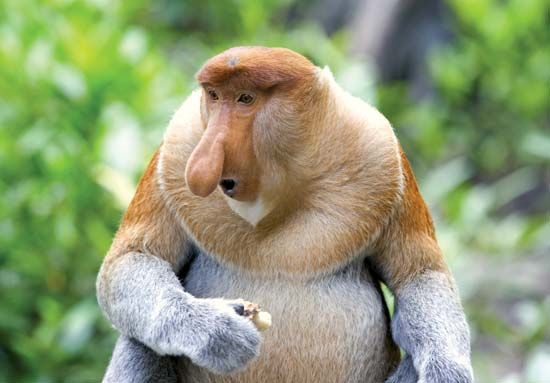
- Nose: The most prominent feature is the male’s long, pendulous nose. In contrast, females have significantly smaller noses, and the noses of young monkeys are upturned.1
- Coloration: Their fur is a distinct red-brown, complemented by pale underparts. Interestingly, infants are born with blue faces.1
- Size and Dimorphism: The species exhibits significant sexual dimorphism. Males typically measure 56–72 cm (22–28 inches) in length and weigh an average of 20 kg (44 pounds), while females are smaller, weighing approximately 10 kg (22 pounds).1
- Tail: They possess a long tail that is roughly equal in length to their body.1
- Locomotion: They are uniquely adapted for their environment, being habitually bipedal and capable of wading upright through water.1
Sources
- proboscis monkey — Encyclopædia Britannica
- proboscis monkey — Merriam-Webster
Published on · 2 min read