Goldfinch
Goldfinches are small, active songbirds belonging to the family Fringillidae. While they vary by species, they generally share several physical traits:
What are the distinguishing physical characteristics of goldfinches?
Goldfinches are small, active songbirds belonging to the family Fringillidae. While they vary by species, they generally share several physical traits:12
- Plumage: Most species are characterized by prominent yellow in their feathers.12
- Body Structure: They possess short, notched tails and delicate, sharp-pointed bills, which are well-suited for their granivorous diet.13
- Size: They are small birds, typically measuring between 10 and 14 cm (4 to 5.5 inches) in length.1
Specific species exhibit distinct markings:
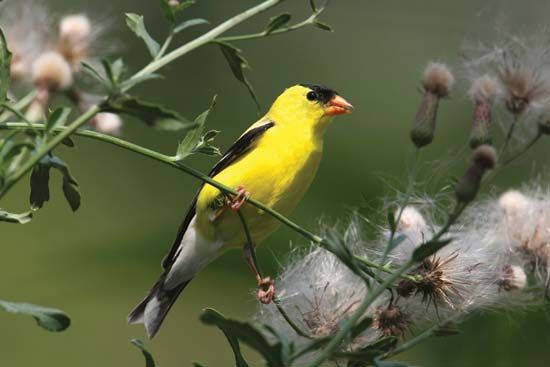
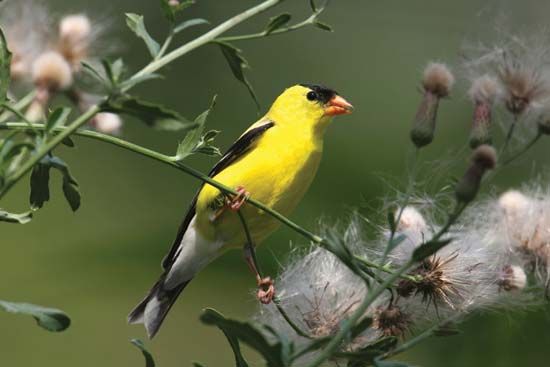
- American Goldfinch (Spinus tristis): Males in breeding plumage are bright yellow with a black cap, wings, and tail. In winter, both sexes transition to a more drab appearance of brown, olive, and muted yellow-green.13
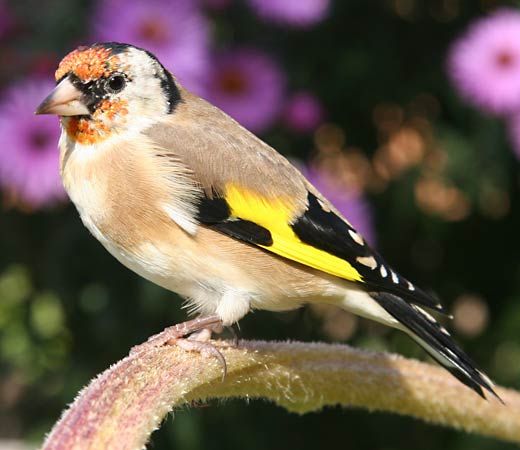
- European Goldfinch (Carduelis carduelis): This species features a distinctive red, white, and black head pattern, with black on the nape, wings, and tail, and bright yellow wing markings.12
Where are goldfinches commonly found, and what are their preferred habitats?
Goldfinches are widely distributed across various regions, with specific habitats depending on the species.
Geographic Range
- American Goldfinch (Spinus tristis): This species is native to North America. It is found throughout the contiguous United States and southern Canada, as well as along Mexico’s Gulf coast, in The Bahamas, and on other islands in the Caribbean Sea.134
- European Goldfinch (Carduelis carduelis): Native to western Eurasia, this species has been introduced to Australia, New Zealand, and Bermuda.1
- Dark-backed Goldfinch (Spinus psaltria): This species ranges from the western United States down to Peru.1
Preferred Habitats
Goldfinches are highly adaptable birds that thrive in a variety of environments. They are commonly found in:
- Open fields and meadows134
- Floodplains34
- Cultivated areas, orchards, and gardens134
- Urban and suburban environments34
- Roadsides34
These birds are frequently observed in flocks feeding on weeds in fields and gardens, often nesting in trees and shrubs.14
How have goldfinches been represented in art and culture throughout history?
Sorry, the Britannica knowledge base does not contain information regarding the representation of goldfinches in art and culture throughout history.
What are the different species of goldfinches found around the world?
Goldfinches belong to the songbird family Fringillidae and are primarily classified within the genera Carduelis and Spinus. These birds are characterized by their delicate, sharp-pointed bills and the presence of yellow in their plumage.14
The primary species of goldfinches include:
- European goldfinch (Carduelis carduelis): Native to western Eurasia, as well as central Asia and northern Africa, this species is known for its distinctive red, white, and black head pattern and bright yellow wing markings. It has been introduced to regions including Australia, New Zealand, and Bermuda.14
- American goldfinch (Spinus tristis): Also known as the wild canary, this small, acrobatic bird is native to North America.1 Breeding males are recognized by their bright yellow plumage contrasted with a black cap, wings, and tail.31
- Dark-backed goldfinch (Spinus psaltria): Also referred to as the lesser goldfinch, this species is the smallest of the three, measuring about 10 cm (4 inches), and ranges from the western United States down to Peru. from the western United States down to Peru.1
Sources
- Goldfinch — Encyclopædia Britannica
- goldfinch — Merriam-Webster
- American goldfinch — Encyclopædia Britannica
- American goldfinch: Top Questions — Encyclopædia Britannica
- Finch — Encyclopædia Britannica
Published on · 3 min read