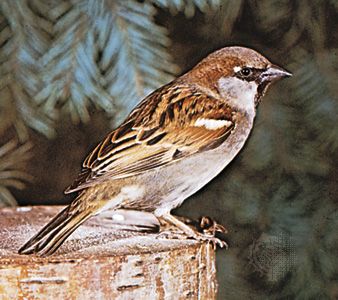
House Sparrow
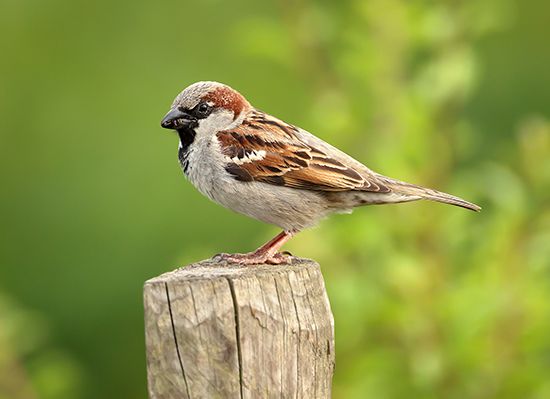
The house sparrow (Passer domesticus) is native to most of Eurasia and northern Africa.
Where are house sparrows native to, and how have they spread globally?
The house sparrow (Passer domesticus) is native to most of Eurasia and northern Africa.1
These birds have spread globally by accompanying humans, often thriving in urban and agricultural environments. Their expansion into new regions was frequently facilitated by intentional introduction. For example, the house sparrow was introduced to North America in Brooklyn, New York, in 1852. Following this introduction, the species successfully colonized the continent within a century.1
In many areas where they were introduced, house sparrows have become established as urban pests, known for fouling buildings and obstructing infrastructure like rain gutters and ventilators with their nests. Their historical population growth in urban centers was also supported by the availability of waste grain from horse feed, though these numbers declined in some areas as automobiles replaced horses.21
What are the mating and nesting habits of house sparrows?
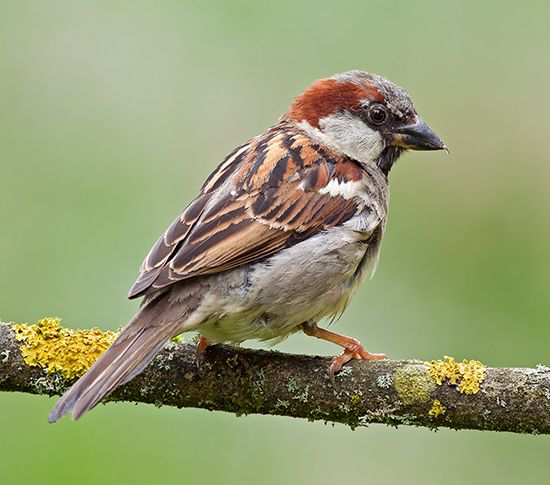
House sparrows (Passer domesticus) exhibit specific reproductive behaviors characterized by colonial nesting and cooperative effort.
Nesting Habits
House sparrows are colonial nesters, meaning they build their individual nests in close proximity to one another. The nest itself is typically an untidy, often dirty bundle constructed from straw and feathers. Both members of the breeding pair participate in the construction of the nest. These structures are commonly placed in the eaves of houses. A typical clutch contains four to nine eggs. In warmer regions, house sparrows are capable of breeding nearly year-round.14
Mating and Breeding
While the provided information notes that house sparrows are colonial nesters, it is important to distinguish their behavior from other species mentioned in broader studies of avian social behavior. For instance, while some birds engage in complex paternity-guarding behaviors—such as the cloacal pecking observed in the dunnock (also known as the hedge sparrow)—the house sparrow is a distinct species with its own established nesting and breeding patterns.45
What role do house sparrows play in human culture and folklore?
While house sparrows (Passer domesticus) are one of the world’s most abundant birds, they are primarily recognized in human culture for their role as urban pests rather than as central figures in folklore or mythology.13
Unlike some other passerines that have been historically imbued with symbolic meaning—such as the goldfinch representing the Passion of Christ or the raven serving as an omen—the house sparrow is more frequently noted for its economic and practical impact on human environments. Since their introduction to regions like North America, they have become well-known for fouling buildings and obstructing infrastructure with their nests. Their historical relationship with humans was largely defined by their reliance on waste grain from horses, a connection that diminished as automobiles became the primary mode of transport.31
While they lack the deep symbolic status of some songbirds, their ubiquity ensures they remain a constant, if often unwelcome, presence in human-dominated landscapes.13
What makes house sparrows so successful at adapting to urban environments?
House sparrows (Passer domesticus) have demonstrated remarkable success in adapting to urban environments due to several key factors:
- Dietary Flexibility: Historically, house sparrows thrived in urban areas by exploiting waste grain from horse feed. Their ability to capitalize on human-provided food sources allowed them to establish large populations in towns and cities worldwide.1
- Nesting Habits: These birds are highly adaptable in their choice of nesting sites. They frequently utilize human infrastructure, such as the eaves of houses, to build their nests. This behavior allows them to thrive in close proximity to human activity.17
- Reproductive Strategy: In warmer regions, house sparrows are capable of breeding nearly year-round. This high reproductive rate, combined with their colonial nesting behavior, enables them to maintain and expand their populations rapidly in human-dominated landscapes.1
- Global Expansion: Originally native to Eurasia and northern Africa, the species has proven its adaptability by successfully colonizing diverse environments. Following their introduction to North America in 1852, they spread across the entire continent within a century, demonstrating a high capacity for dispersal and establishment in new urban settings.1
Sources
- House sparrow — Encyclopædia Britannica
- Sparrow — Encyclopædia Britannica
- Passeriform - Aesthetic and economic importance — Encyclopædia Britannica
- Animal social behavior - Social interactions involving sex — Encyclopædia Britannica
- Passeriform - Territoriality and courtship — Encyclopædia Britannica
- Bird - Nesting — Encyclopædia Britannica
- house sparrow — Merriam-Webster
- Passeriform - Size range and structural diversity — Encyclopædia Britannica
Published on · 3 min read