American Goldfinch
The American goldfinch (Spinus tristis), sometimes called a wild canary, is a small, acrobatic songbird native to North America. Belonging to the family…
What is American goldfinch?
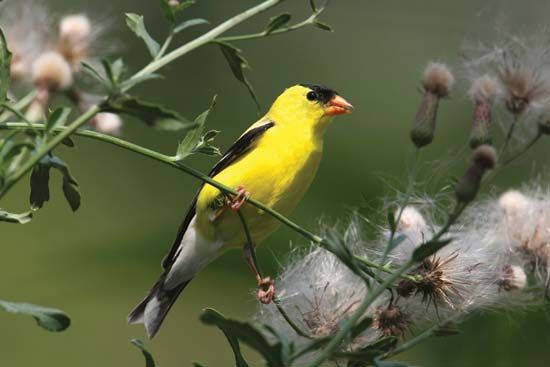
The American goldfinch (Spinus tristis), sometimes called a wild canary, is a small, acrobatic songbird native to North America. Belonging to the family Fringillidae, these birds are widely recognized for their sexual dimorphism; while both sexes appear in drab olive and brown tones during winter, males develop a striking, bright yellow plumage with a black cap, wings, and tail during the spring breeding season.12
These granivorous birds possess strong bills adapted for consuming seeds from various plants, including sunflowers and dandelions. They are highly adaptable, inhabiting environments ranging from suburban areas and orchards to open fields. Currently listed as a species of least concern, their populations are robust and protected under the Migratory Bird Treaty Act. Interestingly, the species name tristis—Latin for “sad”—refers to a mournful note often heard in their vocalizations.2
Why do male American goldfinches change color with the seasons?
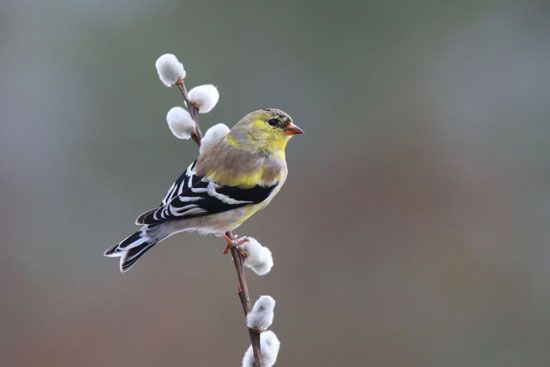
Male American goldfinches undergo seasonal changes in plumage as a form of sexual dimorphism, transitioning from a drab winter appearance to a vibrant yellow breeding plumage in the spring.3
This transformation is driven by the physiological control of hormones, which regulate the deposition of specific biochromes in the feathers. While the exact mechanisms vary significantly between bird species, these seasonal color shifts are generally tied to the bird’s reproductive cycle, allowing males to display their bright yellow feathers—contrasted by black caps, wings, and tails—during the courtship and nesting season. In contrast, during the winter months, both sexes adopt a more muted, protective coloration of brown and olive, which helps them blend into their environment when they are not actively seeking mates.43
How does the brown-headed cowbird attempt to trick other birds?
The brown-headed cowbird is a brood parasite, meaning it tricks other birds into raising its young. Rather than building its own nest, the female cowbird habitually lays her eggs in the nests of other songbirds.5
To ensure the success of her offspring, the female cowbird often removes one of the host’s eggs before depositing her own. She is highly prolific, capable of laying up to 40 eggs in a single season, and has been documented parasitizing the nests of more than 200 different species. Once the cowbird egg hatches, the young cowbird often behaves aggressively toward its foster siblings, either displacing them from the nest or outcompeting them for food. In many cases, the cowbird nestling grows to exceed the size of the foster parents, effectively sacrificing the host’s own brood for its survival.5
We could dive deeper into the evolutionary impact this parasitic behavior has on the populations of host bird species.
What are some other common songbirds found in North America?
North America is home to a wide variety of songbirds, which belong to the suborder Passeri and are characterized by their specialized vocal organ, the syrinx., the syrinx.97
Here are some common songbirds found across the continent:
- Northern Mockingbird: Famous for its ability to mimic the songs of dozens of other bird species, this bird is a widespread and familiar resident of the continental United States and Mexico.87
- Wood Thrush: A migratory species that breeds in the forests of the eastern United States and southern Canada, known for its distinctively spotted plumage.8
- Yellow Warbler: Often found across North America, these bright yellow birds are frequently seen in various habitats during their breeding season.8
- Western Meadowlark: Recognizable by its vibrant yellow breast accented with a black “V,” this bird is common throughout western and central North America.8
- Song Sparrow: A widespread species found across most of North America, known for its complex and varied song repertoire.98
- Bobolink: Found in grasslands and wetlands, the male is noted for its bubbling song during the breeding season.8
- European Starling: Although introduced from Eurasia, this species has become one of the most common and abundant birds across North America.810
Sources
- Goldfinch — Encyclopædia Britannica
- American goldfinch — Merriam-Webster
- American goldfinch — Encyclopædia Britannica
- coloration - Physiological control — Encyclopædia Britannica
- Cowbird — Encyclopædia Britannica
- brown-headed cowbird — Merriam-Webster
- Finch — Encyclopædia Britannica
- Apodiform - Distribution and abundance — Encyclopædia Britannica
- 15 of the Best Birdsongs (According to Britannica) — Encyclopædia Britannica
- Passeriform - Aesthetic and economic importance — Encyclopædia Britannica
- Songbird — Encyclopædia Britannica
Published on · 3 min read