Gossamer-winged Butterfly
A gossamer-winged butterfly belongs to the family Lycaenidae, a group of small to medium-sized, agile, and delicate butterflies. This diverse family includes…
What is gossamer-winged butterfly?
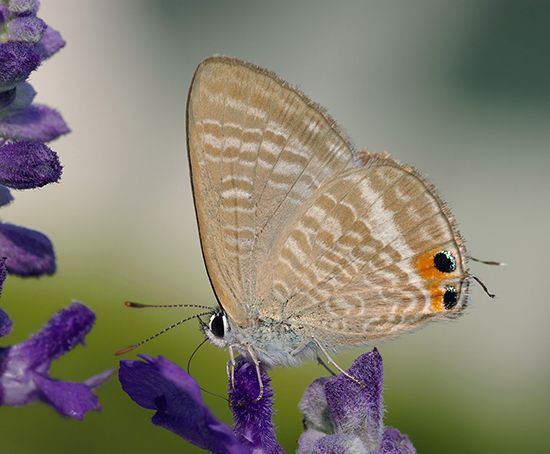
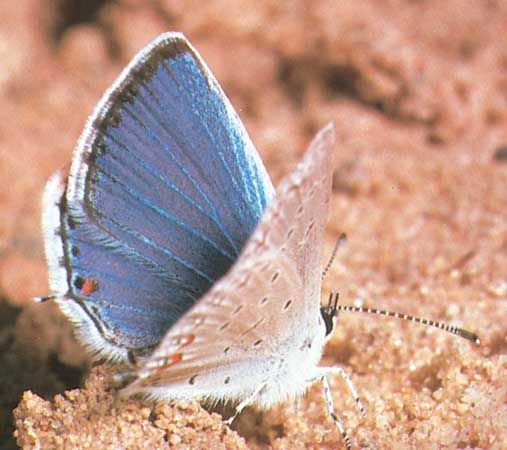
A gossamer-winged butterfly belongs to the family Lycaenidae, a group of small to medium-sized, agile, and delicate butterflies. This diverse family includes several hundred species, such as coppers, blues, hairstreaks, harvesters, and metalmarks.12
These butterflies typically have a wingspan ranging from 1 to 3 cm (0.4 to 1.2 inches). Males often display bright, iridescent colors on their upper-wing surfaces, while both sexes feature underwing patterns with spots, streaks, and sometimes false eye-markings. Many species also possess trailing filaments on their hind wings, which act as decoys to protect them from predators.1
Their life cycles are equally fascinating; while many feed on trees, shrubs, and legumes, some larvae are carnivorous, consuming aphids or ant larvae. In some instances, these larvae maintain a symbiotic relationship with ants, providing secretions from special milk glands in exchange for protection.1
How do false eye-markings help butterflies survive against predators?
False eye-markings serve as a vital defense mechanism for many butterflies and moths by manipulating the behavior of visually hunting predators. These prominent, colored spots on the wings act as targets that draw the predator’s attention and focus their attacks on less vulnerable parts of the insect’s body, such as the hind wings.3
When a predator strikes at these eye-markings, the spots are often torn off, which causes no vital injury to the butterfly. This interaction provides the insect with a critical window of time to escape while the predator is distracted by the damaged wing section. Additionally, some species utilize these markings to create a “startle effect,” where the sudden exposure of bright, eye-like patterns can momentarily delay or confuse an attacker, allowing the butterfly to flee to safety.3
What is the relationship between butterfly larvae and ants?
The relationship between butterfly larvae and ants is a fascinating example of a mutualistic relationship, where both parties derive benefits from their interaction.
In many species of gossamer-winged butterflies, the larvae maintain a symbiotic connection with ants. The larvae possess special milk glands that secrete substances, often rich in nutrients, which the ants consume. In exchange for this food source, the ants provide protection to the larvae, defending them from potential predators or parasites.6
This interaction is part of a broader ecological strategy where insects utilize chemical secretions to influence the behavior of others. While some relationships are mutually beneficial, others involve social parasitism, where certain beetle larvae produce chemical secretions that pacify ants, inducing the ants to adopt, feed, and rear the beetle larvae alongside their own brood.6
What are the main differences between butterflies and moths?
While both butterflies and moths belong to the order Lepidoptera, they exhibit several distinct physical and behavioral differences:
Physical Characteristics
- Antennae: Most butterflies possess simple, club-tipped antennae, whereas the majority of moths have thick or feathery antennae.13
- Body Shape: Butterflies typically have slim, dainty bodies, while moths are generally stouter and often appear fuzzy.13
- Appearance: Butterflies are often brightly colored with dramatic wing patterns, while moths are frequently more drab, though there are notable exceptions in both groups.13
Behavioral and Developmental Differences
- Activity Patterns: Butterflies are typically diurnal (active during the day), while most moths are nocturnal.13
- Resting Posture: When at rest, butterflies usually hold their wings vertically over their backs. Moths typically fold their wings tentlike over their bodies, wrap them around their bodies, or hold them extended at their sides.13
- Pupation: During metamorphosis, butterflies form a naked chrysalis. In contrast, most moths build fibrous cocoons for protection, though there are exceptions, such as satyr and parnassian butterflies that also construct cocoons.132
Sources
- gossamer-winged butterfly — Encyclopædia Britannica
- List of insects - butterflies and moths (order Lepidoptera ) — Encyclopædia Britannica
- Lepidoptera - Protection against danger — Encyclopædia Britannica
- Eyespot — Encyclopædia Britannica
- metalmark — Encyclopædia Britannica
- Hymenoptera - Social parasitism — Encyclopædia Britannica
- Reproductive behaviour - Protective adaptations — Encyclopædia Britannica
- mimicry - The chemical basis for repulsion — Encyclopædia Britannica
- Reproductive behaviour - Insects — Encyclopædia Britannica
- caterpillar — Encyclopædia Britannica
- nectar — Encyclopædia Britannica
- nectary — Encyclopædia Britannica
- What’s the difference between moths and butterflies? — Encyclopædia Britannica
- Lepidoptera - Pupa , or chrysalis — Encyclopædia Britannica
Published on · 3 min read