Grallinidae
Grallinidae is a family of birds belonging to the order Passeriformes. This family includes species such as the mudlark, the apostle bird, and the…
What is Grallinidae?
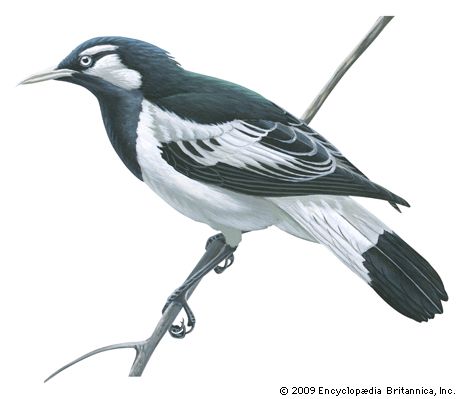
Grallinidae is a family of birds belonging to the order Passeriformes. This family includes species such as the mudlark, the apostle bird, and the white-winged chough.1
These birds, which are primarily found in Australia and New Zealand, are often referred to as “mudnest builders” because they construct distinctive, bowl-shaped nests out of mud, reinforced with materials like grass, hair, or feathers. Their nesting behavior is communal, with multiple birds cooperating to build the nest and sometimes multiple females laying eggs within the same structure. Physically, these birds range from 19 to 50 cm in length and are characterized by weak wings, preferring to move by walking on the ground or through trees.1
Why are these birds called mudnest builders?
Members of the Grallinidae family are called mudnest builders because they construct distinctive, bowl-shaped nests out of mud high in trees. To ensure the structural integrity of these nests, the birds incorporate binding materials such as grass, hair, or feathers.1
This construction process is a cooperative effort, with several birds working together to build a single nest. Once completed, these sturdy structures may serve as a communal site where two or more females lay their eggs.1
What does it mean for a bird to be a weak-winged walker?
To be a “weak-winged walker” means that a bird possesses wings that are not well-adapted for sustained or powerful flight, leading the bird to rely primarily on its legs for locomotion.5
In the case of the Grallinidae family, being weak-winged means these birds prefer to progress by walking on the ground or moving through trees rather than taking to the air. While most birds are capable of flight and use it for travel, weak-winged species have evolved to favor terrestrial movement as their primary means of getting around. This is distinct from birds that are entirely flightless, such as ostriches or emus, which have rudimentary wings and are permanently afoot, or birds like swifts that are so specialized for flight that they rarely walk at all.51
How has modern bird classification changed the status of Grallinidae?
Modern avian classification has significantly altered the status of the Grallinidae family. While historically recognized as a distinct family within the order Passeriformes, contemporary taxonomic revisions have largely reclassified these birds. Most species formerly grouped under Grallinidae, such as the mudlark (Grallina cyanoleuca), the apostle bird, and the white-winged chough, are now typically placed within the family Corcoracidae.1
This shift reflects ongoing efforts by ornithologists to better understand the evolutionary relationships and genetic lineages of Australian passerines. By moving these species into Corcoracidae, scientists have refined the categorization of these unique “mudnest builders” to more accurately represent their biological heritage and shared characteristics.1
Sources
- Grallinidae — Encyclopædia Britannica
- mud lark — Merriam-Webster
- Nest — Encyclopædia Britannica
- Passeriform - Nesting — Encyclopædia Britannica
- Bird - Walking and hopping — Encyclopædia Britannica
- Falconiform - Flapping, soaring , and diving — Encyclopædia Britannica
- Charadriiform - Adaptations for flight — Encyclopædia Britannica
- Bird: Top Questions — Encyclopædia Britannica
- Bird - Locomotion — Encyclopædia Britannica
Published on · 2 min read