Great Fish River
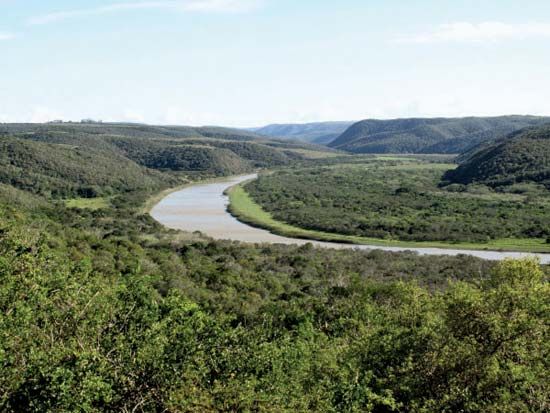
The Great Fish River is a 430-mile-long river located in the Eastern Cape province of South Africa. It should not be confused with the Fish River in Namibia…
What is Great Fish River?
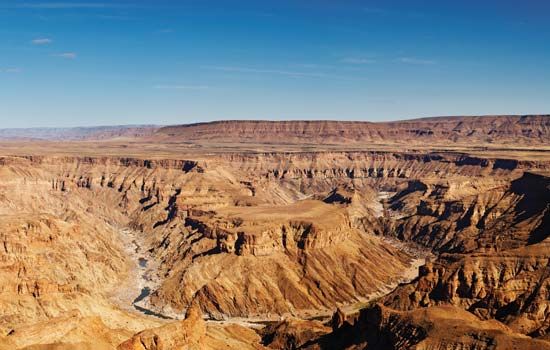
The Great Fish River is a 430-mile-long river located in the Eastern Cape province of South Africa. It should not be confused with the Fish River in Namibia, which is a separate, intermittent stream that flows into the Orange River.12
The Great Fish River flows primarily southward before turning east to enter the Indian Ocean near Makhanda. Historically, the river served as a significant boundary; by 1500 CE, Nguni peoples had settled in the region, and in the 19th century, the valley became a conflict zone between British settlers and local tribal groups.1
Due to the river’s erratic runoff, an irrigation project was established in 1980 to transfer water from the Gariep Dam via a 51-mile-long tunnel.1
What was the significance of the Great Fish River during the 19th-century frontier wars?
During the 19th-century Cape Frontier Wars, the Great Fish River served as a critical, contested boundary between the Cape Colony and the Xhosa people.
Its significance included:
- Territorial Boundary: The river valley functioned as a primary frontier zone where colonial expansion met Xhosa settlement. By the early 19th century, the lower valley became a frequent battleground as British settlers moved eastward from the Cape.34
- Buffer Zone: Following the 1818–19 conflict, the territory between the Great Fish and Keiskamma rivers was declared a “neutral” zone. The British government attempted to clear this area of its Xhosa inhabitants to create a buffer, though these efforts were largely unsuccessful.3
- Strategic Flashpoint: The region was the site of intense, intermittent warfare for decades. Tensions over land, cattle trade, and colonial encroachment led to multiple conflicts, eventually resulting in the annexation of Xhosa territories and the displacement of indigenous populations.3
How does the Orange-Fish River water transfer project work?
The Orange-Fish River water transfer project is a major engineering feat designed to overcome the erratic and limited runoff of the Great Fish River. Because the Great Fish River basin lacks consistent water flow, this project facilitates the movement of water from the Orange River basin to support agricultural development.15
The system functions through the following components:
- Gariep Dam: Serving as the primary water-conservation structure, this dam stores water in the Gariep Reservoir for distribution.5
- Orange–Fish Tunnel: Completed in 1975–1980, this 51-mile (82-km) tunnel acts as the critical conduit, transporting water directly from the Gariep Dam to the Great Fish River basin.15
- Distribution: Once the water reaches the Great Fish River, it is utilized for irrigation along the river’s course. Additionally, an irrigation canal connects the Great Fish and Sundays River basins to further extend the reach of the transferred water.15
Who were the Khoekhoe and Nguni peoples who lived near the river?
The regions near the Great Fish River were historically inhabited by diverse groups, primarily the Nguni and Khoekhoe peoples.
The Nguni Peoples
The Nguni are a cluster of related Bantu-speaking groups whose ancestors occupied a broad territory extending from the Great Fish River northward along the Indian Ocean coast.6
- Social Structure: They were organized into various political entities, such as the Xhosa, Thembu, and Mpondo, each led by a chief.6
- Economy: Their society was based on mixed farming, with a distinct division of labor where men managed cattle—which held significant social and subsistence value—and women focused on hoe cultivation.6
- Cultural Interaction: The Nguni languages are unique for incorporating “clicking” phonemes, which were absorbed through intermarriage with earlier Khoisan-speaking peoples.6
The Khoekhoe Peoples
The Khoekhoe (historically and pejoratively referred to as Hottentots) were pastoralists encountered by early European explorers.7
- History and Decline: By the end of the 18th century, Khoekhoe chiefdoms were largely decimated by smallpox and colonial expansion. Many survivors were reduced to conditions of serfdom on colonial farms, while others fled to join Xhosa groups in counteroffensives against colonialism.89
- Legacy: Some Khoekhoe groups merged with others of mixed ancestry to form new communities, such as the Griqua, who established independent states north of the Orange River.9
Sources
- Great Fish River — Encyclopædia Britannica
- Fish River — Encyclopædia Britannica
- Cape Frontier Wars — Encyclopædia Britannica
- South African War - Underlying causes — Encyclopædia Britannica
- Orange River - Irrigation — Encyclopædia Britannica
- Xhosa — Encyclopædia Britannica
- Nguni — Encyclopædia Britannica
- South Africa - Growth of the colonial economy — Encyclopædia Britannica
- South Africa - Settlement of the Cape Colony — Encyclopædia Britannica
- Khoekhoe — Encyclopædia Britannica
Published on · 3 min read