Great Horned Owl
The great horned owl (Bubo virginianus) is a powerful, mottled-brown predator belonging to the horned owl genus. It is widely distributed across the…
What is Great horned owl?
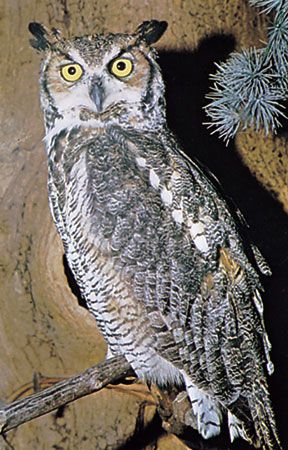
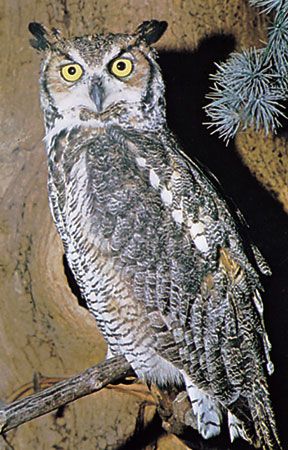
The great horned owl (Bubo virginianus) is a powerful, mottled-brown predator belonging to the horned owl genus. It is widely distributed across the Americas, ranging from the Arctic tree limits south to the Strait of Magellan, though it is notably absent from the Amazon Rainforest.
Physically, the species is robust, often exceeding 60 cm (24 inches) in length with a wingspan that can reach up to 2 meters (6.6 feet) in females. Adapted to both desert and forest environments, these owls are primarily nocturnal hunters that feed on small rodents and birds, though they are capable of taking larger prey. They typically migrate only when food sources become scarce.
Behaviorally, they are known for their distinct vocalizations and territorial displays, which include deep hooting and elaborate posturing, such as bowing and raising the tail. As apex predators, they are even known to prey upon other raptors, including the spotted owl.
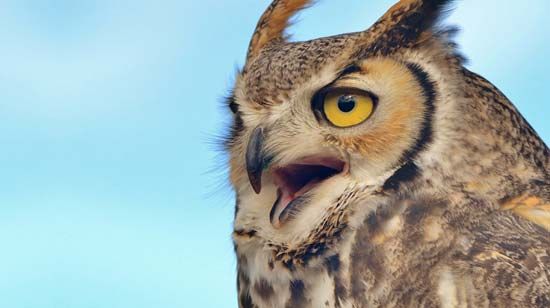
What do the ‘horns’ on a great horned owl actually do?
The “horns” on a great horned owl are not actual horns, nor do they have any function related to hearing. They are simply tufts of feathers, often called ear tufts, that are controlled by small muscles under the skin.6
These feather tufts serve two primary purposes:
- Camouflage: By breaking up the round outline of the owl’s head, the tufts help the bird blend into its surroundings, making it look more like a broken branch when it is resting at its daytime roost.78
- Communication: Owls use these tufts as part of their visual signaling. For instance, when an owl is trying to avoid attention, it may elevate its ear tufts while compressing the rest of its plumage to enhance its disguise.8
While these tufts are sometimes colloquially referred to as “ears,” the owl’s actual ear openings are located on the sides of the head, hidden by feathers.6
How do great horned owls hunt in the dark?
Great horned owls are highly effective nocturnal hunters that rely on a combination of acute senses and specialized physical adaptations to capture prey in the dark.
Auditory Precision
The primary tool for hunting in low-light conditions is the owl’s exceptional hearing. Their ears are large and surrounded by a ruff of papery feathers that concentrates sound toward the ear openings. Crucially, many owls possess asymmetrical ear openings—one positioned higher than the other—which allows them to localize the source of a sound in two planes simultaneously. By detecting the minute time difference (as little as 30 millionths of a second) between when a sound reaches each ear, they can pinpoint the exact location of prey, such as a rustling mouse, even in total darkness.4710
Silent Flight and Vision
To ensure they can hear their prey without interference, great horned owls have flight feathers with a specialized nap that renders their flight perfectly noiseless. While they rely heavily on sound for the final strike, their large, forward-facing eyes are highly sensitive to light, providing excellent visual acuity during the twilight hours of dusk and dawn.10
What are some other species of owls found in North America?
North America is home to a diverse array of owl species, ranging from the tiny elf owl to the large great gray owl. Here are some notable species found on the continent:
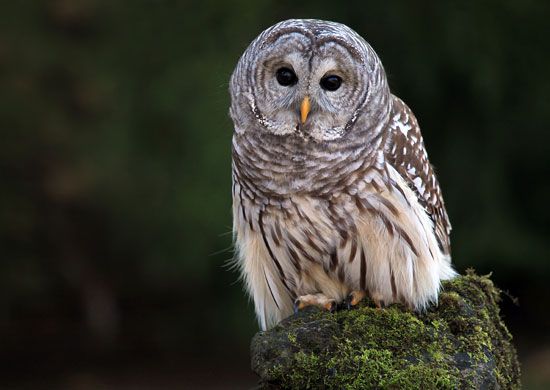
- Barred owl: A common species in eastern North America, the Pacific Northwest, and parts of Canada and Mexico. They are easily recognized by their brown-and-white barred plumage and their distinctive “Who cooks for you?” call.712
- Spotted owl: A medium-sized, earless owl found in western North America. They are known for their preference for old-growth forests and are currently listed as a near-threatened species due to habitat loss and competition with barred owls.7135
- Great gray owl: One of the largest owl species, often exceeding 70 cm in length. They are found in northern regions of North America, as well as Europe and Asia.7
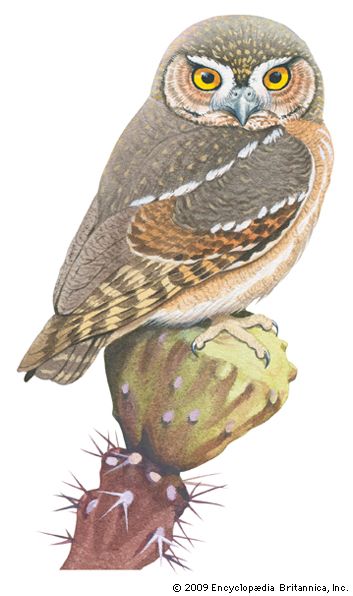
- Elf owl: Known as the smallest owl in the world, this sparrow-sized bird inhabits the southwestern United States and Mexico, often nesting in cacti.14
- Short-eared owl: One of the most widely distributed owl species in the world, found across many continents including North America.15
- Barn owl: Another globally widespread species that is also found throughout North America.15
Sources
- Great horned owl — Encyclopædia Britannica
- Owl - Reproduction and development — Encyclopædia Britannica
- Horned owl — Encyclopædia Britannica
- Owl - Behaviour — Encyclopædia Britannica
- Spotted owl — Encyclopædia Britannica
- horned owl — Merriam-Webster
- Owl - Form and function — Encyclopædia Britannica
- How Do Birds Hear? — Encyclopædia Britannica
- great horned owl — Merriam-Webster
- sound reception - Uses of hearing in birds — Encyclopædia Britannica
- Owl - Ecology — Encyclopædia Britannica
- Wood owl — Encyclopædia Britannica
- Barred owl — Encyclopædia Britannica
- Spotted owl: Top Questions — Encyclopædia Britannica
- Owl - General features — Encyclopædia Britannica
- Elf owl — Encyclopædia Britannica
Published on · 3 min read