Laughing Owl
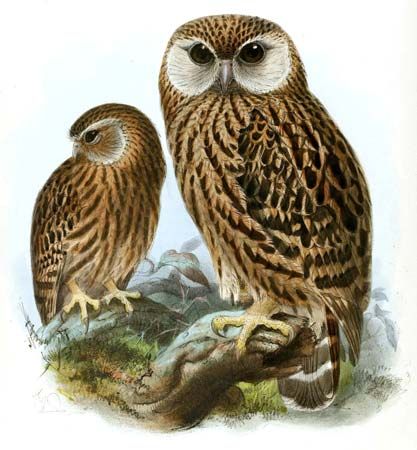
The laughing owl (Sceloglaux albifacies) was a species of owl in the family Strigidae that was endemic to New Zealand.
What is Laughing owl?
The laughing owl (Sceloglaux albifacies) was a species of owl in the family Strigidae that was endemic to New Zealand.12
Measuring approximately 40 cm (1.3 feet) in length, this brownish bird was a ground-nester, a trait that made it particularly vulnerable to predators introduced by settlers, such as cats, rats, goats, and weasels. Its diet consisted primarily of insects, lizards, and rodents. The species was driven to extinction in the early 1900s due to these environmental pressures.12
What other species in New Zealand have gone extinct?
In addition to the laughing owl, several other species native to New Zealand have gone extinct, largely due to human activity and the introduction of non-native predators. Notable examples include:
- Moa: These were a group of ostrich-like flightless birds that ranged significantly in size. While some smaller species may have persisted into the 19th century, the ancestors of the Māori people are credited with hunting all 11 known species to extinction between 1250 and 1350.45
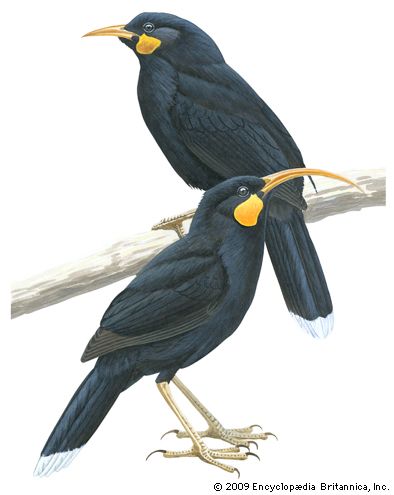
- Huia: A member of the wattlebird family (Callaeidae), the huia was famous for its extreme sexual dimorphism, where males and females possessed differently shaped bills. This unique bird has been extinct since the early 20th century.6
The loss of these species highlights the vulnerability of island-dwelling animals that evolved in the absence of predatory mammals.
Why are ground-nesting birds more vulnerable to predators?
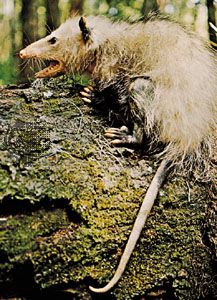
Ground-nesting birds are significantly more vulnerable to predators because their nests are situated in locations that are easily accessible to a wide range of terrestrial animals, such as snakes, raccoons, opossums, and introduced species like rats and domestic cats.89
Unlike birds that nest in elevated or protected sites, ground-nesting species lack the physical barriers that typically deter predators from reaching their eggs and young. This vulnerability is particularly acute for species on islands, where native wildlife may have evolved without exposure to mammalian predators and therefore lack the necessary defensive behaviors to protect their nests. Because these nests are placed on the ground, they are often easily discovered by predators that hunt by scent or sight, making the eggs and helpless nestlings easy targets.1089
What are some other unique owl species found around the world?
Owls exhibit remarkable diversity in size, habitat, and behavior across the globe. Beyond the species already discussed, here are several unique owls found in various environments:
- Spectacled owl: Found in tropical American forests, this nocturnal predator is named for the distinctive white feathers surrounding its eyes. It is the largest tropical American owl and is often heard emitting a rhythmic series of accelerating hoots.12
- Elf owl: As the smallest owl in the world, the elf owl is roughly the size of a sparrow. Native to the southwestern United States and Mexico, it typically nests in holes found in cacti or trees and hunts insects at night.13
- Burrowing owl: These small, long-legged owls inhabit prairie lands throughout the Western Hemisphere. Unlike many other species, they nest in underground burrows abandoned by other animals and are often active during the day.1415
- Great horned owl: A powerful and widespread predator, this species ranges from the Arctic to the southern tip of South America. It is known for its size, often exceeding 60 cm (2 feet) in length, and its ability to hunt a variety of prey.16
- Snowy owl: This large, Arctic-dwelling bird is well-adapted to cold climates with thick plumage. Unlike many other owls, it nests on the ground in open tundra and is known for its white or barred brown-and-white appearance.1718
- Barn owl: Easily recognized by its heart-shaped facial disk, the barn owl is found worldwide. It is a nocturnal hunter that often utilizes man-made structures, such as towers and buildings, for nesting.19
Sources
- Laughing owl — Encyclopædia Britannica
- laughing owl — Merriam-Webster
- Owl - Reproduction and development — Encyclopædia Britannica
- Moa — Encyclopædia Britannica
- New Zealand - Plant and animal life — Encyclopædia Britannica
- Callaeidae — Encyclopædia Britannica
- Flightless bird — Encyclopædia Britannica
- conservation - Introduced species — Encyclopædia Britannica
- Bird - Nesting — Encyclopædia Britannica
- Common yellowthroat: Top Questions — Encyclopædia Britannica
- Reproductive behaviour - Parental care — Encyclopædia Britannica
- Spectacled owl — Encyclopædia Britannica
- Elf owl — Encyclopædia Britannica
- Burrowing owl — Encyclopædia Britannica
- Great horned owl — Encyclopædia Britannica
- Snowy owl — Encyclopædia Britannica
- burrowing owl — Merriam-Webster
- snowy owl — Merriam-Webster
- Owl - General features — Encyclopædia Britannica
- Owl - Form and function — Encyclopædia Britannica
- Barn owl — Encyclopædia Britannica
- Spotted owl — Encyclopædia Britannica
Published on · 3 min read