Green Mountains
The Green Mountains serve as a defining feature of Vermont, significantly shaping its economic landscape through both agriculture and tourism.
How have the Green Mountains influenced Vermont’s economy, particularly in agriculture and tourism?
The Green Mountains serve as a defining feature of Vermont, significantly shaping its economic landscape through both agriculture and tourism.
Agriculture
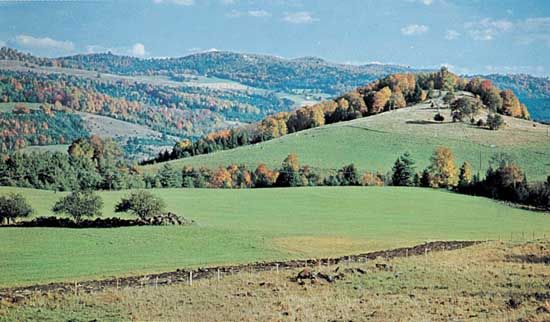
The mountains influence farming primarily through their topography and climate. Because the terrain is largely rocky with thin topsoil, only about 15 percent of the state consists of level, fertile land. This environment, combined with a short growing season, has made dairying the dominant form of commercial agriculture. While farming has been surpassed by other sectors, it remains vital to the state’s identity and economy, as the agricultural landscape itself is a key driver of tourism.123
Tourism
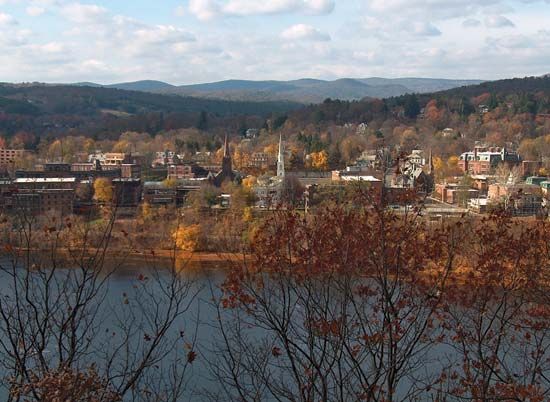
Tourism is the state’s second-largest economic component, heavily reliant on the Green Mountains’ natural resources.4
- Winter Sports: The mountains are a premier destination for skiing, with major resorts at locations like Stowe and the Mad River valley attracting visitors throughout the Northeast.45
- Recreation: During warmer months, the mountains support hiking along the Long Trail and other outdoor activities.45
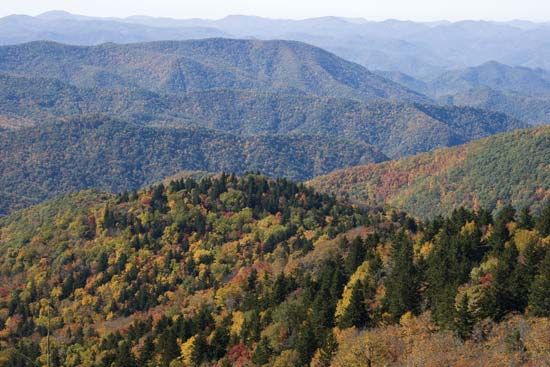
- Seasonal Appeal: The scenic beauty of the forested peaks—protected in part by the Green Mountain National Forest—draws significant numbers of “leaf-peeping” tourists each autumn.45
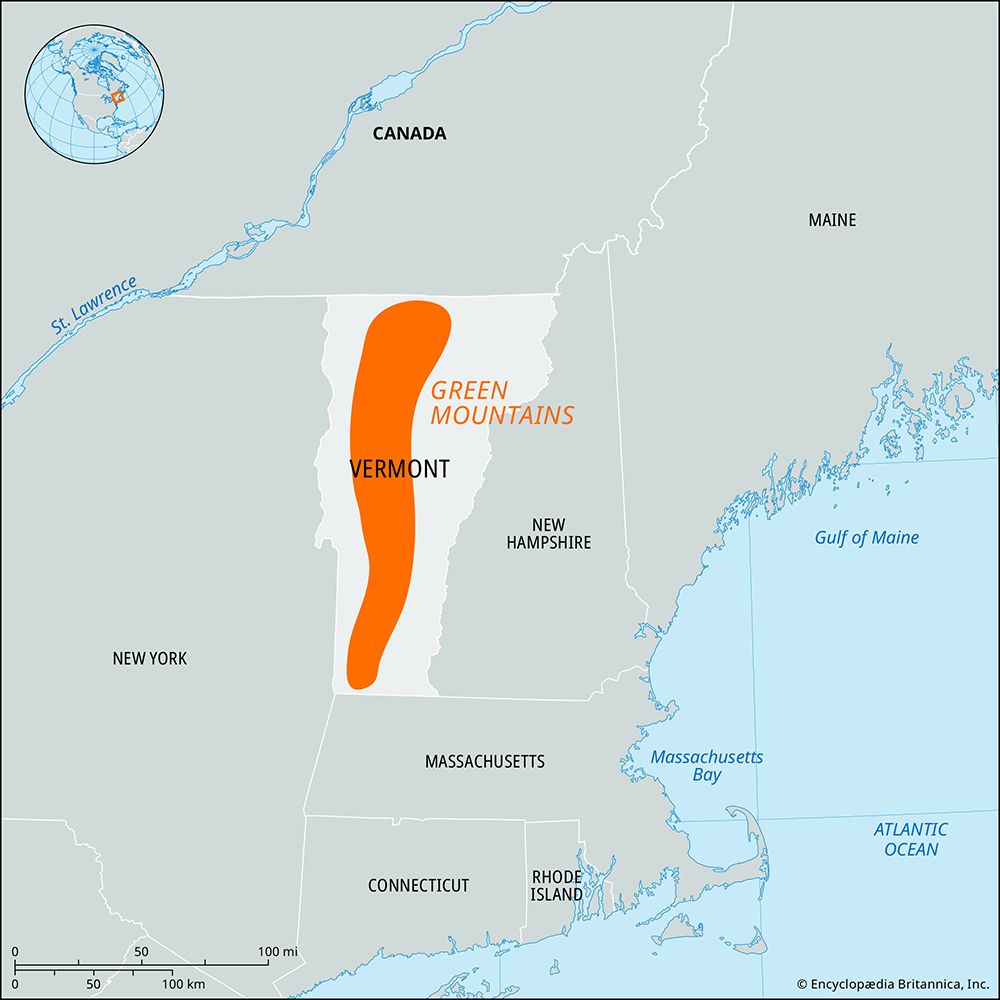
Where are the Green Mountains located in Vermont, and how extensive is the mountain range?
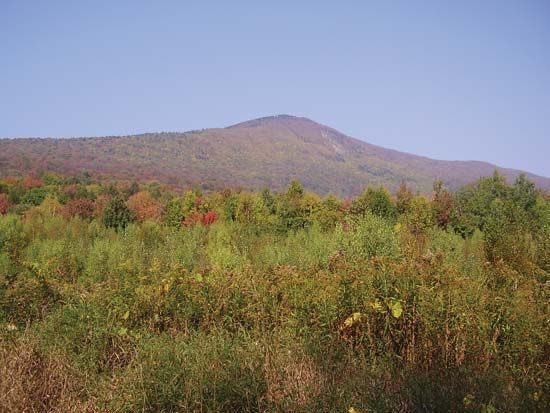
The Green Mountains are a prominent mountain range within the Appalachian Mountain system, serving as a north-south “backbone” through the center of Vermont.47
The range is quite extensive, stretching approximately 250 miles (402 km) from southern Quebec through Vermont and continuing into western Massachusetts, where the mountains become known as the Berkshire Hills. Within Vermont, the range maintains a width that typically varies between 20 and 36 miles (30 to 58 km).410117
The landscape is characterized by numerous peaks rising above 3,000 feet, with Mount Mansfield standing as the highest point in the state at 4,393 feet (1,339 meters). The mountains are traversed by the Long Trail, which is partly integrated with the Appalachian National Scenic Trail.4712
What Native American tribes originally inhabited the Green Mountains region?
The region encompassing the Green Mountains was primarily inhabited by the Abenaki, an Algonquian-speaking people who occupied the area by the 17th century. The Abenaki were organized into various groups, including the Sokoki and Cowasuck along the Connecticut River and the Missisquoi near Lake Champlain.1314
In addition to the Abenaki, other groups such as the Mohican and Mohawk also lived in the region. Historically, Lake Champlain served as a boundary between the Abenaki and the tribes of the Iroquois Confederacy.13
These Indigenous populations utilized the diverse landscape for a traditional economy based on hunting, fishing, and horticulture, growing crops such as corn, beans, and squash. Following European contact, the Abenaki were significantly impacted by disease and the military conflicts of the colonial era, leading many to migrate to Canada or integrate into the local population. Today, several groups in Vermont assert Abenaki descent and have received state-level recognition.1314
How did the Green Mountains get their name, and has it changed over time?
The name “Vermont” is derived from the French words vert and mont, which translate to “green mountains.” This name was applied to the region because of the thick coniferous growth that keeps the mountains appearing green throughout the year.11
The name of the mountain range itself has remained consistent as the “Green Mountains.” While the name has not changed, it has served as the namesake for several significant historical and cultural entities. Most notably, the Green Mountain Boys were a famous patriot militia organized in 1770 to defend land rights in the region during the period leading up to the American Revolution. The term “Green Mountain boy” subsequently became a common nickname for male residents of Vermont.154
Sources
- Vermont - Agriculture — Encyclopædia Britannica
- Vermont - Tourism — Encyclopædia Britannica
- Vermont - Mining — Encyclopædia Britannica
- Green Mountains — Encyclopædia Britannica
- Vermont - Demographic trends — Encyclopædia Britannica
- Vermont - Settlement patterns — Encyclopædia Britannica
- Vermont - Relief — Encyclopædia Britannica
- Vermont - Climate — Encyclopædia Britannica
- skiing - Skiing grows in popularity — Encyclopædia Britannica
- Appalachian Mountains - Physiography — Encyclopædia Britannica
- Green Mountains — Merriam-Webster
- Mount Mansfield — Encyclopædia Britannica
- Vermont - Exploration and settlement — Encyclopædia Britannica
- Abenaki — Encyclopædia Britannica
- Green Mountain boy — Merriam-Webster
- Green Mountain Boys — Encyclopædia Britannica
Published on · 3 min read