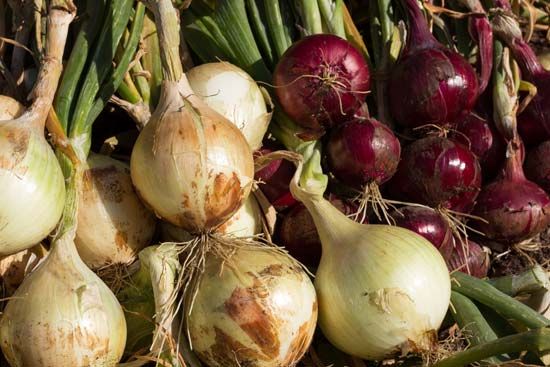
Green Onion
A green onion, also known as a scallion, is a young onion harvested while its tops remain green and its underdeveloped bulb is 13 mm (0.5 inch) or less in…
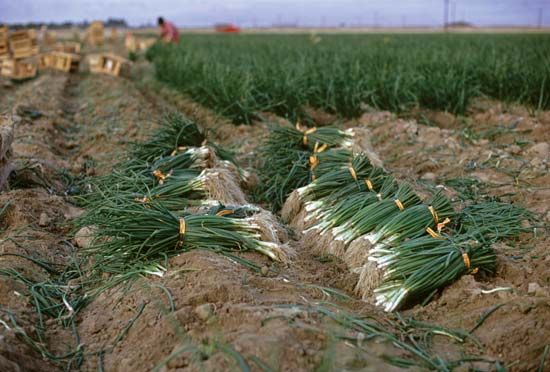
What is Green onion?
A green onion, also known as a scallion, is a young onion harvested while its tops remain green and its underdeveloped bulb is 13 mm (0.5 inch) or less in diameter.12
While many commercial green onions are immature plants of the common onion (Allium cepa), the term also encompasses the Chinese onion (A. chinense), the Welsh onion (A. fistulosum), and various hybrids of these species. Because they possess a mild flavor, nearly the entire plant—including the hollow tubular tops, stem, and bulb—is edible. They are frequently used raw in salads and sauces, as a garnish, or as a seasoning for prepared dishes, and they can also be pickled.12
Green onions are closely related to other members of the Amaryllidaceae family, such as chives, leeks, shallots, and garlic.1

What are the main differences between scallions and spring onions?
While the terms are sometimes used interchangeably, there are distinct differences between scallions and spring onions based on their maturity and physical characteristics:
- Scallions (Green Onions): These are young onions harvested when their tops are still green and the underdeveloped bulb is 13 mm (0.5 inch) or less in diameter. Because they are very young, almost the entire plant—including the stem, bulb, and hollow green tops—is edible and typically used raw in salads, sauces, or as a garnish.4
- Spring Onions: These are small white onions that are allowed to grow slightly larger than scallions, typically harvested when the bulb is between 25 and 38 mm (1 and 1.5 inches) in diameter. While the tops are sometimes left attached, these onions are more frequently served cooked, such as boiled or baked, or used to flavor delicate dishes like omelets and sauces.4
In some contexts, the terms are considered synonymous, though the specific size of the bulb at harvest remains the primary technical differentiator.34
How do chives and leeks differ from green onions in flavor and use?
While green onions (scallions) are young, underdeveloped onions used for their mild flavor in raw applications like salads, garnishes, and sauces, chives and leeks offer different culinary profiles:
Chives
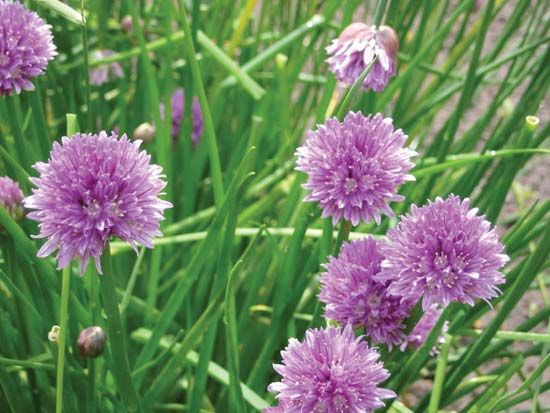
- Flavor and Use: Chives are small perennial plants grown primarily for their thin, tubular leaves, which serve as a delicate seasoning. Unlike green onions, which are used for their bulb and stem, chives are typically used as a fresh or dried herb to flavor eggs, soups, salads, and vegetables.15
- Characteristics: They grow in clumps and produce attractive, edible flowers, making them popular as both a potherb and an ornamental plant.1
Leeks
- Flavor and Use: Leeks have a mild, sweet, onion-like flavor. Unlike the raw-focused use of green onions, leeks are widely used in cooked dishes, particularly as a staple in European soups and stews or cooked whole as a vegetable.6
- Characteristics: They are hardy biennial plants with long, linear leaves that overlap to form a cylindrical bulb. Growers often mound soil around the base to blanch the stalk, creating a long, white, tender section.6
Why do onions make people cry when they are chopped?
When you chop onions, you trigger a series of chemical reactions that result in tears. Onions are highly effective at absorbing sulfur from the soil, which they incorporate into various amino acids.
When a knife breaks the onion’s cells, it releases these sulfur-rich amino acids and enzymes that were previously separated. These components react to form unstable sulfenic acids, which then rearrange into a volatile chemical known as syn-propanethial-S-oxide (also called the lacrimatory factor).89
Because this chemical is volatile, it easily vaporizes and floats up from the cutting board. When it makes contact with your eyes, it causes a burning sensation. Your brain, attempting to protect your eyes from this irritant, triggers a tear response to rinse the substance away.8
To reduce this effect, you can refrigerate or freeze onions before chopping, as cold temperatures slow down the enzymes responsible for these reactions. Additionally, choosing less sulfurous varieties, such as sweet onions, can help minimize the irritation.8
Sources
- Green onion — Encyclopædia Britannica
- green onion — Merriam-Webster
- Onion — Encyclopædia Britannica
- spring onion — Merriam-Webster
- Chive — Encyclopædia Britannica
- Leek — Encyclopædia Britannica
- chive — Merriam-Webster
- Why Do Onions Make You Cry? — Encyclopædia Britannica
- organosulfur compound - Reactions — Encyclopædia Britannica
Published on · 3 min read