Onion
Onions (Allium cepa) are versatile bulbs that vary significantly in size, shape, color, and pungency. Their characteristic flavor comes from sulfur-rich…
What are the different varieties of onions, and how do they differ in taste and appearance?
Onions (Allium cepa) are versatile bulbs that vary significantly in size, shape, color, and pungency. Their characteristic flavor comes from sulfur-rich volatile oils, which are generally milder in onions grown in warmer climates.1
Common varieties include:
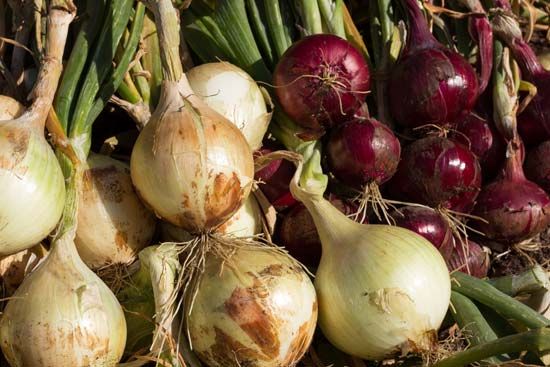
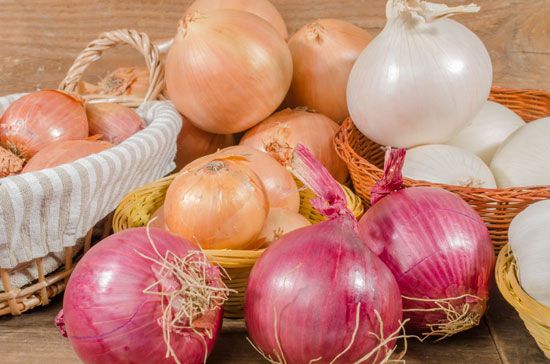
- Globe-shaped onions: Available in white, yellow, or red, these have a strong flavor and are ideal for soups, stews, and frying.1
- Bermuda onions: Large and flat with white or yellow skin, these offer a fairly mild taste and are excellent for roasting, stuffing, or raw use.1
- Spanish onions: Large, juicy, and sweet, these range from yellow to red and are often used raw in salads or as a garnish.1
- Italian (cipollini) onions: Flat and colorful (red, white, or yellow), these are typically mild and sweet.1
- Shallots: Small, angular bulbs with white flesh and brown or red skin; they are mildly aromatic and often grow in clusters.12
- Pearl onions: Small, round white onions (under 25 mm) often used for pickling or as a garnish.1
- Spring onions: Small white onions harvested young, used for delicate dishes.1
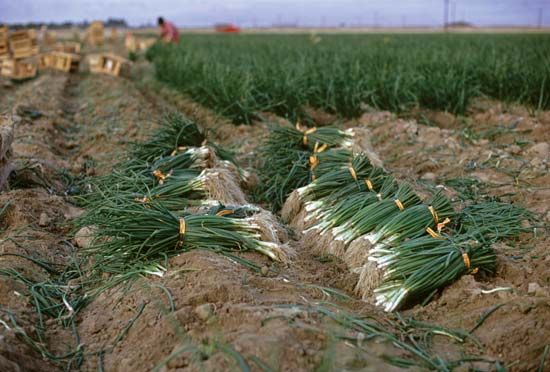
- Green onions: Also known as scallions, these are harvested when young with green tops and are used raw for a mild flavor.1
What parts of the onion plant are edible, and how are they used?
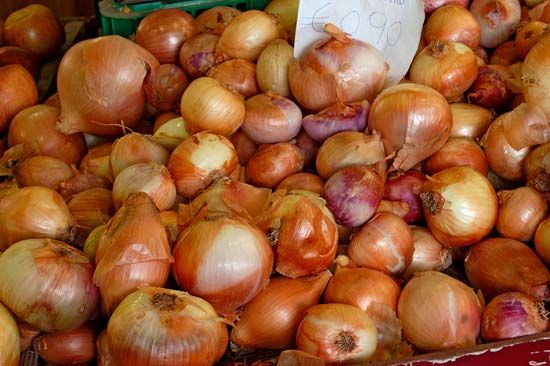
The onion plant (Allium cepa) is primarily cultivated for its edible bulb, which is formed by the plant’s concentric leaf bases. While the bulb is the most widely consumed part, other portions of the plant are also edible depending on the variety and stage of growth.1
Edible Parts and Uses
- Bulbs: The underground bulb is the primary edible portion of the common onion. It is used extensively in cooking to add flavor to stews, roasts, soups, and salads, or served as a cooked vegetable.1
- Green Tops and Stems: In varieties such as green onions (scallions), nearly the entire plant—including the hollow tubular tops, stems, and underdeveloped bulbs—is edible. These are typically used raw in salads and sauces, as a garnish, or as a seasoning. Similarly, the green leaves of shallots are also edible.13
- Bulbils: Some onion plants produce tiny secondary bulbs known as bulbils at the top of their flower stalks, which can be used for propagation.1
How have onions been used historically in various cultures and cuisines?
Onions are among the world’s oldest cultivated plants, with a history of use in India, China, and the Middle East that predates recorded history. Their cultural significance has been profound: Ancient Egyptians revered the spherical bulb as a symbol of the universe, and the concentric layers were famously likened to the Aristotelian cosmos.1
Historically, onions have served both culinary and medicinal roles:
- Culinary Traditions: The Romans introduced onions to Britain, while in the New World, Native Americans incorporated the pungent wild onion (Allium canadense) into their stews. Today, they remain a global staple, valued for adding depth to soups, roasts, and salads.1
- Folk Medicine: For centuries, various cultures have attributed curative powers to the onion. It has been used as a traditional remedy for ailments ranging from colds, earaches, and laryngitis to burns, warts, and animal bites.1
How do onions grow, and what are the ideal conditions for cultivating them?
Onions (Allium cepa) are hardy biennial plants that grow by developing concentric leaf bases, which swell underground to form the edible bulb. While they can be propagated asexually through bulbils—tiny secondary bulbs that sometimes form on flower stalks—most commercial crops are grown from seeds sown directly in the field. Alternatively, they may be cultivated from small bulbs or transplants.15
Regarding cultivation, onions are highly adaptable and can survive in a wide range of growing conditions, though they are primarily grown in temperate zones. Climate significantly influences the final product: warmer climates generally produce onions with a milder, sweeter flavor, whereas other conditions may result in higher pungency due to the plant’s sulfur-rich volatile oil.1
Sources
- Onion — Encyclopædia Britannica
- Shallot — Encyclopædia Britannica
- Green onion — Encyclopædia Britannica
- Egyptian onion — Merriam-Webster
- Asparagales - Storage organs — Encyclopædia Britannica
Published on · 3 min read