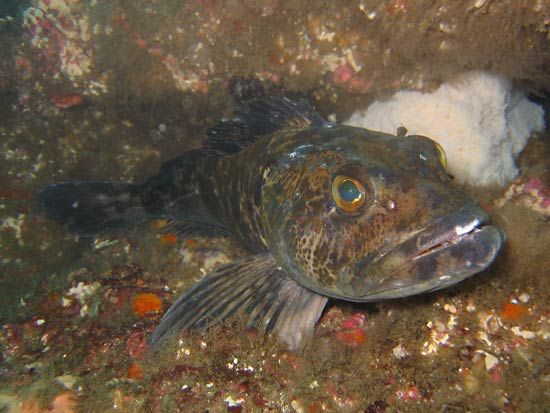
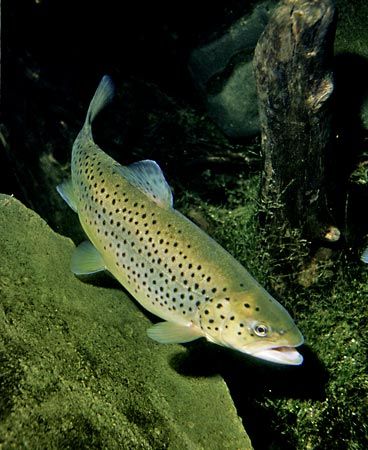
Greenling
A greenling is any of several marine fish belonging to the family Hexagrammidae. These carnivorous fish are native to the North Pacific and are generally…
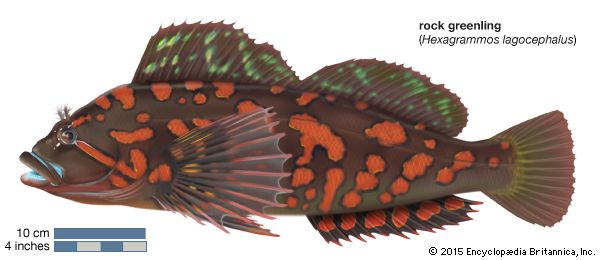
What is greenling?
A greenling is any of several marine fish belonging to the family Hexagrammidae. These carnivorous fish are native to the North Pacific and are generally characterized by long dorsal fins, small scales, and strong jaw teeth. Most species in this family do not grow longer than 45 to 46 centimeters (about 18 inches).
Several notable species fall under this classification, including:
- The Atka mackerel, a black and yellow banded fish popular for sport and consumption.
- The lingcod, a large predator found in the North Pacific.
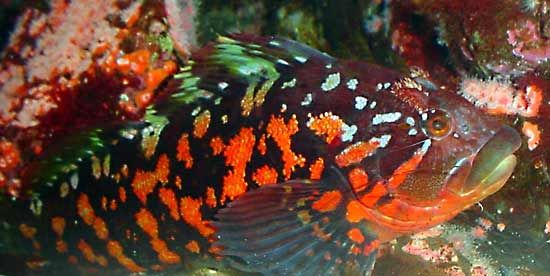
- The rock greenling, a game fish inhabiting shallow coastal waters.
- The ainame, a common food fish in Japan.
Many greenlings are highly valued as food sources.
What makes the lingcod a unique predator?
The lingcod (Ophiodon elongatus) is a unique and voracious predator native to the Pacific coast of North America. Unlike many other members of the greenling family, which are generally smaller, the lingcod can reach impressive lengths of up to 1.5 meters (5 feet).2
Its predatory nature is supported by several distinct physical adaptations:
- Powerful Anatomy: It possesses a large mouth equipped with sharp, canine-like teeth, which allow it to effectively hunt and consume a variety of aquatic prey, including other fish and squid.2
- Physical Build: The species features well-developed fins and tails, providing the agility and strength necessary for its role as an active hunter.2
- Distinctive Appearance: While the fish is a popular commercial and game species, it is notable for having meat that exhibits a greenish color, though it remains highly regarded as a food source.23
How do Atka mackerel survive in the North Pacific?
The Atka mackerel (Pleurogrammus monopterygius) is a member of the greenling family (Hexagrammidae) found in the waters of Alaska and adjacent North Pacific regions.4
Regarding their survival and reproductive strategies, Atka mackerel deposit their eggs in a single clump, typically attaching them to algae located on stony bottoms in shallow water. Unlike some of their relatives, such as the lingcod, which actively guard their egg masses during the incubation period, the provided information does not indicate that Atka mackerel provide parental care for their eggs.5
The Britannica knowledge base does not contain further specific details regarding the broader survival mechanisms, such as feeding habits or environmental adaptations, of the Atka mackerel in the North Pacific.
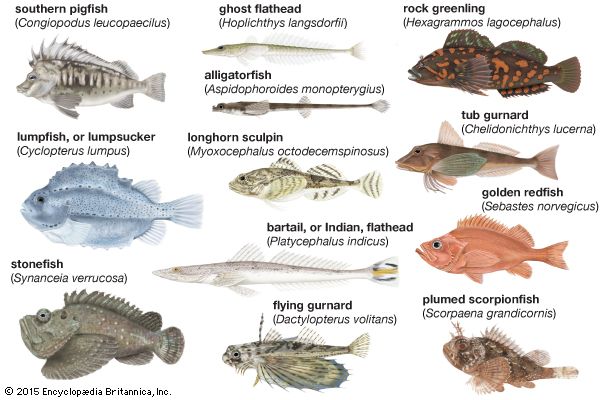
What are the characteristics of the order Scorpaeniformes?
The order Scorpaeniformes, commonly known as “mail-cheeked fishes,” is a diverse group of bony fishes found in oceans worldwide, ranging from coastal zones to depths of at least 4,000 meters.6
Key Characteristics
The defining diagnostic feature of the order is a bony bar or “stay” beneath the eye, which is an extension of the second infraorbital bone that connects to the preopercular bone. This structure creates a rigid plate across the cheek, giving the group its common name.786
Additional general characteristics include:
- Body Plan: While many species exhibit a simple spindle-shaped body, others are extremely slender or heavily armored with bony plates and scutes.78
- Fins: Most members possess two dorsal fins, with the forward one often supported by stiff spines. The pelvic fins are typically thoracic in location and, in some groups, are modified into sucker disks.78
- Diversity: The order includes approximately 1,477 species, ranging from the well-known scorpion fishes and rockfishes to sea robins, sculpins, and flatheads.68
Sources
- greenling — Encyclopædia Britannica
- lingcod — Encyclopædia Britannica
- lingcod — Merriam-Webster
- Atka mackerel — Merriam-Webster
- scorpaeniform - Reproduction — Encyclopædia Britannica
- scorpaeniform — Encyclopædia Britannica
- scorpaeniform - General features — Encyclopædia Britannica
- scorpaeniform - Annotated classification — Encyclopædia Britannica
- scorpaeniform - Critical appraisal — Encyclopædia Britannica
Published on · 3 min read