Scorpaeniform
The provided search results do not contain information regarding the conservation status of scorpaeniform fish, such as whether any specific species are…
Are there any scorpaeniform fish that are considered endangered or threatened?
The provided search results do not contain information regarding the conservation status of scorpaeniform fish, such as whether any specific species are currently classified as endangered or threatened.
The available information focuses on the biological characteristics, ecology, and classification of the order Scorpaeniformes, including well-known groups like scorpion fishes, sea robins, flatheads, and sculpins.
How do scorpaeniform fish, like lionfish, impact marine ecosystems?
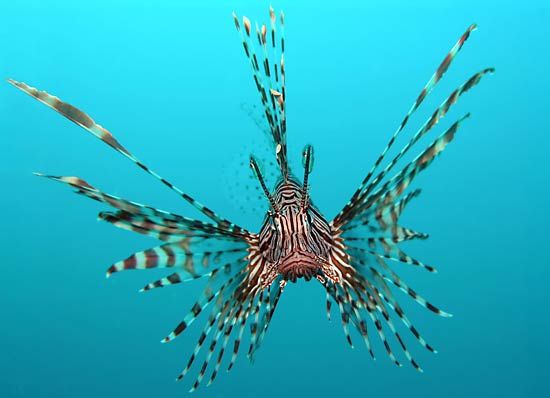
Scorpaeniform fishes, such as the lionfish, impact marine ecosystems primarily through their roles as predators and, in some cases, as disruptive invasive species.
Ecological Impact of Invasive Lionfish
When species like the red lionfish are introduced to non-native environments—such as the Caribbean Sea, the Gulf of Mexico, and the U.S. Eastern Seaboard—they can cause significant ecological damage. Their impact is driven by several factors:43
- Lack of Natural Enemies: In these invaded regions, lionfish face few natural predators, allowing their populations to grow unchecked.43
- Decimation of Local Species: Their rapid reproduction and predatory nature lead to the significant reduction of local reef fish populations, which disrupts the balance of the ecosystem.43
- Establishment: Often introduced by pet owners or through accidental releases, these fish have successfully established breeding populations in new territories, such as the Mediterranean basin via the Suez Canal.4
General Ecological Roles
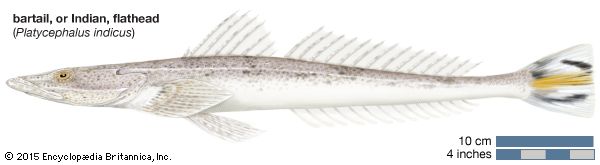
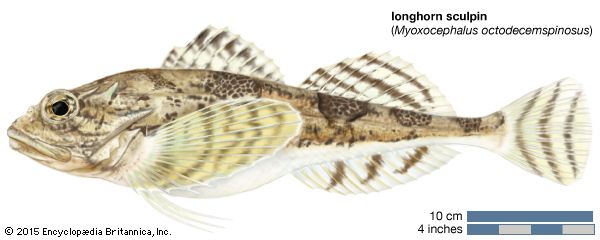
Beyond invasive contexts, scorpaeniforms are generally carnivorous and occupy various niches in marine and freshwater environments. Many, such as sculpins and flatheads, act as bottom-dwelling predators that help regulate populations of smaller fishes and crustaceans. While some species use camouflage to ambush prey, others, like the lionfish, are active hunters that use their pectoral fins to assist in capturing food.52
What are the main characteristics of scorpaeniform fish?
Scorpaeniforms (order Scorpaeniformes) are a diverse group of bony fishes found globally in marine and some freshwater environments. They are highly successful, inhabiting areas ranging from the littoral zone to depths exceeding 4,000 meters.1
Diagnostic Characteristics
The defining feature of the order is a bony bar or “stay” beneath the eye, which is an extension of the second infraorbital bone. This structure varies from inconspicuous in primitive species to prominent or armor-like in others.6
Physical and Behavioral Traits
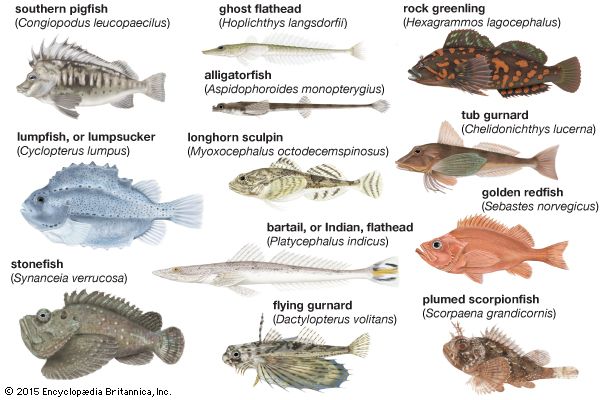
- Body Plans: While many species exhibit a simple spindle-shaped body, others are extremely slender or have evolved specialized shapes, such as the flattened bodies of flatheads adapted for life on the seabed.62
- Fins: Most species possess two dorsal fins, with the forward one often supported by stiff spines. Pectoral fins are frequently large and can be used for locomotion or as auxiliary power during prey capture.62
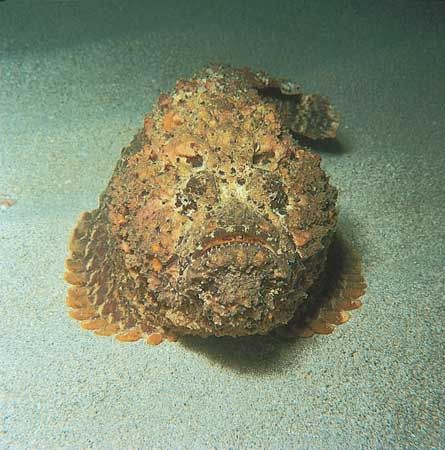
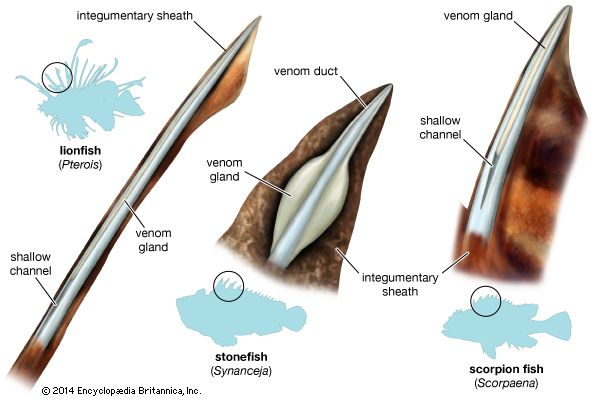
- Camouflage and Defense: Many scorpaeniforms, such as scorpion fishes, utilize concealing coloration to blend into rocky or coral backgrounds. Some, like the stonefish, possess venomous dorsal spines for defense.2
- Specialized Adaptations: Sea robins use modified pectoral fin rays as sensory organs for touch and taste, while cyclopterids have developed pelvic sucker disks to resist wave action.2
How do scorpaeniform fish differ from other ray-finned fishes?
Scorpaeniform fishes are distinguished from other ray-finned fishes primarily by a unique anatomical feature known as the “suborbital stay.” This is a rigid plate of bone formed by the union of the second infraorbital bone with the preopercular bone, which runs across the cheek. Because of this characteristic, they are often referred to as “mail-cheeked fishes”.17
While many scorpaeniforms share a general appearance with perciforms—typically presenting as scaled, spiny-rayed fishes—they are further differentiated by a distinctive type of caudal (tail) skeleton that may set them apart from other bony fishes.89
Other notable differences and characteristics include:
- Pelvic Fin Placement: Their pelvic fins are thoracic in location, with bones directly attached to the cleithra (collarbone-like structures).7
- Morphological Diversity: Unlike many uniform groups, scorpaeniforms exhibit extreme physical variation, ranging from the armored, spiny bodies of stonefishes to the obese, often scaleless forms of lumpsuckers.79
- Evolutionary Lineage: They are closely related to the order Perciformes within the superorder Acanthopterygii, though their exact classification remains a subject of ongoing scientific study.8
Sources
- scorpaeniform — Encyclopædia Britannica
- scorpaeniform - Ecology — Encyclopædia Britannica
- scorpionfish — Encyclopædia Britannica
- lionfish — Encyclopædia Britannica
- 10 of the World’s Most Dangerous Fish - Red Lionfish — Encyclopædia Britannica
- scorpaeniform - General features — Encyclopædia Britannica
- scorpaeniform - Annotated classification — Encyclopædia Britannica
- scorpaeniform - Critical appraisal — Encyclopædia Britannica
- scorpaeniform - General features — Encyclopædia Britannica
Published on · 3 min read