Greyhound
Greyhounds are well-regarded as gentle companions for people of all ages, making them suitable for family life. While they are historically known as…
How well do Greyhounds adapt to life as family pets, especially after retiring from racing?
Greyhounds are well-regarded as gentle companions for people of all ages, making them suitable for family life. While they are historically known as sprinters bred for short bursts of speed, they spend the majority of their time resting, which often makes them calm household pets.1
When transitioning from a racing or coursing background, it is important to understand that the breed has developed an independent nature, which can make them slower to follow commands compared to other breeds. Additionally, because they are sight hounds, they have a strong instinct to chase small animals; they may not coexist well with cats or other small pets unless they have been raised alongside them.1
Prospective owners should be aware of the breed’s unique physiology, including a higher hematocrit and sensitivity to certain anesthetics, making it advisable to find a veterinarian familiar with Greyhounds. They also require a fenced area for safe sprinting and are susceptible to cold due to their thin coats.1
How do Greyhounds interact with other pets, particularly smaller animals, given their prey drive?
As a breed that hunts by sight, the Greyhound possesses a strong instinct to pursue small game, such as hares, foxes, and other small animals. Because of this high prey drive, they may not coexist well with cats or other small pets unless they have been raised alongside them from a young age.1
When outdoors, this instinct remains a significant factor in their behavior. Greyhounds should not be allowed off-leash in unfenced areas, as they are prone to chasing movement and may not return when called. While they generally get along well with other dogs, their independent nature—developed through generations of coursing—means they are often more interested in scouting their surroundings than in constant human interaction.12
It is important to remember that these are general breed characteristics, and individual temperaments can vary. If you are considering introducing a Greyhound into a home with existing small pets, careful supervision and a gradual introduction are essential.1
What are the physical characteristics that distinguish Greyhounds from other dog breeds?
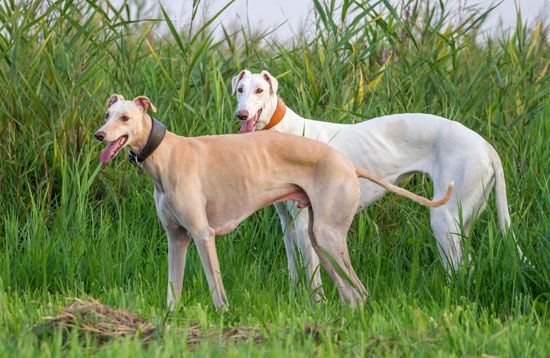
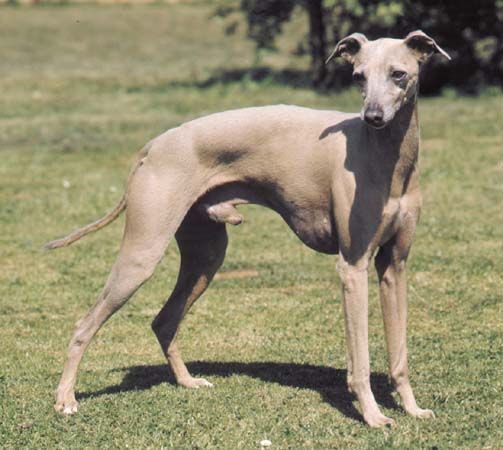
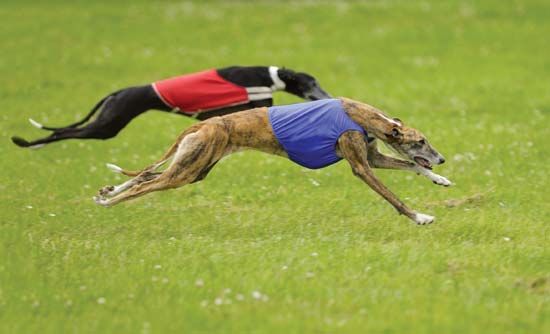
The Greyhound is a highly specialized breed, distinguished by a streamlined, slender, and powerful build designed for extreme speed. Reaching speeds of up to 45 miles (72 km) per hour, its physical structure is optimized for the gallop, a gait in which its unusually flexible spine allows it to contract and extend its limbs so that all four feet leave the ground simultaneously.13
Key physical characteristics include:
- Body Shape: A narrow head, long neck, deep chest, and long, muscular hindquarters.1
- Size: They typically stand 27–30 inches (69–76 cm) at the withers and weigh between 60–70 pounds (27–32 kg).1
- Coat: A short, smooth coat that requires minimal grooming but offers little protection against cold weather.1
Physiologically, the Greyhound differs from most other breeds. They possess a larger heart, a higher hematocrit, and typically lower thyroid levels. Due to their slender limbs and high muscle mass, they are prone to specific injuries when running on hard surfaces and require specialized care regarding anesthesia due to their unique metabolic responses.1
How do Greyhounds compare to other sighthound breeds in terms of speed and hunting abilities?
The Greyhound is widely recognized as the fastest dog breed, capable of reaching speeds of approximately 45 miles (72 km) per hour. While other sighthounds share the instinct to pursue game by sight, their physical capabilities and historical purposes vary.14
For comparison, the Whippet—a breed developed from smaller Greyhounds and terriers—is also a capable racer, reaching speeds of up to 35 miles (56 km) per hour. While both breeds are used for racing and chasing small game, the Greyhound’s larger, more powerful frame allows for greater top-end speed.514
In terms of hunting, sighthounds are generally categorized by their pursuit style:
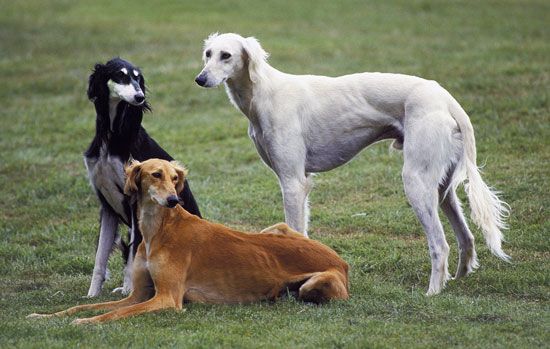
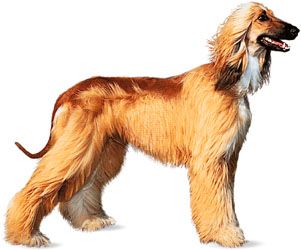
- Pack vs. Solo: Some hounds, such as Foxhounds, are traditionally trained to run in packs, whereas many sighthounds like the Saluki, Borzoi, and Afghan Hound were developed to hunt alone or in smaller groups over long distances.4
- Specialization: Greyhounds were historically used to pursue hares, deer, and foxes, utilizing their explosive speed for short bursts. Other sighthounds may be better adapted for endurance or specific terrains depending on their regional origins.14
Sources
- Greyhound — Encyclopædia Britannica
- dog - Breed-specific behaviour — Encyclopædia Britannica
- dog - Skeletal structure — Encyclopædia Britannica
- hound — Encyclopædia Britannica
- whippet — Encyclopædia Britannica
- hunting - Dogs — Encyclopædia Britannica
Published on · 3 min read