Gribble
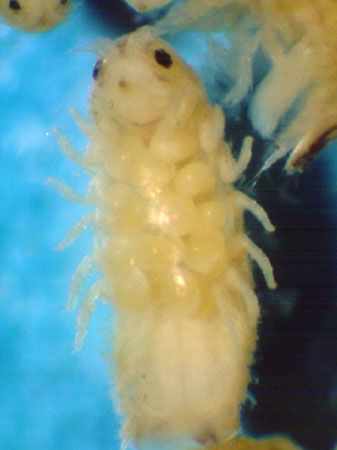
A gribble is a small, wood-boring marine crustacean that belongs to the genus Limnoria. These organisms are classified within the order Isopoda.
What exactly is a gribble and which group of crustaceans does it belong to?
A gribble is a small, wood-boring marine crustacean that belongs to the genus Limnoria. These organisms are classified within the order Isopoda.1
There are approximately 20 known species of gribbles, which are notable for their ability to consume driftwood, algae, and the submerged wood of maritime structures like docks and wharves. Some species, such as L. tripunctata, are particularly resilient and can even penetrate wood treated with creosote, a chemical typically used to repel wood-boring invertebrates. While they primarily target wood, they have also been known to damage the nonwoody insulation of submarine cables.1
How do gribbles differ from other wood-boring marine organisms?
Gribbles differ from other common wood-boring marine organisms primarily in their biological classification and their resilience to chemical deterrents. While many other wood-boring marine animals are mollusks—specifically bivalves like shipworms (Teredinidae) and piddocks (Pholadidae)—gribbles are crustaceans belonging to the order Isopoda.23
Beyond this taxonomic distinction, gribbles exhibit unique survival capabilities. For instance, the species Limnoria tripunctata is notable for its ability to penetrate wood treated with creosote, a chemical preservative specifically designed to repel most other wood-boring invertebrates. Furthermore, while bivalve borers are often categorized by their preference for either hardwoods or softwoods, gribbles are known to consume a broader range of materials, including algae, driftwood, and even the nonwoody insulation found on submarine cables.23
How do gribbles impact wooden structures in marine environments?
Gribbles, which are small crustaceans of the genus Limnoria, cause significant damage to wooden structures in marine environments by burrowing into submerged wood. These organisms feed on the wood of docks, wharves, and other maritime infrastructure, often creating extensive networks of tunnels that compromise the structural integrity of the timber.2
The impact of these borers is particularly severe due to their persistence and adaptability. For example, the species L. tripunctata is capable of penetrating wood that has been treated with creosote, a chemical preservative typically used to deter wood-boring invertebrates. While they primarily target wood, their destructive behavior also extends to the nonwoody insulation of submarine cables, posing risks to underwater communication and power infrastructure.2
In which parts of the world can gribbles be found?
Gribbles of the genus Limnoria are found in marine environments across various regions of the world. Their distribution depends on the specific species:
- Limnoria lignorum: This species is widely distributed throughout the seas of the Northern Hemisphere.2
- Limnoria tripunctata: This species inhabits the Atlantic Ocean from New England in the United States down to Venezuela, as well as the Pacific Ocean from California to Mexico.2
- Limnoria pfefferi: This species is found in both the Pacific and Indian oceans.2
- Limnoria saseboensis: This species is located along the Atlantic coast of the southeastern United States and the coast of Japan.2
Sources
- gribble — Merriam-Webster
- gribble — Encyclopædia Britannica
- bivalve - Associations — Encyclopædia Britannica
- mollusk - Habitats, feeding habits, and associations — Encyclopædia Britannica
Published on · 2 min read