Giant Crab
The term "giant crab" typically refers to one of two distinct, large crustacean species:
What is giant crab?
The term “giant crab” typically refers to one of two distinct, large crustacean species:
- Japanese Spider Crab (Macrocheira kaempferi): Native to Pacific waters near Japan, this spider crab is considered the largest known species of the arthropod phylum. It can span nearly 4 meters (about 12 feet) from the tip of one outstretched claw to another, with a body measuring approximately 37 cm (15 inches) across and weighing over 18 kg (40 pounds).12
- Tasmanian Giant Crab (Pseudocarcinus gigas): An immense Australian species that is also among the largest known crustaceans. While its legs are shorter and stouter than those of the Japanese spider crab, its body can reach 46 cm (18 inches) across, and it can weigh well over 9 kg (20 pounds), with a major claw reaching up to 43 cm (17 inches) in length.32
How do giant crabs grow and molt their shells?
Because giant crabs are encased in a rigid exoskeleton, they cannot grow continuously. Instead, they grow in steplike stages through a process called molting, or ecdysis, which is under hormonal control.45
The process follows four main stages:
- Proecdysis (Premolt): The crab prepares by resorbing calcium from its old shell into its blood. Enzymes digest the base of the old cuticle, and the epidermis secretes a new, soft exoskeleton beneath it.456
- Ecdysis: The old shell splits along preformed lines—typically between the carapace and abdomen in crustaceans. The crab then pulls itself free from the old shell.457
- Metecdysis (Postmolt): Immediately after shedding, the crab swells by rapidly intaking water to stretch its new, flexible cuticle. Over several hours or days, the new shell hardens through tanning and the deposition of calcium carbonate.45
- Intermolt: This is the period of growth and recovery between molts. While internal tissue growth is continuous, the crab’s physical size only increases immediately following a molt.45
What are the main differences between spider crabs and true crabs?
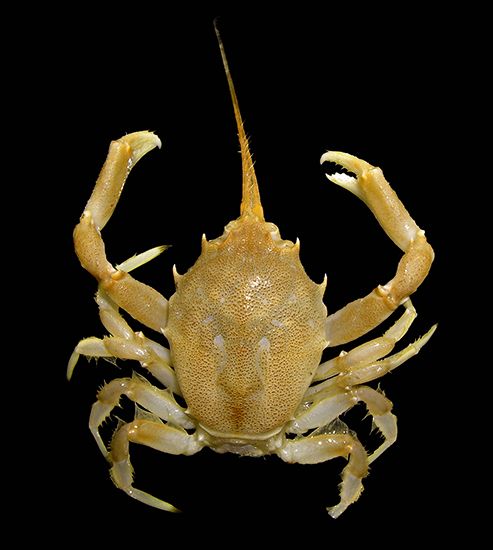
It is important to clarify that “spider crabs” are actually a type of “true crab.” Both belong to the order Decapoda, but they are categorized differently based on their biological classification and physical traits.
Classification
- True Crabs: These belong to the infraorder Brachyura. They are characterized by a greatly reduced abdomen that is folded against the underside of the thorax.9
- Spider Crabs: These are members of the family Majidae (or Maiidae), which falls within the Brachyura infraorder. Therefore, all spider crabs are technically true crabs.1011
Physical and Behavioral Differences
While spider crabs share the general anatomy of true crabs, they possess distinct characteristics:
- Body Shape: Spider crabs typically have thick, rounded bodies and long, spindly legs, whereas many other true crabs have flatter, more compact bodies.1011
- Locomotion: Most true crabs (such as fiddler crabs) are known for their lateral, sideways walking gait. In contrast, spider crabs often move forward and backward.11
- Camouflage: Spider crabs are known for their “decorating” behavior. Their bodies are covered in spines and tubercles, and they often attach algae, sponges, and other materials to themselves using mouth secretions to blend into their environment.10
How do crabs use their pincers for survival and feeding?
Crabs utilize their first pair of legs, which are modified into pincers known as chelae, as essential tools for both feeding and survival.1314
Feeding
Crabs are often omnivorous scavengers, and their chelae are vital for gathering and processing food. These appendages allow them to grasp, tear, and manipulate various food sources, ranging from plant matter to prey.14
Survival and Defense
Beyond feeding, chelae play a critical role in competition and defense:
- Aggression and Fighting: Crabs frequently compete for resources such as food, shelter, and mates. Chelae are used in both ritualized combat and direct physical struggles to determine status or defend territory.15
- Communication and Courtship: Many species use their claws for complex signaling. For example, male fiddler crabs wave their enlarged claws to attract females and establish their identity or intent. Similarly, some species use threat displays, such as snapping the movable finger of the claw against the hand, to deter rivals or predators.153
- Defense: The claws serve as a primary weapon against predators, allowing the crab to posture or strike to protect itself.15
Sources
- giant crab — Merriam-Webster
- giant crab — Encyclopædia Britannica
- crab — Encyclopædia Britannica
- crustacean - Exoskeleton — Encyclopædia Britannica
- arthropod - The exoskeleton and molting — Encyclopædia Britannica
- Endocrine system - Molting — Encyclopædia Britannica
- Ecdysis - Ecdysis — Encyclopædia Britannica
- Ecdysis - Pre-ecdysis — Encyclopædia Britannica
- spider crab — Encyclopædia Britannica
- crab spider — Encyclopædia Britannica
- Why do crabs walk sideways? — Encyclopædia Britannica
- Brachyura — Merriam-Webster
- crustacean - Appendages — Encyclopædia Britannica
- malacostracan - Defense and aggression — Encyclopædia Britannica
- Reproductive behaviour - Crustaceans — Encyclopædia Britannica
Published on · 3 min read