Giant Water Scorpion
Giant water scorpions, or eurypterids, were an extinct order of arthropods that lived from the Ordovician to the Permian periods. They are classified within…
How are giant water scorpions related to other extinct and living arthropods?
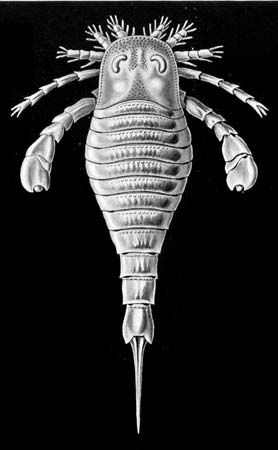
Giant water scorpions, or eurypterids, were an extinct order of arthropods that lived from the Ordovician to the Permian periods. They are classified within the group Merostomata, a lineage of chelicerate arthropods.
Their relationships to other groups are as follows:
- Horseshoe Crabs: The horseshoe crab (Limulus) is considered the closest living relative to the eurypterids, as both are members of the Merostomata.12
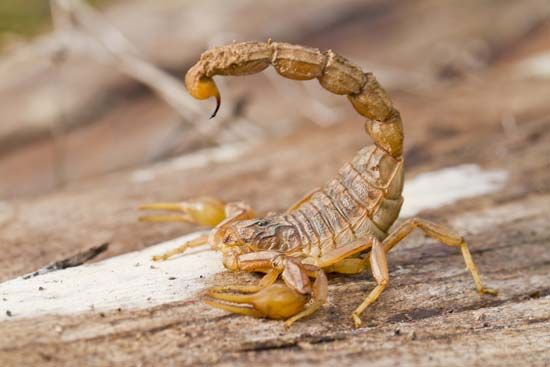
- Scorpions: While they share a superficial resemblance to modern scorpions, they are distinct groups. Some researchers suggest that true scorpions may have evolved from eurypterids, as both share anatomical features like external book gills, flaplike abdominal appendages, and similar chewing structures on their legs. However, other theories propose that scorpions and eurypterids simply share a common ancestor, with scorpions being a separate group within the Arachnida or distinct terrestrial merostomes Arachnida](https://www.britannica.com/animal/arachnid) or distinct terrestrial merostomes.34
How large could giant water scorpions grow, and how does this compare to other prehistoric arthropods?
Giant water scorpions, or eurypterids, were among the most formidable predators of the Paleozoic Era. While most species were relatively small, some reached impressive proportions. The species Jaekelopterus rhenaniae is recognized as one of the largest arthropods to ever exist, reaching lengths of approximately 2.5 meters (8 feet).19
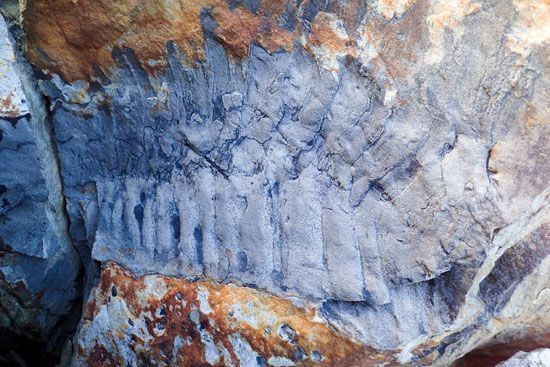
When compared to other prehistoric arthropods, their size is notable but surpassed by certain terrestrial counterparts. The extinct millipede-like Arthropleura holds the record for the largest arthropod in Earth’s history, with an estimated length exceeding 2.6 meters (8.5 feet).2
The size of these ancient creatures was influenced by their environments. Aquatic arthropods like eurypterids could achieve substantial sizes because their bodies were supported by the surrounding water. In contrast, terrestrial arthropods are generally limited in size by the constraints of their exoskeletons and respiratory systems, though high oxygen levels during the Carboniferous Period allowed giants like Arthropleura to thrive. While some prehistoric scorpions also reached significant sizes—such as Brontoscorpio anglicus, which grew to a meter or more—they remained smaller than the largest eurypterids.10211
What scientific methods are used to study and date giant water scorpion fossils?
To study and date fossils of giant water scorpions, or eurypterids, paleontologists employ a multidisciplinary approach that integrates several geological and biological methodologies.
Studying Fossil Remains
The study of these fossils begins with taphonomy, which examines the processes of burial, decay, and preservation that transform organic remains into fossils. Because eurypterids are typically found in brackish and freshwater deposits, researchers analyze the sedimentary context of these sites to understand the animal’s transition from shallow coastal environments to freshwater habitats.
Dating Methodologies
Establishing the age of these fossils relies on an integrated geochronologic framework:
- Biostratigraphy: This is a foundational method where rock sequences are defined by their distinctive assemblages of fossils. By comparing these faunal successions across different regions, scientists can correlate the age of the strata containing the eurypterids.
- Radioisotopic Dating: Since the mid-1900s, techniques such as potassium-argon dating have been used to provide absolute ages for geological layers. These methods measure the decay of isotopes to calibrate the geologic time scale.
- Magnetostratigraphy: Scientists analyze the magnetic orientation of rocks, which record the Earth’s magnetic field at the time of formation. By mapping sequences of polarity reversals, researchers can create a chronology that helps date the sedimentary layers.
- Astronomical Calibration: Recent refinements include using cyclical components driven by astronomical phenomena—such as fluctuations in fossil taxa and lithological patterns—to fine-tune the resolution of the geologic time scale.
What did giant water scorpions eat, and how did they capture their prey?
Giant water scorpions, or eurypterids, were diverse in their feeding habits. While some species were likely bottom-dwelling scavengers, many were active predators that occupied a significant role in their ecosystems.1
These predators are presumed to have been fearsome hunters, utilizing large, grasping pincers to entrap their prey. Their diet likely consisted of various shelled animals and early vertebrates that inhabited the same brackish and freshwater environments. Some species were capable of swimming rapidly, allowing them to pursue and capture prey effectively, while others relied on their specialized appendages to secure food.21
It is important to note that while they are frequently called “giant scorpions,” they are a distinct group from modern scorpions. Unlike modern scorpions, which use venomous stingers for both offense and defense, the primary mechanism for prey capture in giant water scorpions was their powerful, grasping pincers.1216
Sources
- eurypterid — Encyclopædia Britannica
- giant water scorpion — Encyclopædia Britannica
- scorpion - Evolution and paleontology — Encyclopædia Britannica
- merostome — Merriam-Webster
- Merostomata — Merriam-Webster
- thrips - Annotated classification — Encyclopædia Britannica
- arachnid - Evolution and paleontology — Encyclopædia Britannica
- skeleton - Skeletomusculature of arthropods — Encyclopædia Britannica
- Arthropleura — Encyclopædia Britannica
- scorpion - Size range and diversity of structure — Encyclopædia Britannica
- arthropod - Size range — Encyclopædia Britannica
- Tertiary Period - Correlation of Tertiary strata — Encyclopædia Britannica
- Ordovician Period — Encyclopædia Britannica
- Ordovician Period - Early fishes — Encyclopædia Britannica
- taphonomy — Merriam-Webster
- scorpion - Internal features — Encyclopædia Britannica
- scorpion - Associations — Encyclopædia Britannica
Published on · 3 min read