Grosbeak
The term "grosbeak" does not refer to a single taxonomic group but rather describes several species of birds characterized by their thick, conical bills…
How many species of grosbeaks are there, and where are they typically found?
The term “grosbeak” does not refer to a single taxonomic group but rather describes several species of birds characterized by their thick, conical bills adapted for cracking seeds. Because these birds belong to two distinct families—Cardinalidae and Fringillidae—there is no single, definitive count of “grosbeak” species; the name is a descriptive label applied to various finch-like birds across these families.1
These birds are found in diverse regions:
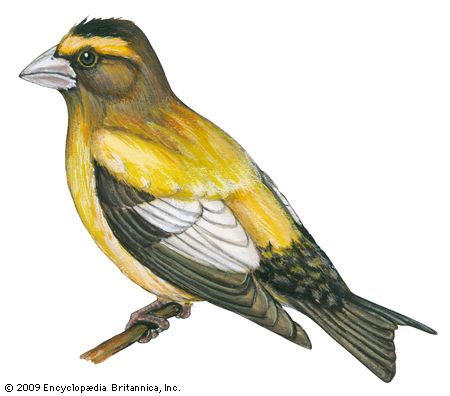
- North America: Species such as the evening grosbeak are well-known in North America, with ranges extending into New England and the Maritime Provinces. The rose-breasted grosbeak and black-headed grosbeak are also found here, inhabiting areas east and west of the Rockies, respectively.1
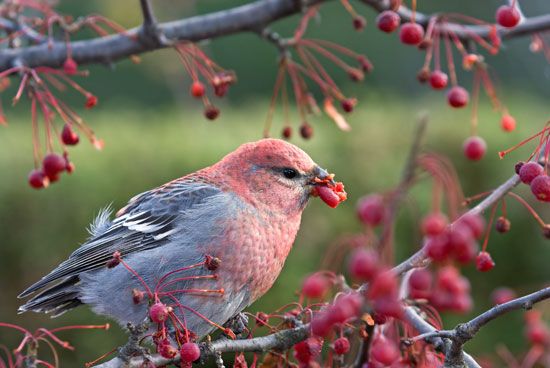
- Northern Hemisphere: The pine grosbeak is found in the coniferous forests of northern Eurasia and North America.12
What are some common behaviors and vocalizations of grosbeaks?
Grosbeaks exhibit a variety of social and foraging behaviors, often influenced by their need to secure food and maintain territory.
Social and Foraging Behaviors
- Gregariousness: Many grosbeaks are social birds. For example, evening grosbeaks are known to travel in noisy flocks, particularly when descending upon bird feeders during the winter months. Similarly, the pine grosbeak typically forages in small groups and may travel significant distances in search of food sources like mountain ash berries.1
- Territoriality: During the breeding season, many bird species establish and defend territories to protect their nesting and foraging areas. This behavior often involves ritualized threat or appeasement displays, which help minimize the need for physical fighting.3
- Comfort Movements: Like other birds, grosbeaks engage in essential maintenance behaviors, including preening, oiling, and stretching, to ensure their feathers remain in optimal condition for flight and insulation.3
While specific vocalizations for individual grosbeak species are not detailed in the provided records, their social nature within flocks suggests that auditory communication plays a key role in their group interactions.1
How do different grosbeak species differ in appearance and behavior?
Grosbeaks are defined by their thick, conical bills, but they vary significantly in appearance and behavior across the families Cardinalidae and Fringillidae.
Appearance
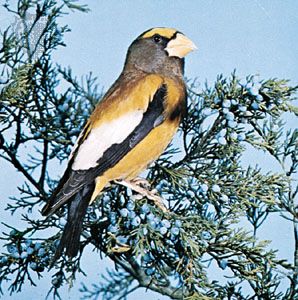
- Evening Grosbeak: A chunky, big-billed finch featuring a striking combination of yellow, black, brown, and white plumage.1
- Pine Grosbeak: Displays sexual dimorphism; adult males are bright reddish, while females are primarily brown.1
- Rose-breasted vs. Black-headed Grosbeak: These two closely related forms differ primarily in the male’s underparts: the rose-breasted grosbeak has red and white coloration, whereas the black-headed grosbeak exhibits brownish-yellow tones.1
Behavior
- Foraging Habits: Evening grosbeaks are known for moving in noisy, gregarious flocks, often congregating at bird feeders to consume sunflower seeds. In contrast, pine grosbeaks typically forage in smaller groups and are known to travel long distances in winter to locate natural food sources, such as mountain ash berries.1
- Geographic Range: While the evening grosbeak has expanded its range eastward, the rose-breasted and black-headed grosbeaks are geographically separated by the Rocky Mountains, inhabiting the eastern and western regions, respectively.1
What role do grosbeaks play in bird watching and ornithology?
Grosbeaks are significant subjects in both ornithology and bird watching due to their distinct physical traits and observable behaviors. Their name, derived from the French gros bec (“thick beak”), highlights their primary functional adaptation: a stout, conical bill designed for cracking seeds.14
In the field of ornithology, grosbeaks serve as valuable case studies for researchers. Because ornithology is a field where nonprofessionals make substantial contributions, amateur bird watchers play a critical role in documenting the distribution, migration, and behavior of these species. For instance, the evening grosbeak has provided researchers with clear evidence of range expansion, as human-provided bird feeders have enabled the species to move from its original western habitats into New England and the Maritime Provinces.51
For bird watchers, grosbeaks are popular attractions. Their tendency to congregate in noisy, visible flocks at feeders makes them accessible for observation. Furthermore, the study of closely related forms, such as the rose-breasted grosbeak and the black-headed grosbeak, offers enthusiasts a fascinating look at taxonomy and the nuances of species classification.1
Sources
- Grosbeak — Encyclopædia Britannica
- pine grosbeak — Merriam-Webster
- Bird - Behaviour — Encyclopædia Britannica
- Ornithology — Encyclopædia Britannica
- grosbeak — Merriam-Webster
Published on · 3 min read