Ground Beetle
Ground beetles, members of the family Carabidae, play a vital role in ecosystems primarily as nocturnal predators. By hunting a wide variety of…
What role do ground beetles play in ecosystems?
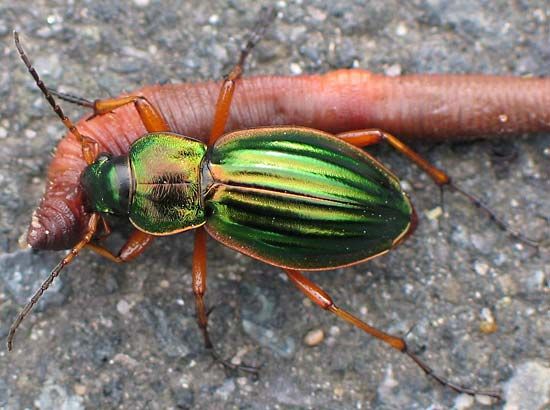
Ground beetles, members of the family Carabidae, play a vital role in ecosystems primarily as nocturnal predators. By hunting a wide variety of prey—including caterpillars, snails, worms, and other small insects—they help regulate insect populations and maintain ecological balance.123
Their contributions are particularly significant in the following ways:
- Natural Pest Control: Because they consume many insects that are considered harmful to humans and agriculture, ground beetles are widely regarded as beneficial organisms. For instance, certain species have been introduced to new regions to help manage populations of destructive pests like the spongy moth.3
- Trophic Interactions: As both predators and prey, they occupy a key position in the food web. While they actively hunt, they also serve as a food source for various insectivorous mammals, birds, and reptiles.34
- Habitat Diversity: Found in nearly every terrestrial habitat on Earth, they occupy diverse niches, from moss on tree trunks to soil and leaf litter, where they contribute to the health of their respective environments.325
What are the defining characteristics of ground beetles?
Ground beetles, belonging to the family Carabidae, are characterized by several distinct physical and behavioral traits:
- Physical Appearance: They are typically dark, shiny, and flattened in shape. They possess long legs and hard wing covers known as elytra, which are often decorated with ridges and may be fused along the midline. In many species, the hind wings are reduced or entirely absent.28
- Behavioral Traits: Ground beetles are primarily nocturnal and prefer moist, cool environments. When disturbed, they typically run rather than fly. They are known to emerge from hiding spots like rocks, crevices, or leaf litter at night to hunt.8
- Diet and Predation: Both the adults and their long, slender larvae are generally carnivorous, feeding on insects, worms, and snails. To defend themselves against predators, many species secrete a foul-smelling or acidic liquid. Some, such as the bombardier beetle, have evolved the unique ability to spray a noxious, boiling-hot chemical fluid from their abdomen.82
How many species of ground beetles exist, and where are they found?
There are more than 40,000 known species of ground beetles, making the family Carabidae one of the largest groups within the order Coleoptera.4
Regarding their distribution, ground beetles are incredibly adaptable and can be found in almost any terrestrial habitat on Earth. While beetles as a whole are present in nearly all climates and latitudes—excluding extreme environments like Antarctica or the highest mountain altitudes—ground beetles specifically favor moist, cool areas. They are typically found hiding in sheltered locations such as under rocks, within crevices, or among leaf litter, emerging primarily at night to hunt.42
Are there any ground beetle species that are considered endangered?
The provided search results do not contain information regarding specific ground beetle species that are currently classified as endangered. While the family Carabidae is vast, comprising over 40,000 species with varying distribution ranges—some widespread and others limited to specific valleys, islands, or vegetation types—the current Britannica knowledge base does not list which of these are considered endangered.42
Sources
- Coleoptera - As predators — Encyclopædia Britannica
- ground beetle — Encyclopædia Britannica
- Coleoptera - Feeding habits and habitats — Encyclopædia Britannica
- Coleoptera - Distribution and abundance — Encyclopædia Britannica
- Coleoptera - Beetles as prey — Encyclopædia Britannica
- Agricultural technology - Biological controls — Encyclopædia Britannica
- Agricultural technology - Chemical control of insects — Encyclopædia Britannica
- Coleoptera - Annotated classification — Encyclopædia Britannica
- Coleoptera - General features — Encyclopædia Britannica
- Coleoptera - Pupae — Encyclopædia Britannica
Published on · 3 min read