Ground Roller
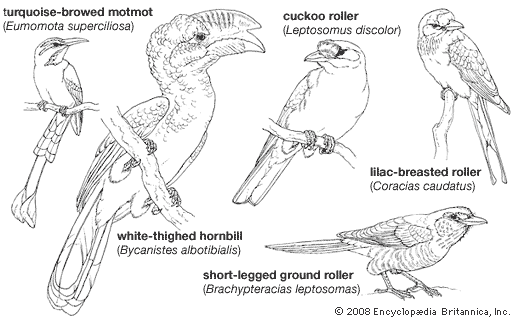
The term "ground roller" refers to any of five species of pigeon-sized birds belonging to the family Brachypteracidae, not the family Coraciidae as sometimes…
What is Ground roller?
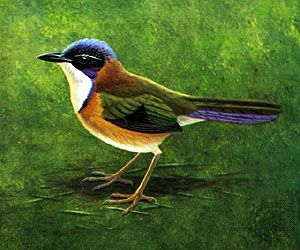
The term “ground roller” refers to any of five species of pigeon-sized birds belonging to the family Brachypteracidae, not the family Coraciidae as sometimes suggested in broader classifications. These birds are endemic to Madagascar, where they are known for their distinctive tumbling flight.123
Ground rollers typically range from 30 to 40 centimetres (12 to 16 inches) in length. While four of the species inhabit deep forests, the long-tailed ground roller (Uratelornis chimaera) is found in a small desert region in southwestern Madagascar and is currently considered nearly extinct. These birds are primarily terrestrial and crepuscular, feeding on small invertebrates such as insects and worms.12
Why are ground rollers only found in Madagascar?
While ground rollers are exclusively found on the island of Madagascar, the provided search results do not contain specific scientific or evolutionary explanations detailing why their distribution is limited to this region.
It is important to clarify that ground rollers belong to the family Brachypteracidae, rather than the family Coraciidae, which contains the broader group of rollers found across Europe, Africa, and Australia. Although they share the same order, Coraciiformes, ground rollers have evolved distinct terrestrial and crepuscular habits that differ from their wider-ranging relatives.132
What makes the long-tailed ground roller endangered?
The long-tailed ground roller (Uratelornis chimaera) is considered nearly extinct primarily due to its extremely limited habitat. Unlike its relatives that inhabit deep forests, this species is confined to a small, specific desert region in southwestern Madagascar.1
While the provided search results do not explicitly detail the specific anthropogenic threats to this bird, they note that much of Madagascar’s original landscape has been significantly altered. The island has experienced widespread deforestation to clear land for agriculture, fuel, and timber exports, leading to severe erosion and the loss of native ecosystems. For a species restricted to a tiny, specialized environment, such habitat degradation poses a critical risk to its survival.5
How do ground rollers differ from typical roller birds?
Ground rollers (family Brachypteraciidae) and typical rollers (family Coraciidae) are both members of the order Coraciiformes, but they exhibit distinct physical and behavioral differences:
- Habitat and Locomotion: While typical rollers are chiefly arboreal and aerial, spending much of their time perched or in graceful flight, ground rollers are primarily terrestrial. They inhabit deep forests or desert brush, where they forage by walking on the ground.163
- Physical Characteristics: Ground rollers are distinguished by their longer tarsi (lower legs) and shorter, rounded wings compared to the typical rollers, which possess short tarsi and long, pointed wings. Ground rollers range from 30 to 40 cm in length, often featuring a long, graduated tail, whereas typical rollers are generally smaller, measuring 25 to 32 cm.176
- Feeding Behavior: Typical rollers are aerial feeders that capture insects by hawking or darting down from perches. In contrast, ground rollers feed on small animals found on the forest floor or in desert brush. When disturbed, ground rollers typically jump or fly to low perches rather than remaining in the air.31
Sources
- Ground roller — Encyclopædia Britannica
- ground roller — Merriam-Webster
- Roller — Encyclopædia Britannica
- elephant bird — Encyclopædia Britannica
- Madagascar - Plant and animal life — Encyclopædia Britannica
- Coraciiform - Annotated classification — Encyclopædia Britannica
- Coraciiform - Evolution and paleontology — Encyclopædia Britannica
- Coraciiform - Locomotion and feeding — Encyclopædia Britannica
Published on · 2 min read