Cuckoo Roller
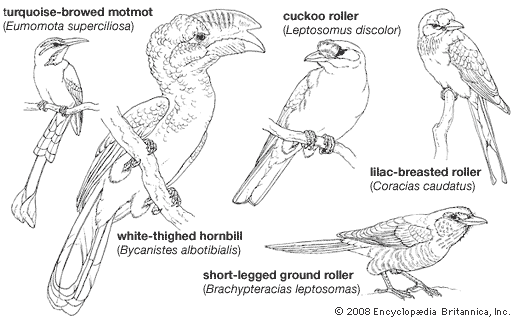
The cuckoo roller (Leptosomus discolor) is a little-known bird native to Madagascar and the neighbouring Comoros. Although it is named for its superficial…
What is Cuckoo roller?
The cuckoo roller (Leptosomus discolor) is a little-known bird native to Madagascar and the neighbouring Comoros. Although it is named for its superficial resemblance to cuckoos, it is typically classified as the sole member of the family Leptosomatidae, though it is sometimes treated as a subfamily of the Coraciidae (rollers).12
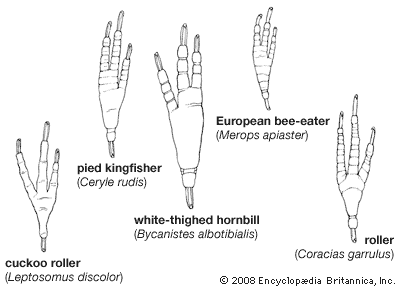
Measuring approximately 43 cm (17 inches) in length, the species is distinguished by its zygodactyl feet, which feature two forward-pointing and two backward-pointing toes. The birds exhibit sexual dimorphism: males are characterized by iridescent green upperparts and gray underparts, while females are brown above with tan and black spotting below.1
What does it mean for a bird to have zygodactyl feet?
For a bird, having zygodactyl feet means that its toes are arranged in pairs, with two toes directed forward and two directed backward. This configuration is often described as “yoke-toed,” as the toes are paired together.45
In contrast, most birds possess an anisodactyl arrangement, where three toes point forward and one (the hallux) points backward. The zygodactyl structure is a specialized adaptation found in several bird groups, including:5
- Parrots (Psittaciformes): Their zygodactyl feet, combined with a stout tarsometatarsus, allow them to climb and manipulate objects with great dexterity.5
- Woodpeckers and allies (Piciformes): This arrangement assists these birds in climbing and navigating vertical surfaces.65
- Cuckoos: Many species in this order also exhibit this toe structure.5
In former biological classifications, birds possessing this specific foot structure were sometimes grouped together as the Zygodactylae.7
What are some other unique animals found only in Madagascar?
Due to its long isolation, Madagascar is home to a vast array of unique, endemic wildlife that differs significantly from the African mainland. Some of the most notable animals found only on the island include:89
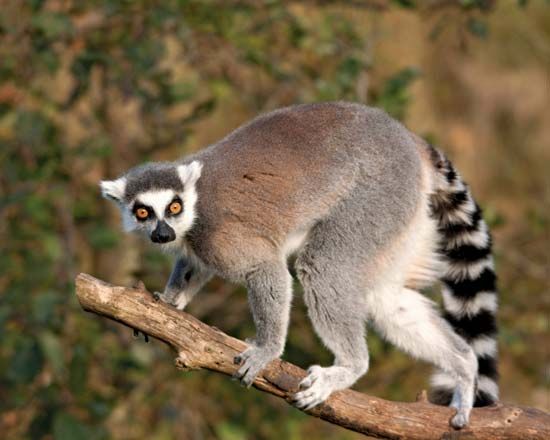
- Lemurs: These primitive primates are perhaps the island’s most famous inhabitants. There are about 40 indigenous species, ranging from the tiny Madame Berthe’s mouse lemur to the larger indri9.10
- Fossa: A slender, carnivorous mammal that serves as the island’s top predator. It evolved as the ecological equivalent of a cat, hunting lemurs and other small animals in the forest.11
- Tenrecs: A diverse group of hedgehoglike insectivores that have evolved into various unique forms on the island.810
- Ground Rollers: A family of five bird species (Brachypteracidae) known for their tumbling flight, found exclusively in Madagascar.1
- Cuckoo Roller: A distinct bird species that is the sole member of its family, Leptosomatidae.12
- Reptiles: Madagascar hosts unique populations of chameleons, as well as iguanas and boas, which are absent from the rest of the Paleotropical realm.81013
How do courtship display flights differ between bird species?
Courtship display flights in birds are specialized, ritualized behaviors that serve as essential communication signals for mate attraction, species recognition, and pair-bond formation. These displays vary significantly between species, often evolving to suit the specific environment and sensory capabilities of the birds involved.1617
Diversity in Aerial Displays
- Species-Specific Maneuvers: In many species, such as the crested bustard, the male performs an aerial display by rising approximately 30 meters into the air before planing steeply back to earth.18
- Group and Pair Flights: Tropic birds engage in communal aerial displays where groups fly and call together; pairs may then break away, with the male depressing his tail feathers while gliding or hovering to entice the female toward a potential nest cavity.19
- Dance-like Rituals: While many displays occur on the ground, some species, such as cranes and trumpeters, incorporate leaping into the air as part of their elaborate “dances.” These movements often involve tossing nest materials like sticks or grass, linking the display to future nesting behaviors.18
- Visual and Auditory Integration: Aerial displays are frequently accompanied by vocalizations or the exhibition of specialized plumage. For example, birds may use their wings and tail feathers to create distinct visual patterns or sounds during flight to signal their fitness to potential mates.182017
These displays function as “identity checks” to prevent cross-mating between species and allow females to assess the quality of a male. Because these signals are costly to produce and can increase vulnerability to predators, they serve as reliable indicators of a male’s health and genetic fitness.161720
Sources
- Cuckoo roller — Encyclopædia Britannica
- Cuckoo — Encyclopædia Britannica
- Roller — Encyclopædia Britannica
- zygodactyl — Merriam-Webster
- Bird - Annotated classification — Encyclopædia Britannica
- Zygodactylae — Merriam-Webster
- Psittaciform - Feet — Encyclopædia Britannica
- biogeographic region - Madagascan region — Encyclopædia Britannica
- lemur — Encyclopædia Britannica
- Madagascar - Plant and animal life — Encyclopædia Britannica
- fossa — Merriam-Webster
- Africa - Reptiles and amphibians — Encyclopædia Britannica
- Africa - Madagascar — Encyclopædia Britannica
- Madagascar — Encyclopædia Britannica
- Ground roller — Encyclopædia Britannica
- Reproductive behaviour - Courtship — Encyclopædia Britannica
- Gruiform - Courtship — Encyclopædia Britannica
- Pelecaniform - Courtship behaviour — Encyclopædia Britannica
- Reproductive behaviour - Displays — Encyclopædia Britannica
- Animal social behavior - Social interactions involving sex — Encyclopædia Britannica
- Reproductive behaviour - Birds — Encyclopædia Britannica
- Sex - Courtship — Encyclopædia Britannica
Published on · 3 min read