Ground Squirrel
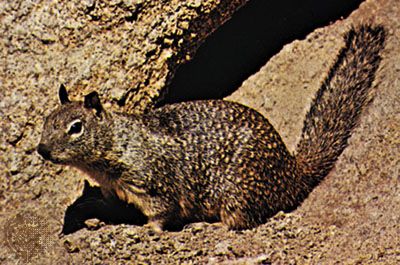
Most ground squirrels are omnivorous, consuming a varied diet that reflects their specific environment.
What is the typical diet of ground squirrels and how does it vary across different habitats?
Most ground squirrels are omnivorous, consuming a varied diet that reflects their specific environment.12
Nontropical Ground Squirrels
In temperate regions of North America, Eurasia, and Africa, ground squirrels typically consume green plant parts, fruits, and a wide range of insects, such as beetles, grasshoppers, and caterpillars. Many species also eat small vertebrates—including frogs, toads, mice, and bird eggs or chicks—as well as carrion. However, there are exceptions; for instance, the Uinta ground squirrel of the Rocky Mountains is primarily vegetarian, feeding mostly on seeds and green vegetation.12
Tropical Ground Squirrels
Ground squirrels inhabiting the forests of Southeast Asia generally incorporate a higher percentage of arthropods into their diets. These species often exhibit specialized feeding behaviors:12
- The shrew-faced ground squirrel uses an elongated snout and long tongue to hunt earthworms and insects.12
- Sulawesi ground squirrels use strong claws to dig for beetle larvae in rotting wood.12
- Other species consume a mix of fruits, roots, and acorns.2
How have ground squirrels adapted to urban environments in some areas?
Sorry, the Britannica knowledge base does not contain information regarding how ground squirrels have adapted to urban environments.
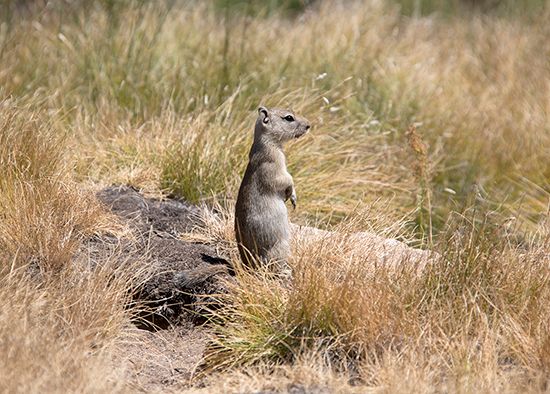
What are some of the most common species of ground squirrels found in North America?
North America is home to a diverse array of ground squirrels, primarily represented by two major genera that have adapted to various open habitats across the continent.2
Common North American Genera
- Genus Spermophilus: This group includes 38 species of ground squirrels found throughout North America and Eurasia. These rodents are known for excavating burrows and are often found in open habitats ranging from sea level to high mountain elevations. Notable examples include:2
- Franklin’s ground squirrel (Spermophilus franklinii): An omnivorous species found in the north-central United States and southern Canada.2
- Uinta ground squirrel (S. armatus): Primarily a vegetarian species native to the Rocky Mountains.2
- 13-lined ground squirrel (S. tridecemlineatus): A well-known species of central North America recognized for its deep hibernation patterns.2
- Rock squirrel (Spermophilus variegatus): One of the largest North American species, inhabiting the southwestern United States and northern Mexico.2
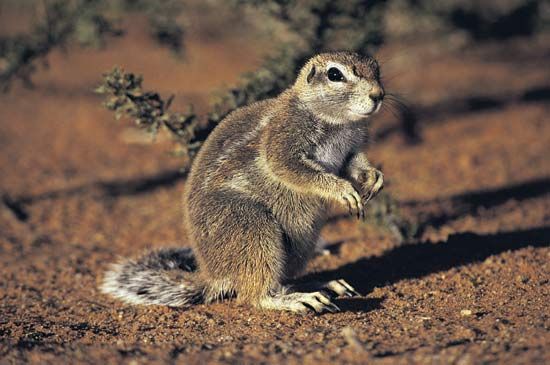
- Genus Ammospermophilus: Commonly known as antelope ground squirrels, this genus consists of five species native to the deserts of the southwestern United States and northern Mexico. The white-tailed antelope squirrel (A. leucurus) is one of the smallest ground squirrels in the region.2
How do ground squirrels prepare for and survive during hibernation?
Ground squirrels are “true” hibernators, undergoing complex physiological transformations to survive periods of food scarcity during winter.45
Preparation
As days shorten and temperatures drop, ground squirrels prepare by consuming large amounts of food to build significant stores of white and brown adipose tissue. They also construct insulated nests of grass and hair within protected burrows to minimize heat loss. It is believed that a blood compound known as Hibernation Induction Trigger (HIT) helps signal the onset of this state.54
Physiological Survival
During hibernation, the squirrel’s body temperature drops to near ambient levels, and its metabolism slows drastically. Key adaptations include:45
- Circulation: Heart rates plummet—sometimes to as low as one beat per minute—while peripheral resistance maintains blood pressure.6
- Neural Activity: Brain electrical activity reduces by about 90 percent, yet the nervous system remains sensitive enough to coordinate vital functions.7
- Thermogenesis: Brown adipose tissue is critical for generating heat through nonshivering thermogenesis, particularly during periodic arousals.85
Hibernation is a precarious, non-continuous state; squirrels rouse periodically to move or eat stored food, a process that consumes the majority of their total winter energy expenditure.45
Sources
- What do squirrels eat? — Encyclopædia Britannica
- ground squirrel — Encyclopædia Britannica
- California ground squirrel — Merriam-Webster
- Dormancy - Heart rate and circulation — Encyclopædia Britannica
- Dormancy - True mammalian hibernation — Encyclopædia Britannica
- brown adipose tissue — Encyclopædia Britannica
- Why Do Some Animals Hibernate? — Encyclopædia Britannica
- Dormancy - Neural changes — Encyclopædia Britannica
Published on · 3 min read