Grouper
Groupers are large-mouthed, heavy-bodied fishes belonging to the family Serranidae. They are widely distributed in warm seas and exhibit several distinct…
What are the defining characteristics of grouper fish?
Groupers are large-mouthed, heavy-bodied fishes belonging to the family Serranidae. They are widely distributed in warm seas and exhibit several distinct biological and behavioral characteristics:
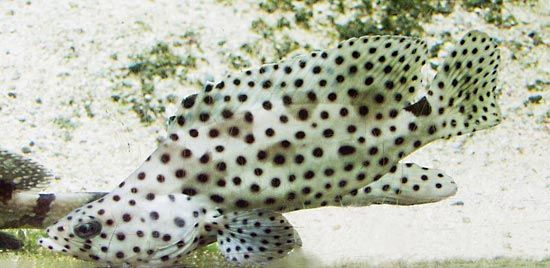
- Physical Traits: While many are dully colored in greens or browns, some species feature bold patterns or bright colors. Certain species, such as the Nassau grouper, can actively change their color patterns. Additionally, some species exhibit color variation based on depth, with individuals in deeper waters appearing redder.1
- Reproduction: Groupers are protogynous hermaphrodites, meaning they function as females first and later transform into males.1
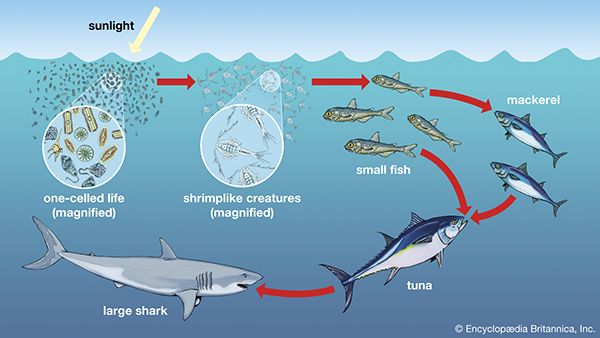
- Feeding Behavior: As predatory perciforms, they occupy a high position in the food chain. They are known to lie in wait for prey among rocks.2
- Size and Toxicity: They range significantly in size, from small species like the 25 cm golden-striped grouper to the massive goliath grouper, which can weigh up to 455 kg. Some species may carry toxins that cause ciguatera poisoning if consumed.13
Where are groupers typically found in the ocean, and what habitats do they prefer?
Groupers are widely distributed throughout the world’s warm seas. Their habitat preferences often center on complex underwater structures that provide shelter and hunting grounds.1
- Coastal and Reef Environments: Many species are commonly found in near-shore areas, including coral reefs, where they utilize crevices and rocky formations to hide and lie in wait for prey.13
- Depth Variations: While many groupers inhabit shallow coastal waters, some species exhibit depth-related behaviors. For instance, individuals of certain species, such as the black and yellowfin groupers, are often found in deeper waters, where they may display different colorations compared to their near-shore counterparts.1
- Geographic Range: Different species occupy various ocean basins. For example, the goliath grouper is found along the Atlantic and Pacific coasts of tropical America and in the eastern Atlantic Ocean, while the giant grouper inhabits the Pacific and Indian Ocean basins. Other species, like the rock hind, are found in the Atlantic.31
How large can groupers grow, and what is their average lifespan?
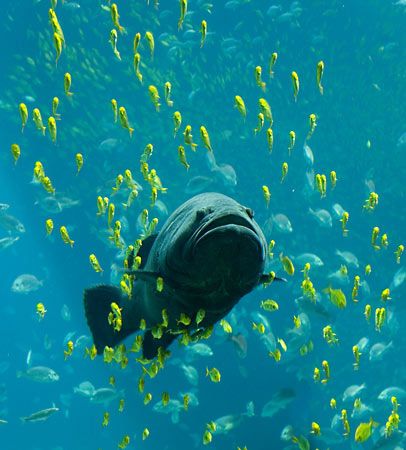
Groupers exhibit a vast range in size depending on the species, from relatively small fish to massive predators. The goliath grouper can reach lengths of 2.5 metres (8.2 feet) and weigh approximately 455 kg (1,000 pounds), while the giant grouper can grow even larger, reaching up to 2.7 metres (8.8 feet) in length. Other large species, such as the black (or Warsaw) grouper, can reach 2.3 metres (7.5 feet) and weigh nearly 200 kg (440 pounds). Conversely, smaller species like the golden-striped grouper typically measure only about 25 cm (10 inches) in length.14
Regarding their lifespan, the provided search results do not contain information on the average life expectancy of grouper species.
What are some of the most common species of grouper, and how do they differ?
Groupers are diverse members of the family Serranidae, ranging from massive predators to smaller, distinctively patterned fish. They are generally characterized as protogynous hermaphrodites, meaning they begin life as females and later transition into males.1
Common species include:
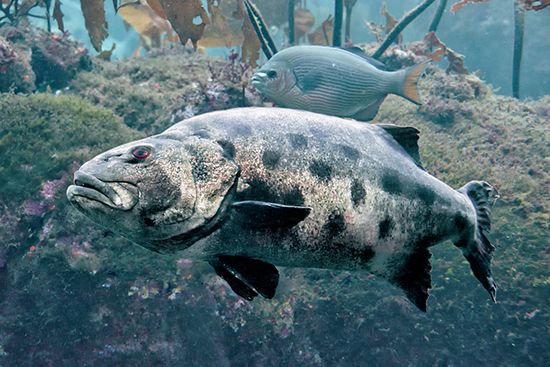
- Goliath Grouper: A massive, solitary fish found in the tropical Atlantic and Pacific. It can reach 2.5 metres in length and is known for its dull olive-brown coloration.13
- Giant Grouper: Inhabiting the Pacific and Indian Oceans, this species is even larger than the goliath, reaching up to 2.7 metres.35
- Nassau Grouper: An abundant Caribbean species noted for its remarkable ability to shift between various color patterns.1
- Black (Warsaw) Grouper: Distinguished as the only grouper with 10 dorsal spines, this Atlantic species can grow to 2.3 metres.1
- Red Grouper: A Caribbean food fish typically reddish with pale blotches.1
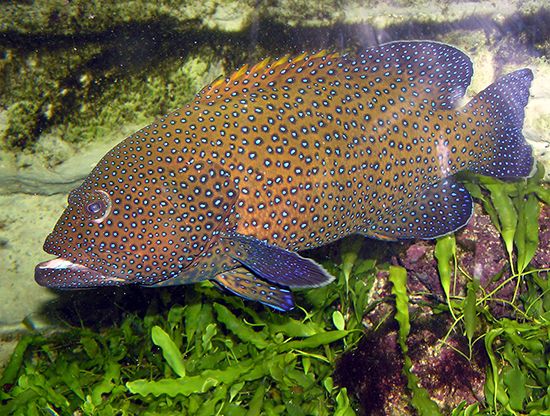
- Rock Hind: A smaller Atlantic species, reaching about 61 cm, identified by its orange or red spots.16
- Golden-striped Grouper: A small Indo-Pacific species that changes appearance from rows of dashes as a juvenile to yellow stripes as an adult.1
Sources
- grouper — Encyclopædia Britannica
- perciform - Feeding behaviour — Encyclopædia Britannica
- goliath grouper — Encyclopædia Britannica
- How big are anglerfish compared to humans? — Encyclopædia Britannica
- giant grouper — Merriam-Webster
- rock hind — Merriam-Webster
Published on · 3 min read