Cardinal Fish
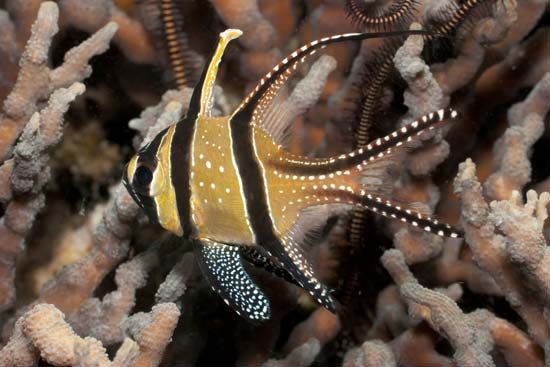
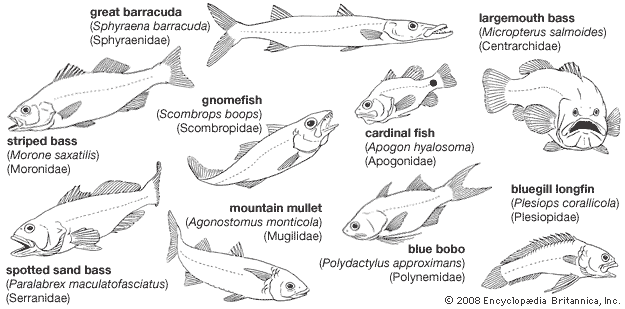
A cardinal fish is any member of the family Apogonidae (order Perciformes), a group comprising approximately 200 species of small, typically nocturnal fish.
What is cardinal fish?
A cardinal fish is any member of the family Apogonidae (order Perciformes), a group comprising approximately 200 species of small, typically nocturnal fish.1
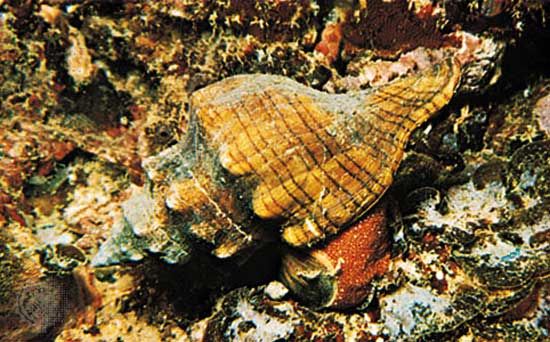
These fish are primarily found in tropical and subtropical marine environments, often inhabiting shallow reef areas. While some species, such as Astrapogon stellatus, seek shelter within the shells of living conchs, most are characterized by their distinct physical features: a large mouth, large eyes, large scales, and two dorsal fins. They typically range from 5 to 20 cm (2 to 8 inches) in length.1
The name “cardinal fish” is derived from their coloration, which is often red or reddish—reminiscent of a cardinal’s robes—though some species may appear silvery, brownish, or black. The common European cardinal fish (Apogon imberbis) is a well-known example within this family.12
Why are cardinalfish mostly nocturnal?
While cardinalfish are widely recognized as nocturnal fish, the provided search results do not explicitly state the specific evolutionary or environmental reasons why this family (Apogonidae) has adopted a nocturnal activity cycle.1
In general, fish species that exhibit nocturnal behavior often rest during the day in protected areas, such as holes or thick vegetation, to avoid predation. Conversely, many other fish are diurnal, remaining active during daylight hours and seeking shelter in reef crevices at night. For many aquatic species, the choice of activity cycle and resting location is heavily influenced by the need to balance energy conservation with the risk of predation, as fish remain partially alert even while in a restful state.34
How do cardinalfish use their large eyes to hunt?
While cardinalfish are known to possess large eyes, the provided search results do not contain specific information detailing how they utilize these eyes to hunt.
We know that cardinalfish are typically nocturnal fish belonging to the family Apogonidae. In general, nocturnal animals often possess specialized eye structures—such as spherical lenses that fill most of the eye cavity—to capture the maximum amount of light possible in low-light environments. Furthermore, nocturnal species frequently have retinas with a high concentration of rods, which are photoreceptors that perceive brightness, shape, and size rather than color. While these adaptations are common among nocturnal creatures to aid in vision, the specific hunting mechanisms of the cardinalfish remain outside the scope of the available data.16
What other marine animals live in coral reefs?
Coral reefs are among the most complex and biodiverse ecosystems on Earth, supporting a vast array of marine life that relies on the structural framework provided by reef-building corals.78
Diverse Inhabitants of Coral Reefs
- Fishes: Reefs are home to a staggering variety of fish, including colorful species such as parrotfishes, damselfishes, butterflyfishes, rabbitfishes, and surgeonfishes. Larger predators, such as groupers and barracudas, also frequent these areas to hunt.910
- Invertebrates: Sessile and slow-moving invertebrates are common. This includes sponges, sea anemones, sea cucumbers, urchins, and various mollusks.78
- Algae and Microorganisms: While macroalgae are less common on tropical reefs than on temperate rocky reefs, calcareous algae play a vital role in binding and cementing the reef structure together. Additionally, zooxanthellae—symbiotic, single-celled algae—live within coral tissues and are essential for the reef’s growth.78
These organisms interact within a complex food web, ranging from herbivores that graze on algae to predators that maintain the balance of the ecosystem.79
Sources
- cardinal fish — Encyclopædia Britannica
- cardinal fish — Merriam-Webster
- tetraodontiform - Activity cycle — Encyclopædia Britannica
- How do fish sleep? — Encyclopædia Britannica
- Avoidance behaviour - Warning behaviour — Encyclopædia Britannica
- Photoreception - Diversity of eyes — Encyclopædia Britannica
- Marine ecosystem - Benthos — Encyclopædia Britannica
- biodiversity — Encyclopædia Britannica
- perciform - Feeding behaviour — Encyclopædia Britannica
- coral reef - Corals and other reef-building organisms — Encyclopædia Britannica
- cnidarian - Distribution and abundance — Encyclopædia Britannica
- coral fish — Merriam-Webster
Published on · 3 min read