Cobia
The cobia (Rachycentron canadum) is a swift-moving, slim marine fish and the sole member of the family Rachycentridae. Found in most warm oceans, this…
What is cobia?
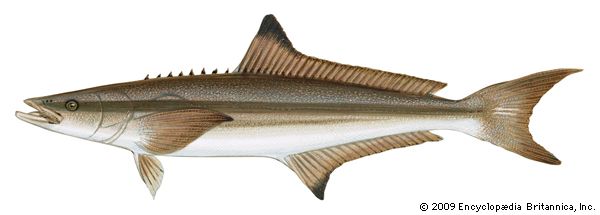
The cobia (Rachycentron canadum) is a swift-moving, slim marine fish and the sole member of the family Rachycentridae. Found in most warm oceans, this predatory species is highly regarded as both a food and sport fish.12
Physically, the cobia is characterized by a flat head, a jutting lower jaw, and light-brown sides marked by two distinct lengthwise brown stripes. A defining feature is its dorsal fin, which consists of a row of short spines followed by a long, soft-rayed fin. These fish can grow to impressive sizes, reaching lengths of up to 1.8 meters (6 feet) and weights of 70 kilograms (150 pounds) or more.1
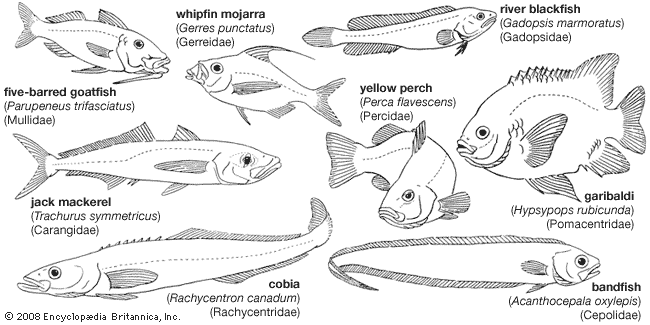
What other fish belong to the order Perciformes?
The order Perciformes is the largest group of fishes in the world, encompassing over 6,000 species across approximately 150 families. These bony fishes inhabit diverse environments, ranging from shallow freshwater ponds to deep ocean waters.3
The order includes a wide variety of significant food and game species, as well as popular aquarium fish. Notable members include:
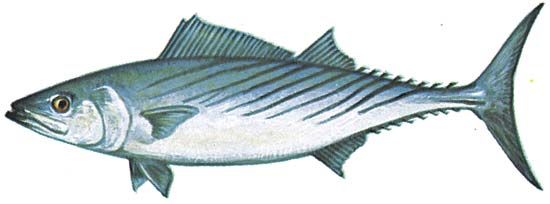
- Scombridae: Includes tunas, mackerels, bonitos, and skipjacks.3
- Carangidae: A large family featuring pompanos, jacks, cavallas, and scads.3
- Serranidae: Known as sea basses.3
- Billfishes and Marlins: Members of the family Istiophoridae.3
- Swordfish: The sole member of the family Xiphiidae.3
- Freshwater Species: Includes sunfishes (Centrarchidae) as well as perches and walleyes (Percidae).3
- Rachycentridae: The family containing the cobia.1
How do predatory fish like cobia hunt in the ocean?
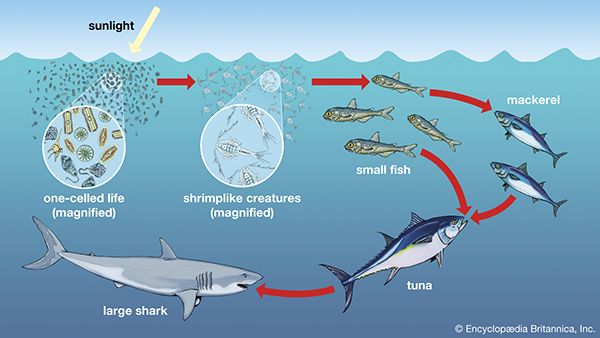
While the specific hunting mechanics of the cobia (Rachycentron canadum) remain less documented than those of some other species, it is classified as a voracious, predatory fish. As a member of the order Perciformes, the cobia shares the general ecological role of a predator that occupies a higher position in the food chain, typically feeding on smaller fishes.14
Predatory fish in this order utilize a variety of strategies to secure food:
- Active Pursuit: Many predatory perciforms, such as dolphins (mahi-mahi), rely on their speed to chase down fast-moving prey.4
- Ambush Tactics: Some predators, like groupers and stargazers, lie in wait for prey, sometimes using specialized mouth outgrowths as lures.4
- Morphological Adaptations: Many species have evolved specialized jaw structures, such as large, protrusible mouths, which allow them to capture and consume prey that is significantly large relative to their own body size.4
While some marine predators like sharks utilize highly developed senses—including smell, hearing, and the lateral line system to detect vibrations and electrical impulses—to locate prey, the specific sensory reliance of the cobia is a subject of ongoing study.5
What makes a fish popular for sport fishing?
The popularity of a fish for sport fishing is driven by a combination of accessibility, the challenge it provides to the angler, and the cultural or economic infrastructure surrounding the species.
Factors Influencing Popularity
- Sporting Challenge: Many anglers are drawn to species that offer a significant fight, such as large tuna, marlin, and swordfish. The development of specialized gear, such as reels with internal drags and “fighting seats,” has allowed anglers to target these powerful fish on relatively light tackle.1
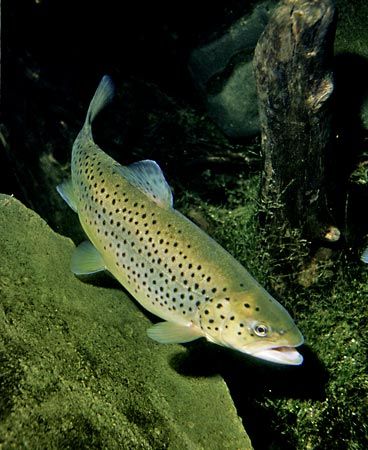
- Accessibility and Management: Species like trout and salmon are highly popular because government agencies invest heavily in hatching, rearing, and stocking them to meet high demand. In the United States, the largemouth bass is the most popular game fish, supported by a massive industry of specialized boats, professional associations, and televised competitions.78
- Technological Advancement: Methods like trolling allow anglers to cover wide areas and target highly mobile species, such as walleye and muskellunge, by matching boat speed to the fish’s behavior.9
- Conservation and Ethics: Modern sport fishing increasingly emphasizes catch-and-release practices and habitat management, which helps ensure that fish populations remain available for future generations.8
Sources
- cobia — Encyclopædia Britannica
- cobia — Merriam-Webster
- perciform — Encyclopædia Britannica
- chondrichthyan - Senses — Encyclopædia Britannica
- perciform - Feeding behaviour — Encyclopædia Britannica
- Predation — Encyclopædia Britannica
- protacanthopterygian - Importance — Encyclopædia Britannica
- fishing - Recent trends in fishing — Encyclopædia Britannica
- fishing - Big-game fishing — Encyclopædia Britannica
- trolling — Encyclopædia Britannica
Published on · 3 min read