Basse-Terre
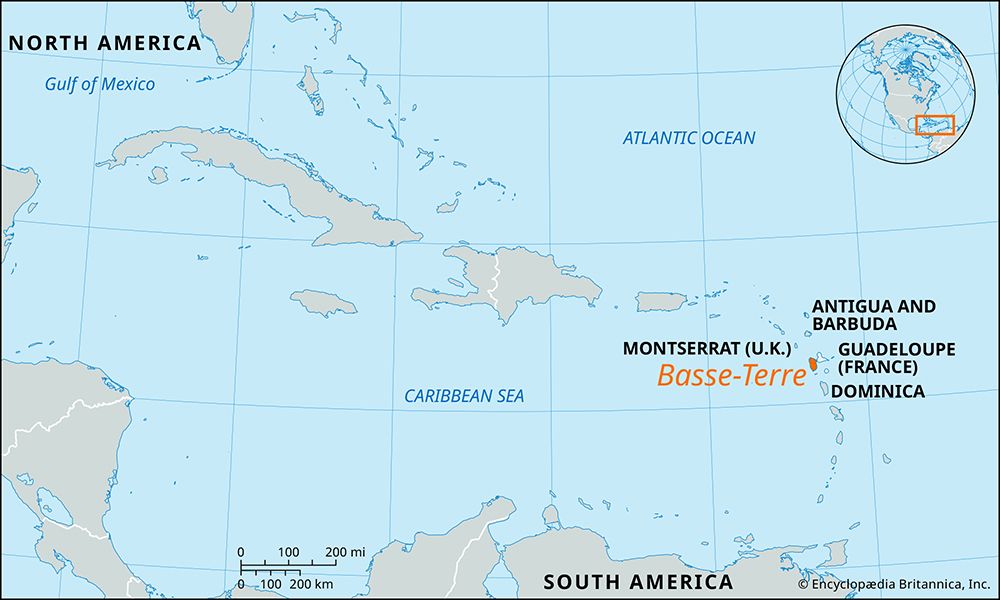
Basse-Terre refers to two distinct geographical entities within the French overseas department of Guadeloupe:
What is Basse-Terre?
Basse-Terre refers to two distinct geographical entities within the French overseas department of Guadeloupe:
- The Island: Basse-Terre is the western, mountainous island of the Guadeloupe archipelago in the Caribbean. It covers an area of approximately 364 square miles and is home to the Soufrière volcano.12
- The Town: Located on the southwestern coast of the island, the town of Basse-Terre serves as the administrative capital of Guadeloupe. Founded in 1643, it functioned as the region’s primary commercial hub until the late 18th century, when it was surpassed by Pointe-à-Pitre on the neighboring island of Grande-Terre1.13
While the town remains a significant administrative center, it has faced economic challenges due to natural disasters, including hurricanes and droughts that have impacted its port and agricultural sectors.1
What is the Soufrière volcano?
The name “Soufrière” (French for “Sulfur Mine”) refers to two distinct active volcanoes located in the Lesser Antilles of the Caribbean Sea:
- Soufrière (Guadeloupe): Located on the southern part of Basse-Terre island, this is the highest point in Guadeloupe, rising to 4,813 feet (1,467 meters). It is situated within the National Park of Guadeloupe. In August 1976, the volcano began a series of eruptions that lasted several months; however, a massive evacuation of approximately 72,000 people prevented any loss of life.456
- Soufrière (Saint Vincent): This volcano is located on the island of Saint Vincent. It has a history of violent activity, most notably in 1902, when an eruption resulted in approximately 1,600 deaths. Subsequent eruptions, such as those in 1979, caused significant agricultural damage but were managed through evacuations without loss of life.75
How does the geography of Basse-Terre differ from Grande-Terre?
Although Basse-Terre and Grande-Terre are separated only by the narrow Salée River, they possess distinct geological and environmental characteristics:
Geological Composition
- Basse-Terre: Belongs to the inner, mountainous volcanic arc of the Lesser Antilles. It features a north-to-south mountain chain, including the active Soufrière volcano, which reaches 4,813 feet (1,467 meters).859
- Grande-Terre: Belongs to the outer limestone arc. It is generally low-lying, with few elevations exceeding 490 feet (150 meters).89
Climate and Hydrology
- Precipitation: Basse-Terre is significantly wetter, receiving over 100 inches of rain annually, which supports lush tropical forests. In contrast, Grande-Terre has a drier climate, receiving approximately 40 inches of rain per year.510
- Drainage: Basse-Terre’s mountain watershed feeds numerous rivers, such as the Goyaves. Grande-Terre lacks rivers entirely, relying on sandy soils and scrub forest vegetation.89
What does it mean for Guadeloupe to be an overseas department of France?
As an overseas department (département) and region of France, Guadeloupe is an integral part of the French Republic rather than a colony or a separate territory. This status means that Guadeloupe is subject to the same laws and administrative structures as departments in metropolitan France, while also maintaining specific local governance.1112
Key aspects of this status include:
- Representation: Guadeloupe sends elected representatives to the French National Assembly, the French Senate, and the European Parliament, ensuring its voice is heard in both national and European legislative processes.11
- Administration: The French government is represented by an appointed prefect. Local executive and legislative authority is held by the Departmental Council and the Regional Council, whose members are popularly elected.11
- Institutional Autonomy: Since 2000, reforms have transferred various responsibilities from the French state to local assemblies, including certain powers regarding international relations.3
- Integration: As part of France, Guadeloupe is also a member of the European Union, which influences its economic policies and trade, particularly regarding agricultural exports.3
Sources
- Basse-Terre — Encyclopædia Britannica
- Basse-Terre — Merriam-Webster
- Guadeloupe: Country Facts — Encyclopædia Britannica
- Soufrière — Encyclopædia Britannica
- Basse-Terre — Encyclopædia Britannica
- Soufrière — Encyclopædia Britannica
- Soufrière — Merriam-Webster
- Grande-Terre — Encyclopædia Britannica
- Guadeloupe - Relief and drainage — Encyclopædia Britannica
- Guadeloupe - Climate — Encyclopædia Britannica
- Guadeloupe - Government and society — Encyclopædia Britannica
- Guadeloupe - Political and economic changes since 1950 — Encyclopædia Britannica
- France - The overseas territories — Encyclopædia Britannica
- list of islands - France — Encyclopædia Britannica
Published on · 3 min read