Guenon
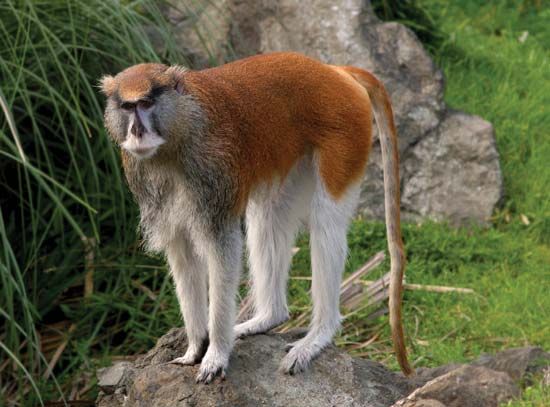
Guenons (genus Cercopithecus) are distinguished by their soft, dense fur, which often features a speckled appearance due to alternating colors along each…
What are the unique facial features and coloration patterns found in different guenon species?
Guenons (genus Cercopithecus) are distinguished by their soft, dense fur, which often features a speckled appearance due to alternating colors along each hair shaft. Their bodies typically display shades of gray, red, brown, green, or yellow.1
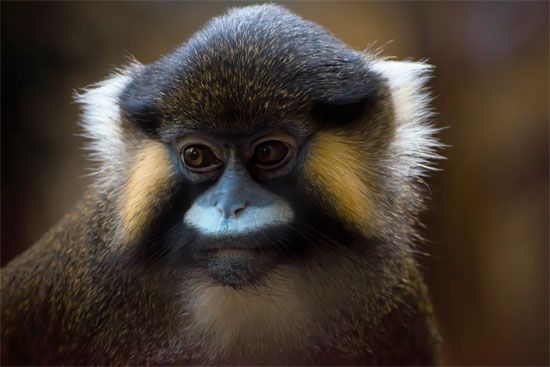
A defining characteristic of many guenon species is the presence of patches of short, contrasting fur on the nose. Notable examples include:1
- Spot-nosed guenons: The large spot-nosed guenon (Cercopithecus nictitans) features an oval yellowish or white nose spot against gray-flecked black fur. Both the lesser spot-nosed guenon (C. petaurista) and the redtail (C. ascanius) are characterized by heart-shaped white nose spots.1
- Lesula (C. lomamiensis): This species possesses a yellowish-brown nose spot, buff-colored back fur, and jet-black underparts. It is further distinguished by its notably large eye orbits.1
- Owl-faced monkey (C. hamlyni): Named for the white streak running down its nose, this species is greenish-gray with black underparts and forelimbs. Interestingly, some high-altitude populations lack this distinctive white nasal streak.2
What is the social structure and behavior like in guenon groups?
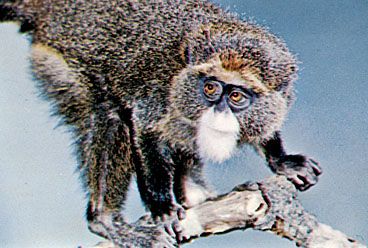
Guenons (genus Cercopithecus) typically live in social groups composed of females and their young, led by a single adult male. These groups are territorial, and males maintain spacing between groups by uttering loud barks or chirps.1
Regarding their behavior, guenons are primarily arboreal forest dwellers, though some species inhabit wetlands. They are active, hardy animals known for their habit of grimacing at observers. Their social interactions often extend beyond their own species; groups from different guenon species frequently combine for foraging and may associate with one another for long periods.1
Guenons forage for a varied diet consisting of fruit, leaves, and other vegetation, and they may also consume insects and small animals. Some species are known to raid crops. Breeding can occur at any time of year in some species, with a single offspring born after a gestation period lasting five to seven months.1
How long do guenons typically live, and what are the main stages of their life cycle?
Guenons are hardy primates that, with proper care, can live for more than 20 to 30 years.1
Their life cycle begins with a gestation period that lasts approximately five to seven months, depending on the specific species. Following this period, a single offspring is born. While the provided information does not detail every developmental milestone from infancy to adulthood, it notes that guenon groups are typically composed of females and their young, led by a single adult male. These monkeys are known for their active and good-natured disposition, and they are frequently observed in zoos where they can be successfully tamed.1
What distinguishes guenons from other primates in terms of physical characteristics?
Guenons (genus Cercopithecus) are distinguished from other primates by several unique physical traits that reflect their classification as Old World monkeys within the subfamily Cercopithecinae.14
Key Physical Characteristics
- Distinctive Markings: Guenons are widely recognized for their bold, colorful patterns. Many species feature soft, dense fur that often appears speckled due to the alternation of two colors along each hair shaft.1
- Facial Features: A hallmark of the genus is the presence of patches of short, contrasting fur on the nose, such as the white or yellowish spots seen on the spot-nosed guenon or the heart-shaped patches on the redtail monkey. As Old World monkeys, they possess narrow noses with a thin septum and downward-facing nostrils.14
- Body Structure: They are slim, graceful, and quadrupedal, characterized by long arms and legs, short faces, and nonprehensile tails that are longer than their combined head and body length.1
- Specialized Anatomy: Like other cercopithecines, guenons possess cheek pouches used for storing food. They also feature ischial callosities, or “sitting pads,” on their buttocks, a common trait among Old World monkeys that is absent in New World primates.4
Sources
- guenon — Encyclopædia Britannica
- owl-faced monkey — Encyclopædia Britannica
- Gestation — Encyclopædia Britannica
- monkey - Old World monkeys versus New World monkeys — Encyclopædia Britannica
- DeBrazza’s monkey — Encyclopædia Britannica
Published on · 3 min read