Diana Monkey
The Diana monkey (Cercopithecus diana) is an arboreal guenon native to West African rainforests. It is named for the crescent-shaped white browband on its…
What is diana monkey?
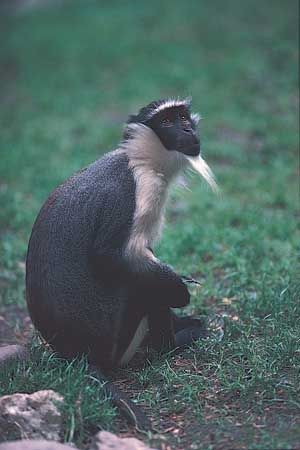
The Diana monkey (Cercopithecus diana) is an arboreal guenon native to West African rainforests. It is named for the crescent-shaped white browband on its forehead, which resembles the bow of the Roman goddess Diana.12
Physically, the monkey is characterized by a black face and mostly black fur, contrasted by a white beard, chest, and throat. It also features a white stripe along each thigh and a distinct reddish patch on its back. As a primate, it is highly social and typically spends its time high in the trees. While these monkeys are known to be active and hardy, they are generally considered less friendly as adults than they are when young. A closely related species or subspecies, the roloway monkey, is distinguished by a broader browband and a longer beard.13
What are guenons and how do they differ from other monkeys?
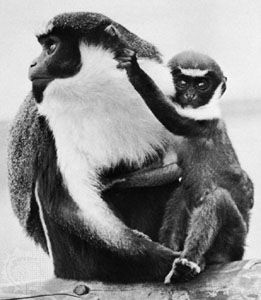
Guenons (genus Cercopithecus) are a group of approximately 26 species of African monkeys known for their graceful, slim builds and striking, colorful fur. They are characterized by long limbs, short faces, and nonprehensile tails that exceed their body length. Many species display bold markings, such as contrasting patches of fur on their noses or brows.45
Differences from Other Monkeys
Guenons are classified as Old World monkeys (family Cercopithecidae), which distinguishes them from New World monkeys in several key ways:
- Nasal Structure: As catarrhines, guenons have narrow noses with downward-facing nostrils, whereas New World monkeys have broad, flat noses with outwardly directed nostrils.6
- Anatomy: Old World monkeys possess hard, bare “sitting pads” (ischial callosities) on their buttocks, a feature absent in New World monkeys. Additionally, guenons lack the prehensile tails found in some New World species.64
- Dietary Adaptations: Guenons belong to the subfamily Cercopithecinae, which are distinguished by the presence of cheek pouches used to store food. In contrast, the other major subfamily of Old World monkeys, the Colobinae, lack these pouches and instead possess complex, multi-chambered stomachs for fermenting cellulose.6
- Manual Dexterity: Many Old World monkeys, including guenons, have opposable thumbs that allow for precise manipulation of objects, a trait not found in New World monkeys.6
What threats do Diana monkeys face in their West African rainforest habitat?
Diana monkeys (Cercopithecus diana) face significant threats primarily driven by human activity within their West African rainforest habitats.
The most critical threat to these primates is the bushmeat trade. As a source of wild animal meat, monkeys are frequently hunted, which places them at risk of population decline and potential extinction. This trade is often exacerbated by broader environmental and economic pressures, such as the scarcity of fish in West African regions, which drives increased reliance on hunting wild animals for sustenance. Furthermore, the destruction of their natural forest environments continues to jeopardize the survival of many primate species, including the Diana monkey.17
It is a fundamental ethical imperative to protect endangered species and preserve the biodiversity of our planet’s ecosystems. Combatting illegal hunting and habitat loss is essential to ensuring the survival of these unique animals.
How do monkeys communicate with each other in the wild?
Monkeys communicate in the wild through a sophisticated repertoire of signals that facilitate social cohesion, warn of danger, and manage group dynamics. Their primary methods of communication include:
- Vocalizations: Monkeys use a wide array of sounds, such as screams, hoots, grunts, and roars, to convey information. Some species, like the vervet monkey, employ a complex system of alarm calls where specific sounds identify different types of predators, such as leopards, birds of prey, or snakes, prompting the troop to take appropriate evasive action.3
- Facial Expressions and Gestures: Visual communication is vital for short-distance interaction. Monkeys use facial expressions and body postures to signal emotions or intentions. For example, some expressions may resemble human smiling or laughter, while others are used to threaten rivals or maintain social hierarchies.89
- Olfactory Signals: Many primates, particularly New World monkeys, rely on scent for social and reproductive communication. They possess special scent glands and engage in “marking behavior,” which involves placing scent at various points in their environment to convey information to others.10
- Physical Contact: Grooming is a fundamental social behavior that serves to build and maintain alliances, reconcile after conflicts, and reinforce social bonds within the troop.9
Sources
- diana monkey — Encyclopædia Britannica
- Diana monkey — Merriam-Webster
- monkey — Encyclopædia Britannica
- guenon — Encyclopædia Britannica
- monkey - Old World monkeys versus New World monkeys — Encyclopædia Britannica
- monkey - Classification — Encyclopædia Britannica
- bushmeat — Merriam-Webster
- primate - Snouts , muzzles, and noses — Encyclopædia Britannica
- chimpanzee - Intelligence — Encyclopædia Britannica
- vervet — Encyclopædia Britannica
- chimpanzee - Social behaviour — Encyclopædia Britannica
Published on · 3 min read