Mona Monkey
The mona monkey (Cercopithecus mona) is a lively primate native to the tropical rainforests of West Africa. It belongs to the guenon group within the Old…
What is mona monkey?
The mona monkey (Cercopithecus mona) is a lively primate native to the tropical rainforests of West Africa. It belongs to the guenon group within the Old World monkey family, Cercopithecidae.12
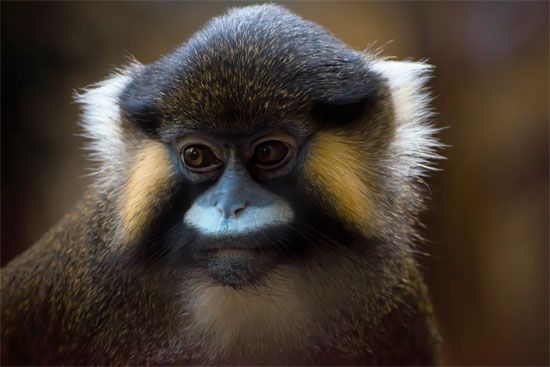
Physically, the mona monkey is characterized by its speckled reddish-brown fur, white underparts, and a distinctive oval white patch on each side of its tail. Its face features a pale band across the forehead and a thin black stripe running between each eye and ear.1
While native to Africa, a wild population of these monkeys was established on the island of Grenada during the 18th century, having been introduced there via the slave trade. Because of their engaging appearance, they are among the most widely exhibited members of the guenon group in zoos. Related species, such as Campbell’s monkey and the crested guenon, are sometimes informally grouped with them as “monas”.12
What are the main differences between Old World and New World monkeys?
Monkeys are categorized into two primary groups—Old World and New World—which are distinguished by significant anatomical and geographical differences.2
Key Anatomical Differences
- Nose Structure: Old World monkeys are catarrhines (“downward-nosed”), featuring narrow noses with a thin septum and downward-facing nostrils. New World monkeys are platyrrhines (“flat-nosed”), characterized by broad noses with a wide septum and outwardly directed nostrils.2
- Tail Ability: Some New World monkeys possess prehensile tails capable of supporting their entire body weight. No Old World monkeys have this ability; many are nearly tailless.2
- Sitting Pads: Old World monkeys have hard, bare “sitting pads” (ischial callosities) on their buttocks, a feature lacking in New World monkeys.2
- Manual Dexterity: Many Old World monkeys have opposable thumbs, allowing for precise manipulation of objects. New World monkeys lack this level of dexterity, and some species have reduced or absent thumbs.2
- Dentition: Old World monkeys (and apes) have two premolars, whereas New World monkeys typically retain three.3
Geographical Distribution
- Old World: Found throughout Africa, the Red Sea coast of Arabia, and across Asia.2
- New World: Primarily inhabit tropical South America, particularly the Amazon rainforests, with ranges extending into Mexico and Argentina.2
How did the mona monkey population become established in Grenada?
The mona monkey (Cercopithecus mona) population in Grenada was established during the 18th century. These primates were brought to the island from West Africa as a result of the slave trade. Following their introduction, they successfully adapted to the local environment, allowing a wild population to persist on the island to this day.1
What are some other examples of guenon monkeys?
The genus Cercopithecus, commonly known as guenons, includes approximately 26 species of African monkeys. These primates are characterized by their slim, graceful builds and often feature bold, colorful markings on their fur and faces.5
Beyond the mona monkey (Cercopithecus mona), other notable examples of guenon species include:1
- Putty-nosed monkey (Cercopithecus nictitans): A common West African species known for its gray-flecked black fur and a distinctive oval white or yellowish spot on its nose.5
- Lesser spot-nosed guenon (C. petaurista): Recognized by its heart-shaped white nose patch.5
- Redtail monkey (C. ascanius): Also features a heart-shaped white nose spot.5
- Lesula (C. lomamiensis): A species discovered in 2007 that inhabits Rwanda’s Nyungwe Forest National Park, distinguished by its large eye orbits and a yellowish-brown spot on its nose.5
- Diana monkey (including the roloway): A well-known member of the group.5
- Owl-faced monkey (C. hamlyni): Also referred to as Hamlyn’s monkey.5
- DeBrazza’s monkey (C. neglectus): A distinct species within the genus.5
- Campbell’s monkey (C. campbelli) and Crested guenon (C. pogonias): Often loosely referred to as monas due to their close relation.1
Sources
- mona monkey — Encyclopædia Britannica
- monkey - Old World monkeys versus New World monkeys — Encyclopædia Britannica
- primate - Teeth — Encyclopædia Britannica
- monkey — Encyclopædia Britannica
- guenon — Encyclopædia Britannica
- monkey - Classification — Encyclopædia Britannica
Published on · 3 min read