Owl-faced Monkey
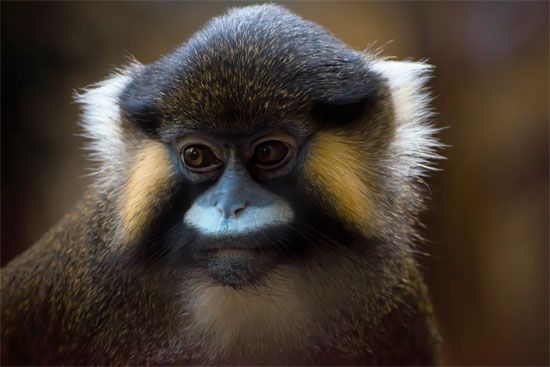
The owl-faced monkey (Cercopithecus hamlyni) is an arboreal guenon native to the tropical forests located east of the Congo Basin.
What is owl-faced monkey?
The owl-faced monkey (Cercopithecus hamlyni) is an arboreal guenon native to the tropical forests located east of the Congo Basin.1
This monkey is characterized by its greenish-gray fur, black underparts and forelimbs, and a silver-gray lower back and tail base. It earns its name from a distinctive white streak running down its nose, which creates an owl-like appearance; however, this feature is sometimes absent in individuals residing at high altitudes, such as those in the bamboo forests of Mt. Kahuzi in the Democratic Republic of the Congo. These primates are primarily herbivorous, consuming fruit and other vegetation, and they typically live in social groups composed of one male and several breeding females.1
What are guenons and how do they differ from other monkeys?
Guenons are a group of 26 species of African monkeys belonging to the genus Cercopithecus. They are recognized for their slim, graceful builds, long limbs, and striking, colorful fur, which often features speckled patterns and distinctive patches of contrasting fur on their noses. Primarily arboreal, these monkeys typically live in social groups consisting of a single adult male and several females with their young.2
Distinctions from Other Monkeys
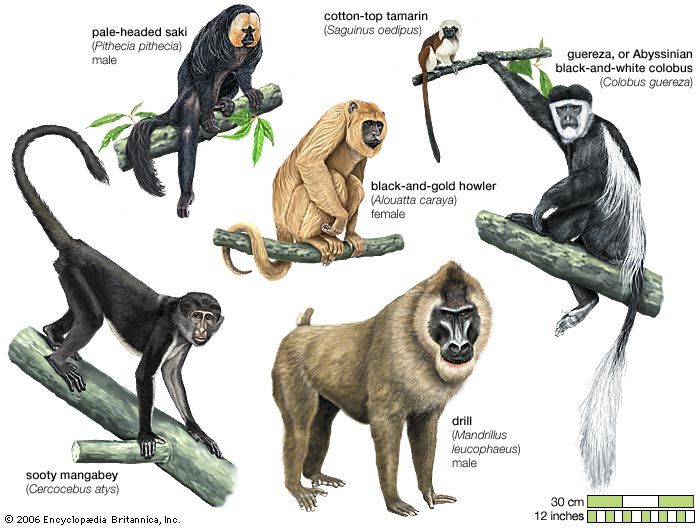
Guenons are classified as Old World monkeys (family Cercopithecidae), which sets them apart from New World monkeys (platyrrhines) in several key ways:
- Nose Structure: As catarrhines, guenons have narrow noses with a thin septum and downward-facing nostrils, whereas New World monkeys have broad, flat noses with outwardly directed nostrils.3
- Sitting Pads: Old World monkeys possess hard, bare “sitting pads” (ischial callosities) on their buttocks, a feature absent in New World monkeys.3
- Tail Function: Guenons have nonprehensile tails, meaning they cannot use them to grasp objects or support their body weight. In contrast, some New World species have prehensile tails capable of supporting their entire body weight.23
- Dietary Adaptations: As members of the subfamily Cercopithecinae, guenons possess cheek pouches used for storing food, a trait that distinguishes them from the Colobinae subfamily of Old World monkeys, which instead utilize complex, multi-chambered stomachs for fermenting vegetation.3
How does living in high-altitude bamboo forests affect monkey behavior?
The premise that living in high-altitude bamboo forests fundamentally alters the behavioral patterns of monkeys is not supported by the provided search results. While environmental factors can lead to physical variations, such as the absence of the characteristic white nose streak in some owl-faced monkeys residing in the bamboo forests of Mt. Kahuzi, the available data does not detail specific behavioral shifts resulting from this habitat.1
Generally, monkeys are highly social animals that live in troops, with most species—including guenons—maintaining a social structure consisting of one male and several breeding females. While some species, such as the Japanese macaque, demonstrate the ability to learn new behaviors and spread innovations throughout a troop, there is no evidence in the provided text to suggest that high-altitude bamboo environments specifically trigger such behavioral changes in other monkey species.14
What other animals share the tropical forests of the Congo Basin?
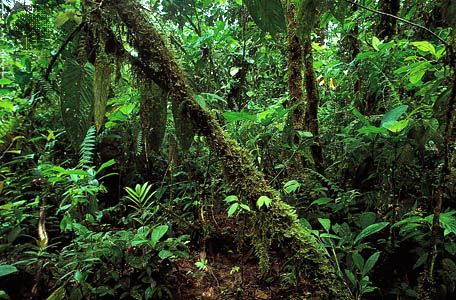
The Congo Basin supports an incredibly rich and diverse array of animal life, ranging from iconic primates to specialized aquatic species and numerous insects.5
Primates and Large Mammals
The equatorial forests are home to several great apes, including chimpanzees, bonobos, and gorillas, the latter of which inhabit both lowland and mountain rainforests. Other notable mammals include:56
- Forest Dwellers: African forest elephants, okapis, giant wild boars, and various species of monkeys and baboons.57
- Savanna and Grassland Species: In the surrounding savanna woodlands, one can find lions, leopards, cheetahs, hyenas, jackals, wild dogs, buffaloes, antelopes, giraffes, and rhinoceroses.57
Aquatic and Reptilian Life
The river systems are well-stocked with diverse fish, such as lungfish, cichlids, catfish, and electric fish. Larger aquatic animals include hippopotamuses, crocodiles, and manatees. Reptiles are also common, featuring various snakes like pythons, vipers, and cobras, alongside turtles, lizards, and chameleons.587
Birds and Insects
The region hosts a vast array of birdlife, including sunbirds, parrots, pelicans, herons, storks, and various birds of prey. Insects are innumerable, encompassing hundreds of butterfly species, bees, termites, ants, and disease-carrying insects like mosquitoes and tsetse flies.587
Sources
- owl-faced monkey — Encyclopædia Britannica
- guenon — Encyclopædia Britannica
- monkey - Old World monkeys versus New World monkeys — Encyclopædia Britannica
- monkey — Encyclopædia Britannica
- Democratic Republic of the Congo - Plant and animal life — Encyclopædia Britannica
- gorilla — Encyclopædia Britannica
- Congo River - Animal life — Encyclopædia Britannica
- Republic of the Congo - Plant and animal life — Encyclopædia Britannica
Published on · 3 min read