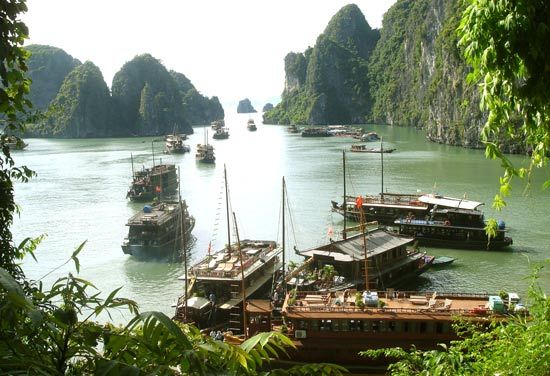
Gulf of Tonkin
The Gulf of Tonkin, a northwest arm of the South China Sea, serves as a significant maritime corridor and resource area for China and Vietnam.
What are the main economic activities and resources associated with the Gulf of Tonkin?
The Gulf of Tonkin, a northwest arm of the South China Sea, serves as a significant maritime corridor and resource area for China and Vietnam.1
Key economic activities and resources include:
- Shipping and Trade: The gulf functions as a vital shipping route, primarily through the Hainan Strait. Major regional ports, such as Haiphong and Ben Thuy in Vietnam and Beihai in China, facilitate international and regional maritime commerce.1
- Energy Exploration: Since the conclusion of the Vietnam War, the gulf has been a focus for oil exploration, attracting interest from numerous multinational corporations.1
Please note that information regarding recreation or tourism in the Gulf of Tonkin is not available in the provided records; the search results provided for those topics pertain specifically to the Gulf of Mexico.2
How deep is the Gulf of Tonkin, and how does this affect maritime activities?
The Gulf of Tonkin reaches a maximum depth of approximately 230 feet (70 metres).1
This relatively shallow depth, combined with the gulf’s geography, influences maritime activities in several ways:
- Navigation: The primary shipping route for the region is concentrated through the Hainan Strait, located between China and Hainan Island, rather than across the broader, shallower expanse of the gulf.1
- Port Accessibility: The gulf serves as a critical maritime corridor for major ports such as Haiphong and Ben Thuy in Vietnam, as well as Beihai in China, which rely on these waters for regional and international trade.1
- Resource Development: The continental shelf characteristics of the gulf have made it a significant site for oil exploration by various multinational corporations since the end of the Vietnam War.1
What is the geographical location and significance of the Gulf of Tonkin?
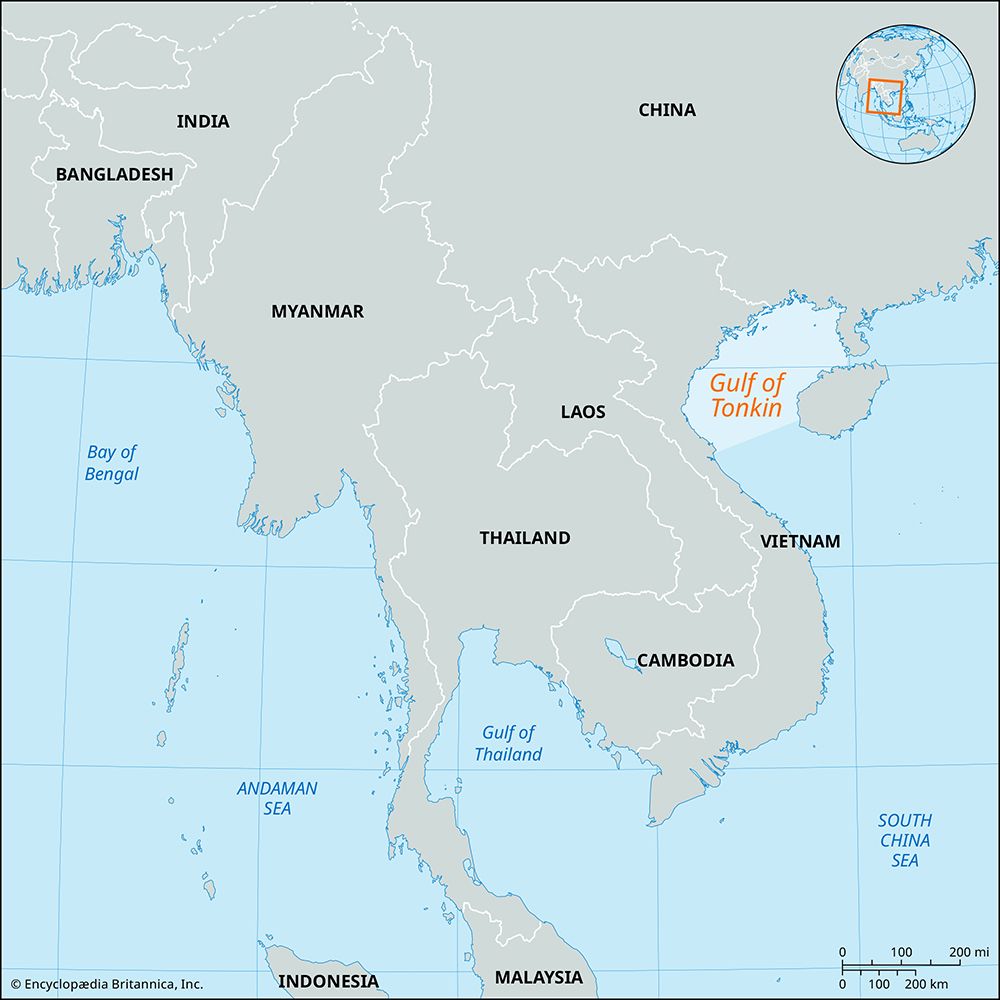
The Gulf of Tonkin is a northwest arm of the South China Sea, spanning approximately 300 miles (500 km) in length and 150 miles (250 km) in width. It is geographically bounded by China to the north and east, Hainan Island to the east, and northern Vietnam to the west.1
Significance
The gulf holds both economic and historical importance:
- Economic Hub: It serves as a vital shipping route via the Hainan Strait and supports major ports, including Haiphong and Ben Thuy in Vietnam and Beihai in China. Additionally, the area has been a site for oil exploration by multinational companies since the end of the Vietnam War.1
- Historical Impact: The region gained global attention in 1964 during the Gulf of Tonkin incident, which led to the Gulf of Tonkin Resolution. This resolution provided the constitutional authorization for the escalation of U.S. military involvement in the Vietnam War, though it was later revealed to be based on a misinterpretation of events.13
How did the Gulf of Tonkin Incident in 1964 impact the Vietnam War?
The Gulf of Tonkin incident in 1964 served as the primary catalyst for the direct and massive escalation of U.S. military involvement in the Vietnam War.45
Following reports of two separate engagements between U.S. destroyers and North Vietnamese forces, President Lyndon B. Johnson requested that Congress pass the Gulf of Tonkin Resolution. Signed into law on August 10, 1964, the resolution granted the president broad constitutional authority to take “all necessary measures” to protect U.S. forces and allies in Southeast Asia.46
The incident’s impact was profound for several reasons:
- Escalation: It provided the legal framework for the U.S. to transition from an advisory role to active, large-scale combat operations.45
- Misinformation: The resolution was based on a misinterpretation of events; while an engagement occurred on August 2, the reported second attack on August 4—which triggered the retaliatory strikes and the resolution—did not actually take place.56
- Political Consequences: While the resolution initially helped Johnson remove Vietnam as a campaign issue during the 1964 election, it later became a source of public disillusionment as the war intensified, leading to its repeal in 1970.46
Sources
- Gulf of Tonkin — Encyclopædia Britannica
- Gulf of Mexico / Gulf of America - Recreation — Encyclopædia Britannica
- Tonkin, Gulf of — Merriam-Webster
- Gulf of Tonkin Resolution — Encyclopædia Britannica
- Gulf of Tonkin incident — Encyclopædia Britannica
- Vietnam War - The Gulf of Tonkin — Encyclopædia Britannica
Published on · 3 min read