Gull Falls
It appears there may be a slight confusion in the name; the landmark you are likely referring to is Gullfoss, which is often translated as "Golden Falls."
What is Gull Falls?
It appears there may be a slight confusion in the name; the landmark you are likely referring to is Gullfoss, which is often translated as “Golden Falls.”
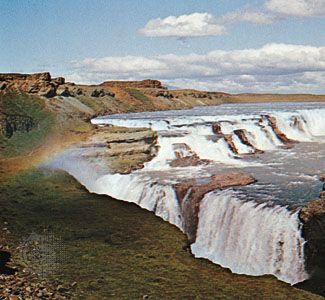
Gullfoss is a prominent waterfall located in southwestern Iceland. Situated on the Hvítá river, it is fed by meltwaters from the Langjökull glacier. The water plunges 105 feet (32 metres) into a canyon, making it one of the country’s most popular tourist destinations, easily accessible by road from Reykjavík.1
How are waterfalls formed by glaciers?
Waterfalls are frequently formed by glaciers through the creation of hanging valleys. This process occurs because a large trunk glacier has a greater erosive capacity than the smaller tributary glaciers that feed into it. Consequently, the main valley is eroded much more deeply and rapidly than the side valleys.34
When the glaciers eventually melt and retreat, these tributary valleys are left at an elevation significantly higher than the floor of the main valley. As postglacial streams begin to flow through these elevated tributary valleys, they must plunge over the steep walls of the main U-shaped valley to join the drainage system below, resulting in the formation of waterfalls. Famous examples of this phenomenon include Yosemite Falls in California and various falls found in Yellowstone National Park.354
Additionally, glaciation can create waterfalls through:
- Glacial steps: The passage of ice over bedrock with varying resistance creates a “stairway” of treads and risers; waterfalls often form at the site of each riser.5
- Glacial potholes: Meltwater runoff carrying gravel can gouge and enlarge depressions in the bedrock, which may later serve as sites for cascades.5
What is the significance of the Hvítá river in Iceland?
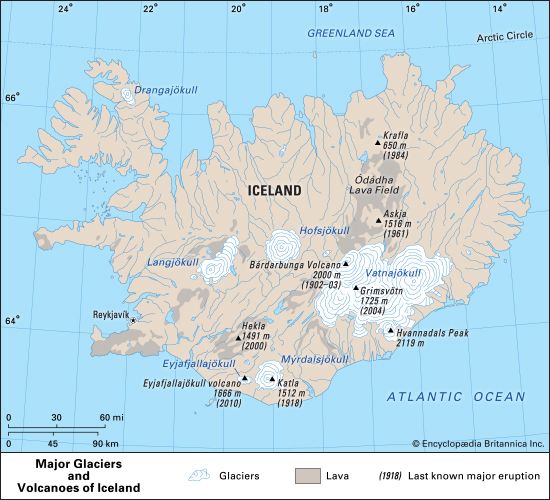
The Hvítá river is a significant waterway in southwestern Iceland that serves as a vital drainage system for the region. It is primarily fed by meltwaters originating from the Langjökull glacier located on the country’s central plateau.1
The river is perhaps best known for hosting Gullfoss, or “Golden Falls,” one of Iceland’s most iconic and popular tourist attractions. As the river flows southward, it descends 105 feet (32 metres) into a canyon at this site before continuing its course toward the southern farming regions, eventually serving as a tributary to the Ölfusá river.1
What are some other famous waterfalls in Iceland?
In addition to the previously mentioned Gullfoss, Iceland features numerous other waterfalls shaped by its geologically young, glaciated landscape. A notable example is:1
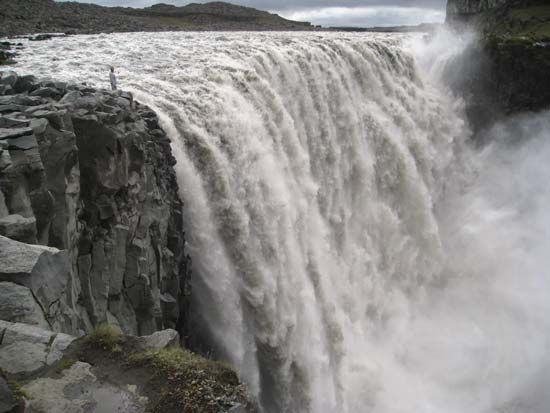
- Dettifoss: Located in northeastern Iceland on the Jökulsá á Fjöllum river, this is the largest waterfall in Iceland by volume. It has a vertical drop of 144 feet (44 metres) and is recognized for having the greatest hydroelectric potential of any location on the island.910
The prevalence of such waterfalls is a defining characteristic of Iceland’s terrain, where rivers are frequently fed by glacial meltwater and the landscape is often altered by volcanic activity and glacial erosion.111
We could dive deeper into how volcanic activity specifically contributes to the formation of these and other waterfalls, or perhaps explore the impact of glacial outburst floods on the Icelandic landscape.
Sources
- Gull Falls — Encyclopædia Britannica
- Grand Falls–Windsor — Encyclopædia Britannica
- glacial valley — Encyclopædia Britannica
- glacial landform - Hanging valleys — Encyclopædia Britannica
- river - Falls attributable to constructional processes — Encyclopædia Britannica
- river - Falls attributable to discordance of river profile — Encyclopædia Britannica
- glacial landform - Cirques , tarns, U-shaped valleys, arêtes, and horns — Encyclopædia Britannica
- river - Development of waterfalls — Encyclopædia Britannica
- Jökulsá á Fjöllum — Encyclopædia Britannica
- Detti Falls — Encyclopædia Britannica
- Iceland - Lakes and rivers of Iceland — Encyclopædia Britannica
Published on · 2 min read