Habanero
The habanero is a variety of the chili pepper species Capsicum chinense, prized for its intense heat and unique flavor profile. While often associated with…
What is a habanero?
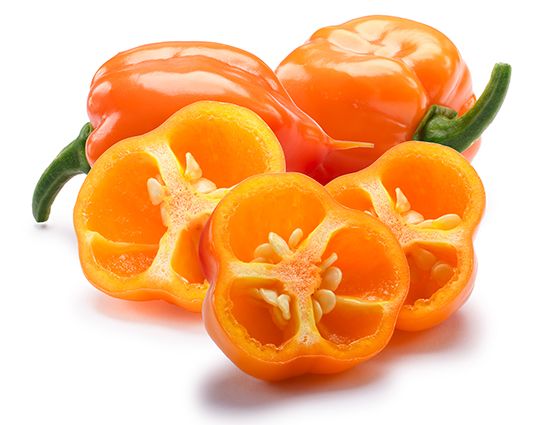
The habanero is a variety of the chili pepper species Capsicum chinense, prized for its intense heat and unique flavor profile. While often associated with Havana, the pepper likely originated in lowland Peru before spreading through trade.12
Measured on the Scoville scale, a standard orange habanero typically ranges from 100,000 to 350,000 Scoville Heat Units (SHU), though specific cultivars like the “chocolate” habanero or the Red Savina can be significantly hotter. Beyond its pungency, the pepper is valued for a subtle floral or citrus-like aroma and a slight sweetness, making it a staple in Mayan cuisine and modern culinary applications.13
The heat in habaneros is caused by capsaicin, a compound that has been studied for various health benefits, including potential anti-inflammatory and metabolic effects. Due to their intensity, it is recommended to handle these peppers with care, often using gloves.1
What plant species does the habanero belong to?
The habanero is a cultivar of the chili pepper species Capsicum chinense.415
As a member of the genus Capsicum, it belongs to the nightshade family (Solanaceae) and the order Solanales. While the habanero is one of the most well-known varieties of C. chinense, this species also includes other notably hot peppers, such as the ghost pepper and the Scotch bonnet.456
Where do habanero peppers originally come from?
While the name habanero translates to “of Havana,” suggesting a Cuban origin, this is a common misconception. The Spanish likely first encountered the variety in Cuba, but plant genetic studies indicate that the habanero likely originated in lowland Peru before spreading through trade routes.3
Archaeological evidence supports a long history of cultivation in the Americas, with remnants of habaneros found in the Valley of Mexico dating back thousands of years. The pepper became a staple of Mayan cuisine and is today commercially associated with Mexico’s Yucatán Peninsula, as well as various regions throughout Central America and the Caribbean.3
Why are habanero peppers known for their heat?
Habanero peppers are known for their intense heat due to a high concentration of capsaicin, an organic nitrogen compound that serves as the primary pungent principle in chili peppers.217
This substance is primarily concentrated in the internal partitions of the fruit. When consumed, capsaicin stimulates specific sensory receptors, creating the characteristic burning sensation associated with spicy foods. The intensity of this heat is measured using the Scoville scale, which assigns Scoville Heat Units (SHU) based on the concentration of capsaicinoids.721
While a standard orange habanero typically ranges from 100,000 to 350,000 SHU, other cultivars—such as the “chocolate” habanero or the Red Savina—can reach even higher levels of pungency. Because of this high capsaicin content, it is often recommended that chefs handle these peppers with gloves to avoid irritation.6
Sources
- habanero — Encyclopædia Britannica
- Scoville scale — Encyclopædia Britannica
- habanero — Merriam-Webster
- chili pepper — Encyclopædia Britannica
- Ghost pepper — Encyclopædia Britannica
- Pepper — Encyclopædia Britannica
- Capsaicin — Encyclopædia Britannica
Published on · 2 min read