Hadean Eon
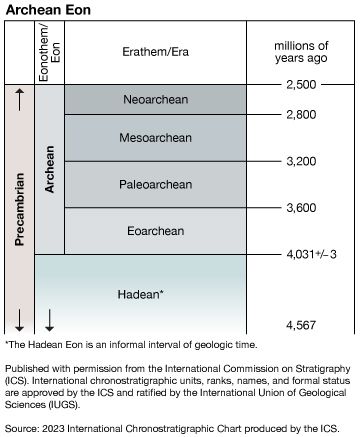
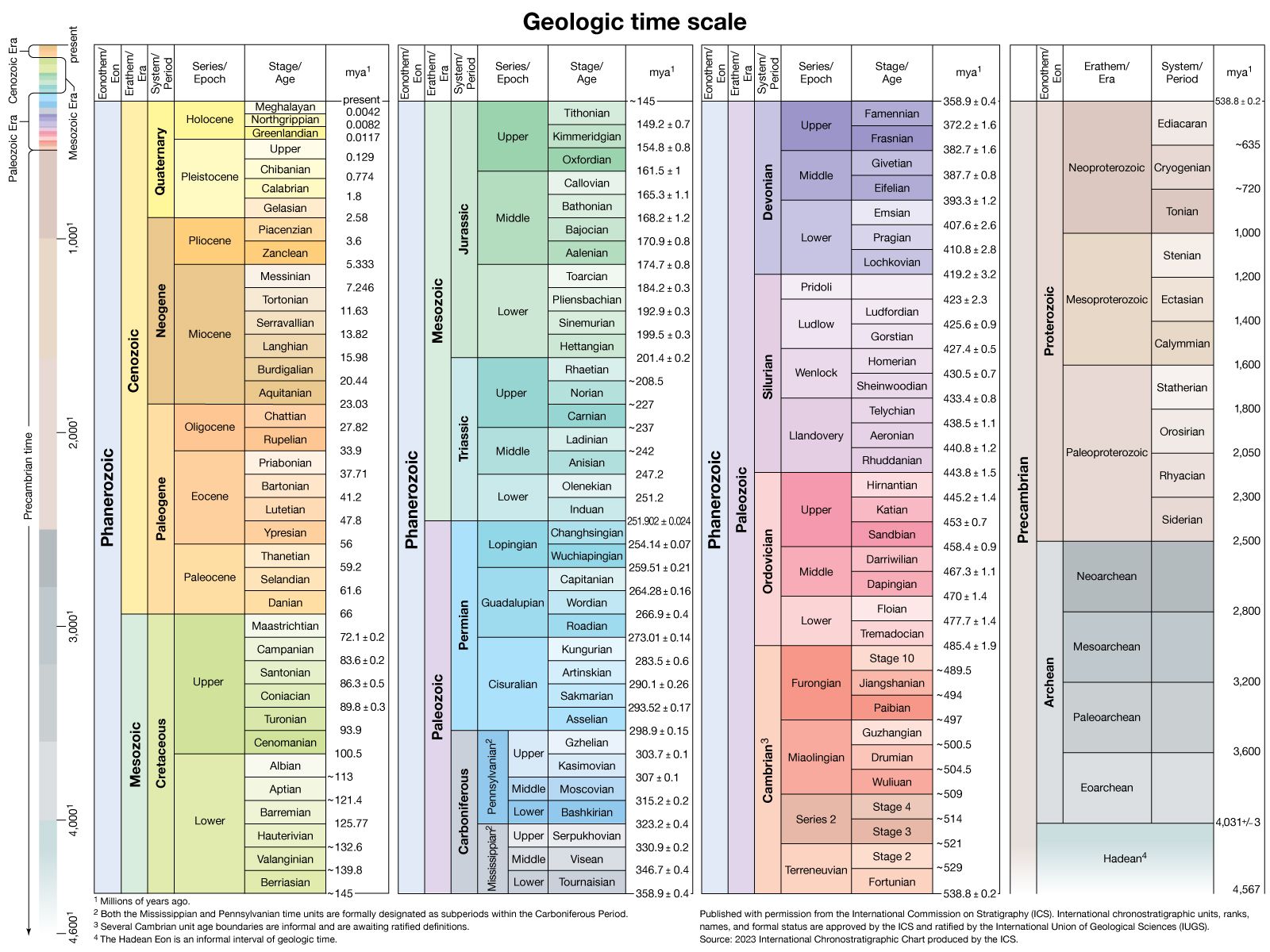
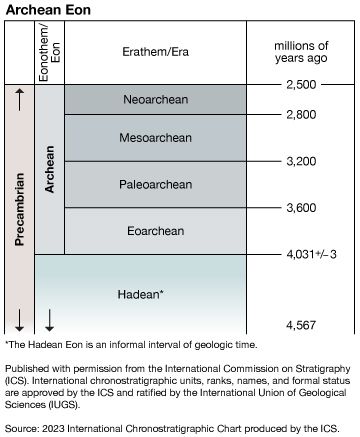
The Hadean Eon (4.6–4.0 billion years ago) and the Archean Eon (4.0–2.5 billion years ago) represent distinct stages in Earth's early development.
How does the Hadean Eon differ from the subsequent Archean Eon in terms of Earth’s conditions?
The Hadean Eon (4.6–4.0 billion years ago) and the Archean Eon (4.0–2.5 billion years ago) represent distinct stages in Earth’s early development.
During the Hadean, Earth was characterized by its initial formation through the accretion of dust and gases and frequent collisions with planetesimals. The surface was extremely unstable, featuring magmatic seas and intense heat from extraterrestrial impacts that likely prevented widespread crustal solidification. While the Moon formed during this time, no rocks from the Hadean survive on Earth today.12
In contrast, the Archean Eon saw the development of greenstone-granite belts and granulite-gneiss belts, marking a period of rapid crustal growth driven by high internal heat flow. Unlike the Hadean, the Archean provides a geologic record through preserved rocks and fossils. By the late Archean, the continental crust achieved significant stability and rigidity, transitioning toward modern tectonic processes.342
What is the Hadean Eon, and when did it occur in Earth’s history?
The Hadean Eon is an informal division of Precambrian time that occurred approximately 4.6 billion to 4.0 billion years ago. Its name is derived from Hades, reflecting the intense heat and unstable conditions that characterized Earth’s earliest history.
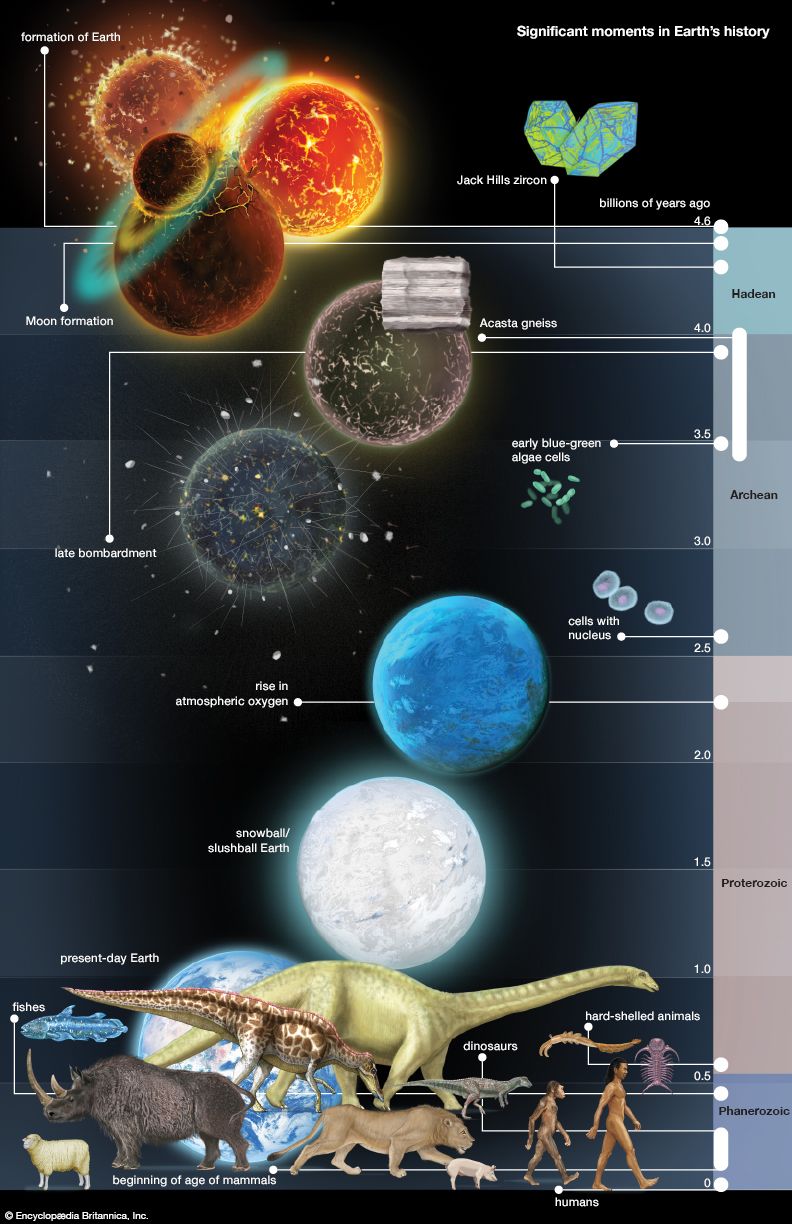
During this period, Earth formed through the accretion of dust and gases and frequent collisions with planetesimals. The surface was initially dominated by magmatic seas, as extreme heat from extraterrestrial impacts prevented most rock from solidifying. Over time, the planet’s core and crust stabilized, and the atmosphere and oceans began to develop. The Moon is also believed to have formed during this eon, likely following a massive collision between Earth and a Mars-sized celestial body. Because of subsequent plate tectonics, very little physical evidence from the Hadean remains, though zircon grains dated to 4.4 billion years ago suggest that stable continents and liquid water may have existed earlier than previously thought.
How do scientists study the Hadean Eon given the lack of rock records from that time?
Because the Hadean Eon predates the oldest known intact rocks, scientists rely on indirect evidence and advanced analytical techniques to reconstruct this period of Earth’s history.71
Key methods used to study the Hadean include:
- Analysis of Zircon Grains: The most significant breakthrough involves the study of zircon crystals, which are highly durable minerals. Using tools like the ion microprobe, researchers have dated individual zircon grains found in younger sedimentary rocks to over 4.4 billion years old. These grains provide a “time capsule” of early Earth conditions, suggesting the presence of stable crust and liquid water.71
- Extraterrestrial Samples: Since Earth’s early surface was largely destroyed by plate tectonics and intense meteorite bombardment, scientists analyze meteorites and lunar samples. Because these bodies formed at the same time as Earth from the same solar nebula, their isotopic ages help establish a timeline for the planet’s formation.71
- Isotopic Geochemistry: By studying the decay of radioactive isotopes, such as the uranium-lead system, scientists can calculate the age of the planet. Extrapolating the growth curve of terrestrial lead isotopes allows researchers to estimate when Earth accreted as a solid body.78
- Geophysical Modeling: Scientists use models of planetary differentiation—the process where heavy elements sank to form the core and lighter elements rose to form the crust—to simulate the thermal and chemical evolution of the early Earth.71
What were the major geological and atmospheric conditions during the Hadean Eon?
During the Hadean Eon, which spanned from approximately 4.6 to 4.0 billion years ago, Earth underwent extreme geological and atmospheric transformations.
Geological Conditions
The early Hadean was characterized by intense instability. Earth formed through the accretion of dust and gases, accompanied by frequent collisions with planetesimals. These impacts generated immense heat, creating a surface dominated by magmatic seas where rock struggled to solidify. Through planetary differentiation, heavier elements like iron sank to form the core, while lighter elements like silicon rose to form the initial crust. Although most of this early crust was later recycled into the mantle via plate tectonics, evidence from zircon grains suggests that stable continents and liquid water may have existed as early as 4.4 billion years ago. Additionally, the Moon is believed to have formed during this eon following a massive collision between Earth and a Mars-sized body.
Atmospheric Conditions
The early atmosphere was highly volatile and evolved significantly over the eon. It likely began as a region of escaping hydrogen and helium. As the crust cooled, volcanic outgassing introduced water vapour, nitrogen, and additional hydrogen, while ammonia, methane, and neon were also present. Some scientists suggest that comet impacts may have delivered additional water to the planet. Eventually, water vapour condensed to form clouds and rain, leading to the accumulation of liquid water on the surface.
Sources
- Hadean Eon — Encyclopædia Britannica
- Precambrian - Archean crustal growth — Encyclopædia Britannica
- life - Geologic record — Encyclopædia Britannica
- Climate - The evolution of life and the atmosphere — Encyclopædia Britannica
- Precambrian - Distinctive features — Encyclopædia Britannica
- Hadean — Merriam-Webster
- geologic history of Earth - The pregeologic period — Encyclopædia Britannica
- Meteorite - The ages of meteorites and their components — Encyclopædia Britannica
- geology - Isotopic geochemistry — Encyclopædia Britannica
- Earth - Planetary differentiation — Encyclopædia Britannica
Published on · 4 min read