Pound Quartzite
Pound Quartzite is a geological formation of Precambrian rocks located in the region of Adelaide, South Australia.
What is Pound Quartzite?
Pound Quartzite is a geological formation of Precambrian rocks located in the region of Adelaide, South Australia.1
While the term quartzite generally refers to a hard, metamorphic or sedimentary rock composed primarily of quartz, the Pound Quartzite formation is specifically notable for its composition of shales, siltstones, limestones, and quartzites.12
Most significantly, this formation is famous for yielding the Ediacara fauna, a very early fossil assemblage. These fossils provide a rare and important glimpse into the diversity and surprising complexity of animal life during the Precambrian period.1
What is the Ediacara fauna?
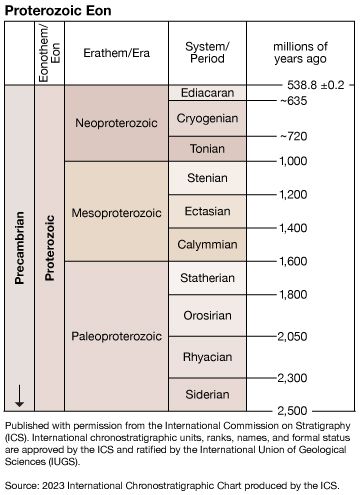
The Ediacara fauna refers to a unique, global assemblage of soft-bodied organisms that lived during the Ediacaran Period (approximately 635 million to 541 million years ago). These organisms are preserved as fossil impressions in sandstone and represent some of the earliest known evidence of complex, multicellular animal life (metazoans).314
Characteristics and Significance
- Appearance: The fossils exhibit diverse shapes, including circular discs, amorphous masses, and plantlike fronds, ranging from less than 1 cm to over 1 meter in length.14
- Biological Nature: They resemble modern jellyfish, worms, sea anemones, and sea pens, though some forms are unlike any organisms known today.14
- Evolutionary Context: These animals predated the Cambrian explosion and are thought to have required atmospheric oxygen for growth3. Their discovery demonstrated that complex evolution occurred earlier in Precambrian time than previously believed.1
The fauna is named after the Ediacara Hills in South Australia, where they were first discovered in 1946 within the Pound Quartzite formation.314
How do fossils form in quartzite?
Fossils are not typically formed within quartzite itself, as the intense heat and pressure required to transform sandstone into quartzite generally destroy organic remains. Instead, fossils like the Ediacara fauna are preserved in the sedimentary layers—such as sandstone, shale, or siltstone—that are often associated with these formations.146
The preservation of soft-bodied organisms in these environments relies on specific conditions:
- Rapid Burial: Organisms must be buried quickly by sediment to prevent decomposition and protect them from scavengers.2
- Low-Energy Environments: Fine-grained sediments in stable, low-energy environments, such as the seafloor, are most conducive to capturing delicate impressions.2
- Mineralization: Over time, the original organic material may be replaced by minerals, or the impression left in the sediment may be filled by mineral-rich solutions, creating a permanent cast or mold.2
While the Pound Quartzite is famous for its fossils, these specimens are found within the sedimentary beds of the formation rather than inside the recrystallized quartz rock itself. Once a rock undergoes the metamorphic process to become true quartzite, its pore spaces are eliminated, and the original sedimentary structure is largely replaced by a mosaic of interlocking quartz crystals, which effectively erases most fossil evidence.1476
What defines the Precambrian time period?
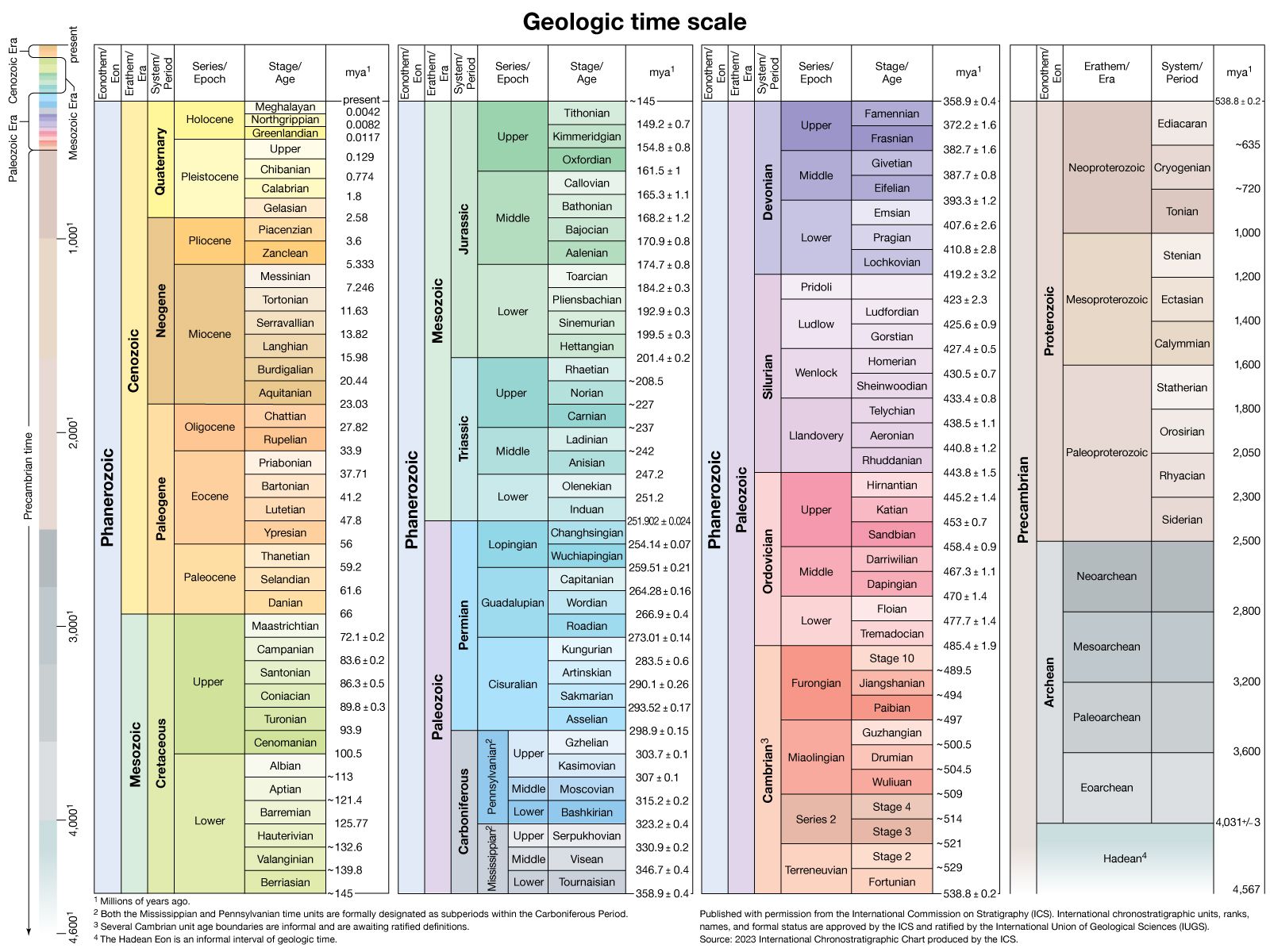
The Precambrian is a vast span of geologic time that encompasses more than 80 percent of Earth’s total history, extending from the planet’s formation approximately 4.6 billion years ago to the beginning of the Cambrian Period 541 million years ago.10
Major Subdivisions
By international agreement, the Precambrian is divided into two formal eons:11
- Archean Eon: Spanning from roughly 4.0 billion to 2.5 billion years ago.11
- Proterozoic Eon: Spanning from 2.5 billion to 541 million years ago.11
Additionally, the Hadean Eon is recognized as an informal interval covering the period from 4.6 billion to 4.0 billion years ago.10
Biological Significance
While it was once assumed that life originated in the Cambrian, evidence shows that primitive life-forms existed as early as 3.5 billion years ago. The Precambrian record includes microfossils of algae, flagellates, and stromatolites. By the late Precambrian, the first multicellular organisms evolved, including the soft-bodied Ediacaran fauna, setting the stage for the rapid diversification of life known as the Cambrian explosion.1012
Sources
- Pound Quartzite — Encyclopædia Britannica
- quartzite — Encyclopædia Britannica
- Ediacaran Period — Encyclopædia Britannica
- Ediacara fauna — Encyclopædia Britannica
- Precambrian - Ediacaran fossils — Encyclopædia Britannica
- fossil — Encyclopædia Britannica
- metamorphic rock - Reactions of other mineral systems — Encyclopædia Britannica
- silica mineral - Solubility of silica minerals — Encyclopædia Britannica
- metamorphic rock - Retrograde metamorphism — Encyclopædia Britannica
- Precambrian — Encyclopædia Britannica
- Precambrian - Major subdivisions of the Precambrian System — Encyclopædia Britannica
- Cambrian Period - Fossil record of the Precambrian-Cambrian transition — Encyclopædia Britannica
Published on · 3 min read