Uranium-thorium-lead Dating
Technological advancements have significantly enhanced the precision and efficiency of uranium-thorium-lead dating. Key developments include:
What technological advancements have improved the accuracy of uranium-thorium-lead dating?
Technological advancements have significantly enhanced the precision and efficiency of uranium-thorium-lead dating. Key developments include:
- Isotope Dilution: By adding a known amount of an artificially enriched isotope, or “spike,” to a sample before dissolution, researchers can determine the concentration of natural isotopes through mass ratios. This process accounts for sample loss during preparation and allows for the analysis of minute quantities of material.12
- High-Sensitivity Mass Spectrometry: Modern mass spectrometry allows for the precise measurement of isotopic abundances. Innovations such as the use of clean-room conditions and specialized pressure vessels for mineral dissolution have reduced lead-background contamination by factors of up to 1,000,000.12
- In-situ Micro-analysis: The sensitive high-resolution ion microprobe (SHRIMP) and laser ablation–inductively coupled plasma–mass spectrometry (LA-ICP-MS) allow for the analysis of mineral grains without chemical dissolution. These methods provide high spatial resolution, enabling scientists to date specific growth zones within crystals.1
What are the limitations and challenges of using uranium-thorium-lead dating?
While uranium-thorium-lead dating is a powerful geochronological tool, it faces several inherent limitations and challenges:
System Disturbance and Discordance
The primary challenge in uranium-lead dating is the potential for “open-system” behavior. If a mineral, such as zircon, undergoes reheating or chemical alteration, daughter isotopes may leak out of the crystal lattice. This results in “discordant” ages, where the two different uranium-lead chronometers (based on the different half-lives of uranium-235 and uranium-238) yield conflicting results. While these data can sometimes be corrected using a concordia diagram, the loss of daughter products remains a significant hurdle to establishing an unequivocal age.2
Challenges with Young Materials
Because the parent isotopes have extremely long half-lives, they produce daughter isotopes at a very slow rate. Consequently, it is difficult to obtain precise ages for materials formed in the recent geologic past, as the amount of accumulated radiogenic lead is often too small to measure accurately.4
Contamination and Sensitivity
The accuracy of the method is highly dependent on minimizing lead-background contamination. Even minute amounts of external lead can skew results, necessitating the use of clean-room conditions and sophisticated isotope dilution techniques to ensure that the measured lead is truly radiogenic.25
How does uranium-thorium-lead dating compare to carbon-14 dating in terms of age range and applications?
Uranium-thorium-lead dating and carbon-14 dating serve different scientific purposes, primarily distinguished by their applicable age ranges and the materials they analyze.
Age Range and Applications
- Uranium-Thorium-Lead Dating: This method utilizes isotopes with extremely long half-lives, such as uranium-238 (4.468 billion years) and thorium-232 (14.01 billion years). It is primarily used in geology to date ancient igneous and metamorphic rocks and to determine the age of the Earth, meteorites, and the Moon.78
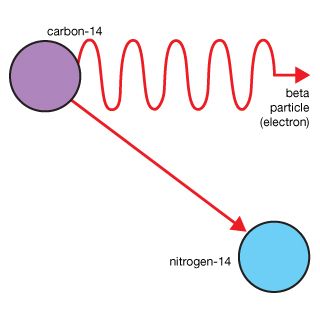
- Carbon-14 Dating: This technique relies on a much shorter half-life of approximately 5,730 years. It is designed for dating organic materials—such as wood, bone, and shell—that have been part of the carbon cycle. It is most effective for specimens ranging from roughly 500 to 50,000 years old, making it a vital tool for archaeology and recent geological studies.794
Key Differences
Feature
Uranium-Thorium-Lead Dating
Carbon-14 Dating
Primary Use
Geochronology (rocks, Earth’s age)
Archaeology (organic artifacts)
Age Range
Millions to billions of years
~500 to 50,000 years
Applicable Materials
Zircon, baddeleyite, monazite, etc.
Biogenic carbon (wood, bone, etc.)
Basis
Decay of long-lived parent isotopes
Decay of cosmogenic carbon-14
While uranium-lead methods benefit from having two independent chronometers that allow for internal consistency checks, carbon-14 dating relies on calibration curves to account for temporal fluctuations in atmospheric carbon levels.792
How does uranium-thorium-lead dating help in studying geological events like volcanic eruptions?
Uranium-thorium-lead dating is a critical tool in geochronology that helps scientists understand the history of volcanic activity by determining the precise age of crystallization for igneous rocks.27
Establishing Chronology
Because minerals like zircon and titanite incorporate uranium but exclude lead during their formation in liquid rock (magma), they act as “time capsules”. By measuring the ratios of uranium isotopes to their radiogenic lead daughter products, geochronologists can determine when a volcanic rock originally crystallized. This allows researchers to date ancient volcanic events and establish the timing of major geological episodes.7211
Distinguishing Complex Events
A significant advantage of this method is its ability to resolve complex thermal histories. Because uranium-lead systems are highly sensitive to temperature, they can distinguish between the primary crystallization of a volcanic rock and subsequent reheating events, such as those caused by later volcanic or tectonic activity. By plotting isotopic data on a concordia diagram, scientists can identify both the initial formation age and the timing of secondary disturbances.7
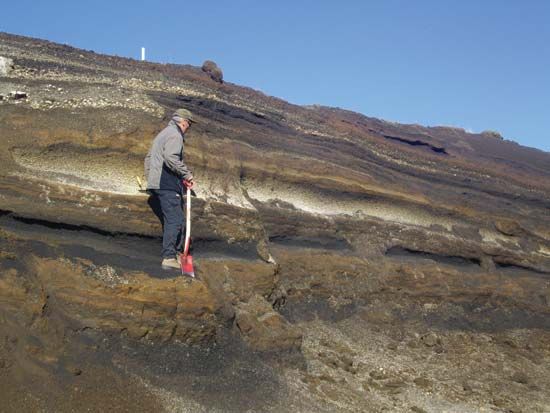
While this method provides absolute ages for volcanic rocks, it is distinct from tephrochronology, which uses layers of volcanic ash as stratigraphic markers to correlate events across wide areas.12
Sources
- dating - Technical advances — Encyclopædia Britannica
- uranium-thorium-lead dating — Encyclopædia Britannica
- dating - Use of mass spectrometers — Encyclopædia Britannica
- dating - Double uranium-lead chronometers — Encyclopædia Britannica
- dating - Uranium-series disequilibrium dating — Encyclopædia Britannica
- dating - Analysis of separated minerals — Encyclopædia Britannica
- dating - Origin of radioactive elements used — Encyclopædia Britannica
- dating - Carbon-14 dating and other cosmogenic methods — Encyclopædia Britannica
- mass spectrometry - Geochronology and geochemistry — Encyclopædia Britannica
- carbon-14 — Encyclopædia Britannica
- dating - Rubidium–strontium method — Encyclopædia Britannica
- radiation-damage dating — Encyclopædia Britannica
- dating - Importance of zircon in uranium-lead dating — Encyclopædia Britannica
- geology - Volcanology — Encyclopædia Britannica
- tephrochronology — Encyclopædia Britannica
- dating - Dating simple igneous rocks — Encyclopædia Britannica
Published on · 4 min read