Hái Falls
Háifoss (often referred to as Hái Falls) is a prominent waterfall located in southern Iceland. Situated on the Fossá river, which is a tributary of the…
What is Hái Falls?
Háifoss (often referred to as Hái Falls) is a prominent waterfall located in southern Iceland. Situated on the Fossá river, which is a tributary of the Thjórsá, the falls are located upstream from the Búrfell area.
Recognized as Iceland’s second-highest cataract, Háifoss features an impressive vertical drop of 400 feet (122 metres).1
What is the tallest waterfall in Iceland?
The premise that Háifoss is the tallest waterfall in Iceland is incorrect; it is the second-highest cataract in the country, with a vertical drop of 400 feet (122 metres). While the provided search results do not explicitly name the single tallest waterfall, they confirm that Háifoss holds the second-place position.1
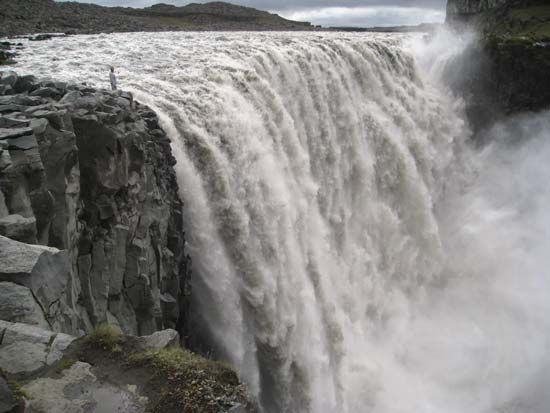
Iceland is home to many significant geological features, such as Detti Falls, which is the largest waterfall in the country by volume and possesses the greatest hydroelectric-power potential.2
How do glaciers contribute to the formation of waterfalls?
Glaciers contribute to the formation of waterfalls primarily through the creation of distinct erosional landforms and depositional processes.
Erosional Processes
The most common way glaciers create waterfalls is by forming hanging valleys. Because a large trunk glacier has greater erosive power than smaller tributary glaciers, it carves its valley floor to a much lower elevation. When the ice retreats, the tributary valleys are left “hanging” high above the main valley floor. Streams flowing from these elevated valleys must drop over the steep walls of the main U-shaped trough to join the drainage below, resulting in waterfalls like those found in Yosemite Falls.345
Additionally, glaciers can create “glacial stairways”—a series of treads and risers carved into bedrock. As postglacial streams establish flow, they often form cascades or waterfalls at each riser. Glacial potholes, gouged by ice and later deepened by sediment-laden meltwater, can also serve as sites for modern cascades.5
Constructional Processes
Glaciers can also create waterfalls through depositional and damming effects:
- Ice Dams: Large ice sheets can block and divert rivers, forming glacial lakes. When these dams breach, the resulting torrents can erode deep canyons and create “fossil waterfalls” like Dry Falls, which remain as evidence of past glacial activity.6
- Moraines: Ridgelike deposits of sediment left by glaciers can act as temporary dams that obstruct drainage, leading to the formation of waterfalls.6
What are some other famous natural landmarks in Iceland?
Iceland is home to a variety of spectacular natural landmarks shaped by its unique position atop the Mid-Atlantic Ridge. Some of the most famous sites include:
- Vatnajökull: The country’s largest glacier, which covers an area comparable to all the glaciers on the European continent combined. It is also the site of Hvannadals Peak, the highest point in Iceland.89
- Thingvellir National Park: A site of immense geological and historical significance, recognized as a World Heritage site.10
- Surtsey: A volcanic island formed between 1963 and 1967 off the southwestern coast, providing a rare opportunity to observe the birth of new land.810
- Hekla: Perhaps the country’s best-known volcano, which has erupted frequently throughout the 20th and 21st centuries.8
- Deildartunguhver: The largest hot spring in Iceland, emitting nearly 50 gallons of boiling water per second.9
Sources
- Hái Falls — Encyclopædia Britannica
- Detti Falls — Encyclopædia Britannica
- glacial valley — Encyclopædia Britannica
- glacial landform - Hanging valleys — Encyclopædia Britannica
- river - Falls attributable to constructional processes — Encyclopædia Britannica
- river - Falls attributable to discordance of river profile — Encyclopædia Britannica
- glacial landform - Glacial erosion — Encyclopædia Britannica
- Iceland - Land — Encyclopædia Britannica
- Iceland - Relief — Encyclopædia Britannica
- list of World Heritage sites - Iceland — Encyclopædia Britannica
Published on · 2 min read