Hekla
Hekla is a prominent volcano located in southern Iceland. Its unique form is primarily determined by its eruptive activity along a 3.4-mile (5.5-km) long…
How did Hekla volcano form, and what type of volcano is it?
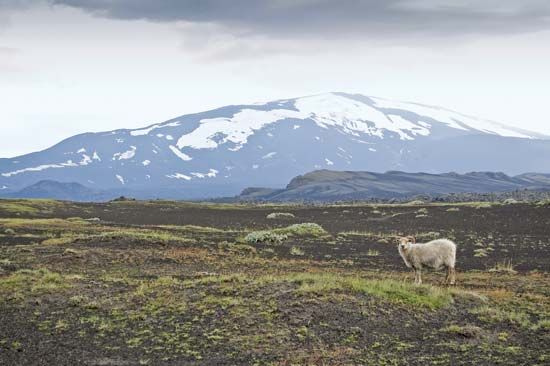
Hekla is a prominent volcano located in southern Iceland. Its unique form is primarily determined by its eruptive activity along a 3.4-mile (5.5-km) long fissure known as Heklugjá.1
Regarding its classification, Hekla is considered a transitional landform. It sits between a plateau-building fissure eruption and a typical stratovolcano, which is usually formed by eruptions from a single major vent. Because of this, the volcano’s appearance depends on the perspective: when viewed along the length of the fissure, it resembles a stratovolcano, but when viewed perpendicularly, it appears as an elongated ridge. The accumulation of lava flows issuing from the fissure over time has contributed significantly to this distinct, elongated shape.21
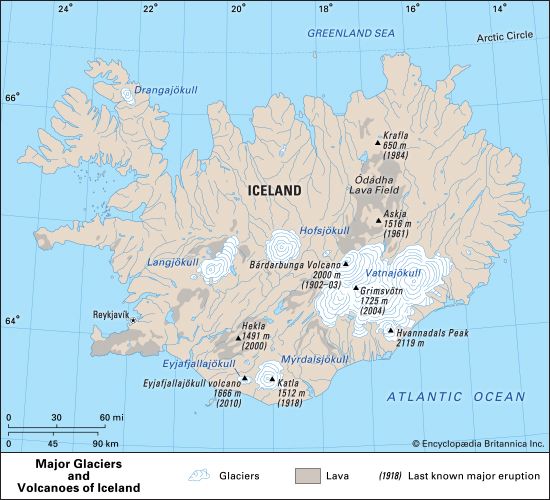
What is the height of Hekla volcano, and how does it compare to other Icelandic volcanoes?
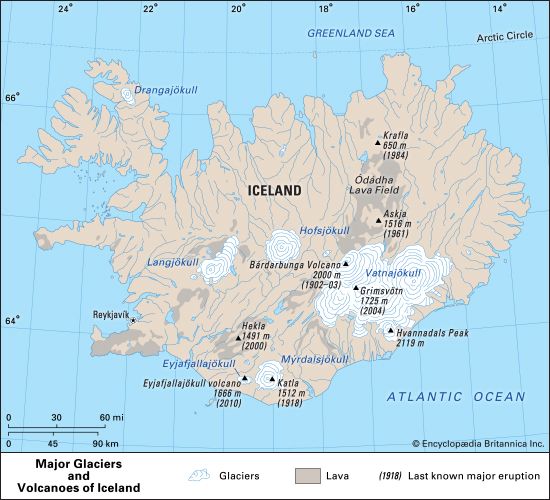
Hekla stands at an elevation of 4,892 feet (1,491 meters) above sea level.1
When compared to other volcanoes in Iceland, Hekla is notably distinct in its structure and activity. While Iceland is home to approximately 200 volcanoes of various types, many of which are influenced by subglacial environments or the Mid-Atlantic Ridge, Hekla is recognized as the country’s most active and well-known volcano.13
In terms of height, Hekla is significantly shorter than Iceland’s tallest peak, Hvannadals Peak, which is part of the Öræfajökull volcanic massif and reaches an elevation of 6,952 feet (2,119 meters). Unlike the massive, ice-covered volcanic structures found in the Vatnajökull region, Hekla’s form is defined by its 3.4-mile-long fissure, making it a transitional landform between a fissure-fed plateau and a traditional stratovolcano.415
What is the geological significance of Hekla volcano in Iceland?
Hekla is geologically significant primarily as Iceland’s most active and well-known volcano, situated within the country’s East Volcanic Zone. Its activity is driven by the island’s position atop the Mid-Atlantic Ridge, a tectonic boundary where the Earth’s crust is constantly shifting and generating volcanic phenomena.13
The volcano is defined by a 3.4-mile (5.5-km) long fissure known as Heklugjá. This structure is geologically unique because it functions as a transitional landform between a fissure-fed plateau and a traditional stratovolcano. During major eruptions, the entire length of this fissure becomes active, with lava flows contributing to the volcano’s characteristic elongated shape.1
Historically, Hekla has been a site of intense volcanic output, erupting more than 20 times between 1104 and 2000. Its eruptions are notable for their explosive, ash-producing phases, which have historically impacted regions far beyond Iceland, including Finland. Because of this frequent and varied activity, Hekla serves as a critical subject for understanding the volcanic processes that shape Iceland’s unstable interior.13
What impact have Hekla’s eruptions had on the surrounding environment and climate?
Hekla, historically referred to as the “Mountain of Hell,” has significantly impacted its surroundings through frequent explosive eruptions. Located at the eastern end of one of Iceland’s most extensive farming regions, the volcano’s activity poses direct risks to local agriculture and infrastructure.1
The environmental impact of Hekla is primarily driven by its explosive, ash-producing phases. During major events, such as the 1947–48 eruption, ash clouds have reached heights of nearly 16 miles (27 km) into the atmosphere, with fallout reaching as far as Finland. While volcanic ash does not typically cause direct fatalities, heavy accumulation can lead to secondary hazards, including the collapse of structures and widespread crop failure, which historically has the potential to trigger famine. Conversely, in the long term, the decomposition of nutrient-rich volcanic fallout contributes to the formation of highly fertile soils.13
While Hekla’s eruptions have caused great loss of life in the past, such as in 1766, its more recent activity has been less destructive to the immediate environment.1
Sources
- Hekla — Encyclopædia Britannica
- volcano - Determinants of size and shape — Encyclopædia Britannica
- Iceland - Land — Encyclopædia Britannica
- Öræfajökull — Encyclopædia Britannica
- Hekla — Merriam-Webster
- Eyjafjallajökull volcano — Encyclopædia Britannica
- volcano - Ash falls — Encyclopædia Britannica
Published on · 3 min read