Haida Gwaii
The archipelago now known as Haida Gwaii was formerly called the Queen Charlotte Islands.
How did Haida Gwaii get its name and what was it called before?
The archipelago now known as Haida Gwaii was formerly called the Queen Charlotte Islands.12
In 1787, the English navigator Captain George Dixon surveyed the islands and named them the Queen Charlotte Islands after his ship, which was named in honor of Charlotte, the queen consort of King George III.1
The name was officially changed to Haida Gwaii in 2009 following an agreement between the Haida people and the government of British Columbia. This change was made to honor the long history and habitation of the Haida people on the islands.1
How has the art of the Haida people influenced contemporary Canadian culture?
The artistic traditions of the Haida people have significantly shaped contemporary Canadian culture, particularly through a resurgence of interest in their highly conventionalized and precise aesthetic. Historically, Haida art was defined by its focus on wood, characterized by massive, balanced elements and intricate carvings that recorded family histories, social status, and lineage through totem poles and decorated utilitarian objects.34
While the arrival of Euro-Americans led to a period where these arts were largely reduced to curio-shop products, the late 20th and early 21st centuries have seen a notable revival. Today, this influence is visible in several ways:5
- Cultural Renaissance: Traditional crafts, such as Chilkat weaving and the carving of wooden masks, are being actively reclaimed and practiced by new generations of artists.5
- Argillite Carving: The unique tradition of carving argillite—a stone found only on Haida Gwaii—continues to experience a modest renaissance, maintaining a distinct link to Haida heritage.5
- Institutional Recognition: The Haida Heritage Centre at Kay Llnagaay serves as a vital space for preserving and showcasing these artistic achievements to the broader public.3
Where is Haida Gwaii located and what is its geographical significance?
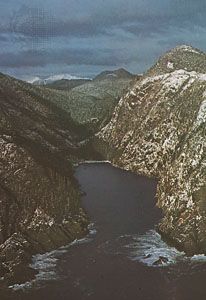
Haida Gwaii is an archipelago located off the western coast of British Columbia, Canada, situated south of the Alaskan Panhandle. The island group consists of approximately 150 islands, extending about 175 miles (280 km) in a north-south direction. It is separated from Alaska, mainland British Columbia, and Vancouver Island by the Dixon Entrance, Hecate Strait, and Queen Charlotte Sound, respectively.1
Geographically, the archipelago is significant for its rugged terrain, with the two largest islands, Graham and Moresby, rising to nearly 4,000 feet (1,200 meters). The region experiences mild winters due to the influence of warm ocean currents, which support lush temperate rainforests, particularly in the southern portion of Moresby Island, now protected as a national park. Furthermore, the islands are home to the Haida people, whose long-standing habitation and resource management are central to the archipelago’s modern governance and cultural identity.13
How has the relationship between the Haida people and the Canadian government evolved over time?
The relationship between the Haida people and the Canadian government has evolved from a history of colonial suppression to a modern framework of shared governance.
During the late 19th and early 20th centuries, the Canadian government actively marginalized indigenous practices. Notably, the potlatch—a central ceremony for maintaining social and political order—was outlawed from 1884 to 1951. During this period, the government also restricted the filing of land claims, and indigenous peoples faced systemic discrimination and exclusion from federal elections until 1960.1
In response, the Haida and other groups formed political organizations, such as the Native Brotherhoods, to advocate for their rights and navigate modern political processes. These efforts eventually led to significant shifts:1
- Legal Reforms: The 1951 repeal of laws banning potlatches and land claims marked a turning point in indigenous advocacy.1
- Collaborative Governance: In 2009, a landmark agreement between the Haida and the government of British Columbia established a joint management council. This council allows both parties to share decision-making regarding the management of the islands’ resources and officially recognized the archipelago as Haida Gwaii.3
Sources
- Haida Gwaii — Encyclopædia Britannica
- Haida Gwaii — Merriam-Webster
- Haida — Encyclopædia Britannica
- Native American art - Northwest Coast — Encyclopædia Britannica
- Northwest Coast Indian - Technology and the visual arts — Encyclopædia Britannica
- Northwest Coast Indian - Cultural continuity and change — Encyclopædia Britannica
Published on · 3 min read